


When the Revolutionary Goans Party arrived on Goa’s political scene, it understood something many established parties had been slow to grasp: politics had moved online. RGP built much of its identity around that understanding. Its young leadership was constantly visible on social media, its messaging was direct and aggressively regionalist, and its politics was presented as a clean break from the compromises and calculations associated with Goa’s traditional political establishment.
That image helped RGP build a following.
But the party now finds itself caught in an irony that is difficult to overlook. The same digital space that once helped project RGP as a modern political alternative has become one of the most visible arenas of its internal collapse.
What began as a leadership disagreement between Manoj Parab and Viresh Borkar has since developed into a wider organisational crisis involving competing claims to authority, expulsions, disputes over party committees, allegations concerning access to official social-media accounts and Cyber Crime complaints. The fight has become so consuming that the question is no longer simply what RGP stands for, but who, exactly, is in charge of it.
That is a particularly uncomfortable question for a party that entered politics promising to offer Goa something better.
The party that wanted to challenge the established political order is now struggling to demonstrate that it can manage its own political organisation.
Read Also: From Goa First to a New Third Front: Is Goa’s Regional Politics Splitting Further?
The Facebook Unfriending That Became a Political Story
The first signs of the present rupture became public in May 2026, when Parab and Borkar unfriended each other on Facebook.
Ordinarily, this would be little more than political gossip. Politicians fall out; colleagues stop speaking; social-media connections disappear. None of it necessarily amounts to a political crisis.
In RGP’s case, however, the online break was followed by a much more consequential confrontation. Internal loyalties began hardening, block-level committees became part of the dispute and the relationship between the two leaders deteriorated rapidly. By the end of May, Parab had resigned as party president, citing internal rifts and what he described as “individual power-centric politics.”
The sequence is revealing not because an online friendship ended, but because of what came after it. A disagreement at the top of a relatively young political organisation quickly became an organisational battle, exposing how little distance there appeared to be between personal differences and the functioning of the party itself.
For a movement that had spoken so confidently about building a new political culture, the spectacle was hardly reassuring.
From Leadership Dispute to Competing Centres of Power
By July and August, the dispute had moved into a much more serious phase.
Borkar was expelled from the party, but he subsequently asserted himself as national president and announced organisational changes of his own. The rival leadership rejected those claims. What emerged was not simply a disagreement between two politicians, but competing assertions over the authority of the party. RGP’s internal meetings had already shown signs of the depth of the problem: a key Core Executive Committee meeting in May ended without a resolution after heated exchanges over allegations involving Borkar.
The dispute then acquired another layer.
Cyber Crime complaints were filed over alleged unauthorised access to RGP’s official Facebook page, email account and YouTube channel. According to the complaint reported by Prudent Media, party office-bearers alleged that administrators had been removed and account credentials and recovery settings changed.
There is something deeply ironic about a political organisation that built its public identity through digital mobilisation now finding its own digital platforms at the centre of an internal power struggle.
Social media, once an instrument for reaching voters and bypassing conventional political machinery, has effectively become another piece of organisational territory to be fought over.
RGP’s political battle is no longer only being fought for Goa; increasingly, it is being fought over RGP itself.
The Cost of the Leadership War Is Not Limited to the Leadership
The real concern, however, lies beyond the competing claims of Parab and Borkar.
Political parties can survive leadership disputes. They can survive ideological disagreements, changes in strategy and even electoral setbacks. What becomes harder to justify is a situation in which the organisation itself appears paralysed while its leaders remain consumed by a struggle for control.
St Andre illustrates the problem.
The constituency gave RGP its lone legislative seat and became one of the party’s strongest examples of grassroots mobilisation. Borkar had built considerable visibility there, particularly through opposition to controversial land-related changes under Section 39A of the TCP Act. In February, he ended a six-day fast after the government agreed to cancel projects sanctioned under Section 39A in the constituency.
That was genuine political capital.
It could have been used to maintain pressure on the issue, organise residents and build a sustained constituency-level political campaign.
Instead, much of the attention surrounding RGP has since shifted towards its internal leadership struggle.
The question, therefore, is not merely who wins the RGP leadership battle. It is what happens to the political issues and the people who put their faith in the party while that battle continues.
A political organisation cannot indefinitely ask voters to wait while its leadership settles who gets to run the organisation.
When the Opposition Becomes Its Own Opposition
The reported factional disputes in Margao and elsewhere make the situation even more difficult to dismiss as a personal disagreement.
Internal disagreements are hardly unusual in politics. In fact, they can be healthy. Political organisations need debate, competing ideas and leaders willing to challenge one another. The problem begins when disagreement stops producing political direction and starts consuming the organisation itself.
That appears to be where RGP finds itself.
Committees, appointments, expulsions and access to party platforms have all become part of the wider struggle. Instead of these structures serving the political work of the organisation, the organisation itself appears to have become the battleground.
For a party that came to power in St Andre on the promise of challenging the established political order, this is an awkward position to occupy.
Its political opponents do not need to dismantle its credibility if the party’s own leadership dispute is doing much of that work for them.
There is also a larger political consequence. Every day spent debating internal authority is a day in which the party has less political space to define the issues on which it wants to challenge the government and the established opposition.
In that sense, RGP risks becoming its own opposition.
But Can a Party That Cannot Govern Itself Govern Goa?
This is where the RGP crisis moves beyond party politics and into the question of governance.
The issue is not whether Parab or Borkar is personally more convincing. Nor is it whether one faction ultimately wins control of the organisation.
The more consequential question is what this episode reveals about the party’s ability to function as an institution.
Governance requires more than political energy. It requires decision-making, internal discipline, continuity, communication and the ability to resolve disagreements without allowing the machinery of an organisation to grind to a halt.
RGP has spent years presenting itself as a political alternative. That naturally invites a higher standard of scrutiny.
If a party struggles to settle questions of leadership, authority and internal procedure within its own organisation, voters are entitled to ask how that same organisation would handle the far more complicated demands of government.
A government has departments to coordinate, budgets to manage, legislation to scrutinise, officials to direct, crises to respond to and competing public interests to balance.
Those responsibilities cannot be managed through factional loyalty or social-media exchanges.
They require institutions that function even when individuals disagree.
That is precisely why the current RGP crisis matters beyond the party’s internal politics.
The question is no longer simply whether RGP can remain united. It is whether the way it handles disagreement gives voters confidence in its ability to govern effectively.
When “No Information” Becomes a Political Metaphor
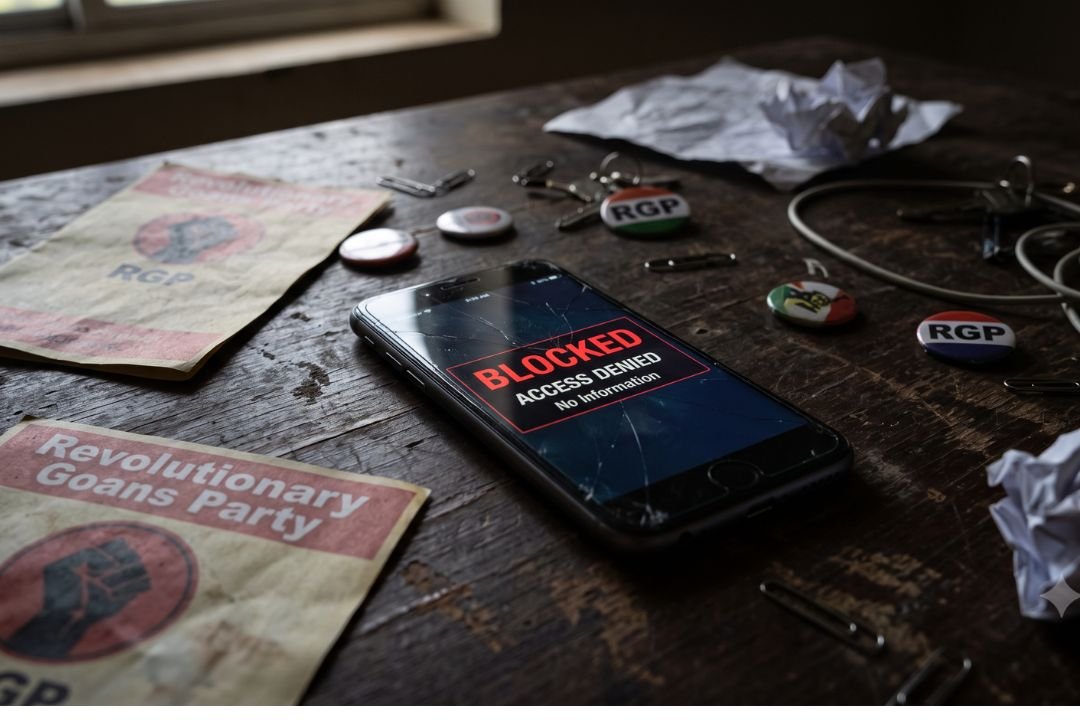
Perhaps the most striking detail in the latest phase of the dispute is Borkar’s reported claim that he had “no information” about Parab because Parab had blocked him.
Taken in isolation, the statement might appear almost trivial.
In the context of everything that has happened, however, it says considerably more.
Two figures at the centre of a political movement are reportedly unable to communicate because one has blocked the other. Meanwhile, their supporters remain divided, competing organisational claims continue and the party’s official digital platforms have become part of the dispute.
For an organisation whose political rise was so closely tied to digital communication, it is an unusually revealing moment.
The technology that once allowed RGP to speak directly to voters now appears to be helping expose just how disconnected its own leadership has become.
What Happened to the Alternative?
This is ultimately where the RGP story becomes larger than Parab and Borkar.
The party did not enter Goa politics merely promising to be another opposition force. It presented itself as an alternative to the political habits of the establishment — younger leadership, stronger regional identity, grassroots participation and a willingness to challenge the existing order.
That promise created expectations.
But political movements are eventually judged not only by what they say about the system outside them, but by how they conduct themselves within their own organisation.
The current crisis therefore presents RGP with a difficult contradiction. It spent years telling Goa that the state needed a different kind of politics. Yet its own leadership is now caught in a dispute in which personal relationships, organisational authority, party committees and even social-media access have become inseparable from the political battle.
The question for RGP is no longer whether it can distinguish itself from BJP, Congress or any other established political force.
It is whether it can first demonstrate the organisational discipline and institutional stability expected of any political force seeking public power.
Goa’s voters may have been willing to give a new political movement a chance. But that goodwill comes with a basic expectation: that the movement itself will remain functional, credible and capable of putting public issues ahead of internal battles.
RGP once asked Goa to believe that politics could be done differently.
Its leadership now has to demonstrate that the same principle can apply inside the party.
Because the ultimate test of a political alternative is not how effectively it can attack the establishment. It is whether it can demonstrate that it is capable of doing the difficult, unglamorous work of governing.
And that leaves RGP with the question it cannot answer through another Facebook post, another factional statement or another leadership claim:
If the party cannot establish stability, accountability and a clear chain of authority within its own ranks, what evidence does it offer voters that it would govern Goa any differently?
Read Also:How United Is Goa First If AAP Is Seeking Clarity From Its Own Ally?