


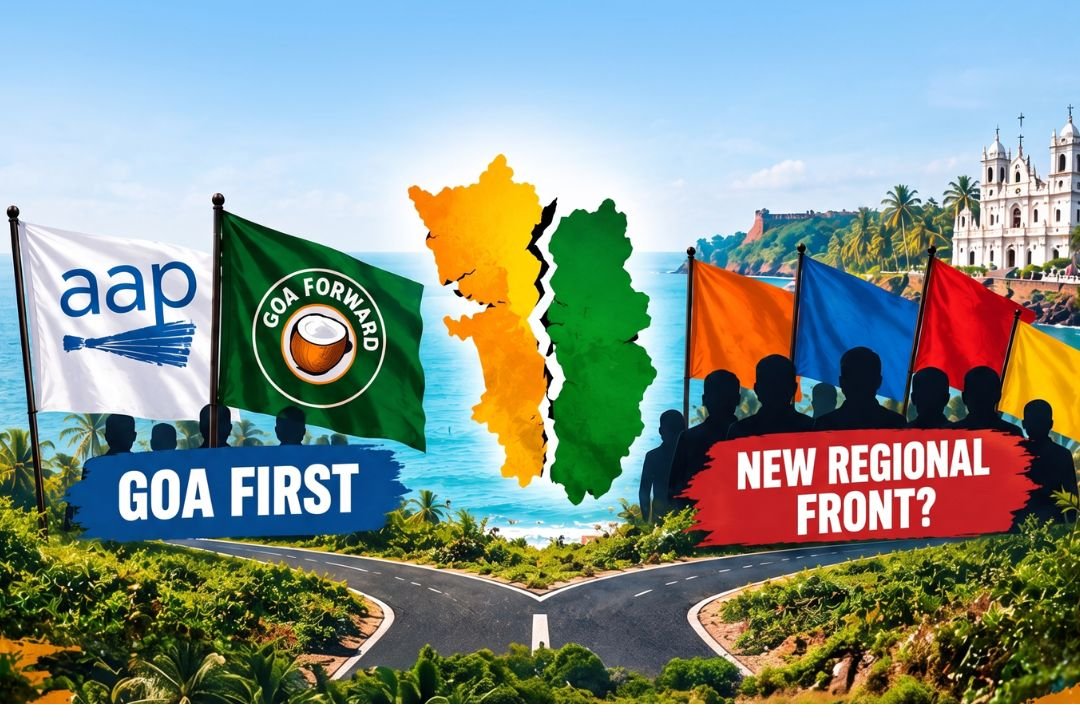
With Goa First already facing questions over its political direction and another regional front reportedly being discussed, the opposition space appears increasingly fragmented ahead of the 2027 Assembly elections.
Goa’s political landscape is witnessing another round of realignment ahead of the 2027 Assembly elections. Reports of a possible new regional front have emerged at a time when the recently formed AAP-GFP Goa First alliance is itself facing questions over its political direction.
The proposed front has not yet been formally announced, and details about its leadership, partners and agenda remain unclear. Speculation suggests that dissident factions from existing regional parties could come together.
Rather than presenting a clear alternative, however, the developments raise a larger question: why are opposition forces repeatedly forming new platforms when existing alliances are already struggling to maintain unity?
Read Also: How United Is Goa First If AAP Is Seeking Clarity From Its Own Ally?
Goa First Faces Its First Test
AAP and Goa Forward Party launched Goa First as a non-BJP, non-Congress alternative for the 2027 elections.
The alliance was expected to bring together two regional political forces around a common platform. However, differences soon emerged over the broader question of opposition unity.
AAP has maintained that Goa First should remain a non-BJP, non-Congress alliance, while GFP president Vijai Sardesai has pushed for a wider opposition arrangement against the BJP.
The disagreement has placed the alliance’s political direction under scrutiny even before the election campaign has fully taken shape.
This raises a straightforward political question: if two parties that recently came together cannot agree on the basic direction of their alliance, how cohesive can a wider opposition formation be?
Another Front Adds to the Fragmentation
Against this backdrop, talk of another regional front creates a second layer of political uncertainty.
If dissident leaders and factions from existing parties come together under a new banner, the immediate question is not simply who will join. It is whether another formation will add strength to the opposition or further divide an already fragmented political space.
Goa’s regional politics already has multiple parties and political groupings claiming to represent local interests.
Creating another platform could therefore mean another leadership structure, another seat-sharing exercise and another political agenda competing for the same electorate.
For voters, this can make the opposition’s larger political objective increasingly difficult to understand.
Where Is the Common Ground?
Political alliances are ultimately built around a common purpose. That purpose must extend beyond opposing one particular party.
If the primary objective is to defeat the BJP, voters can reasonably ask what the proposed alliance intends to offer beyond that objective.
Who will lead?
What will be the common programme?
Which candidates will contest where?
Will the partners remain together after the election?
And if the numbers produce a hung Assembly, will the parties agree on a common government?
These are not minor questions. They determine whether an alliance is an electoral arrangement or a credible governing alternative.
More Alliances, Less Clarity?
The emerging political picture could therefore become a contest between established political strength and an increasingly fragmented opposition space.
Goa First was expected to provide clarity by bringing together AAP and GFP. Instead, disagreements over its political positioning have already put the alliance under scrutiny.
Now, reports of another regional front risk adding yet another layer to the same political equation.
For the opposition, the challenge is no longer simply to find more parties or create more alliances. It is to demonstrate that these parties can stay together, agree on a common political direction and offer voters a stable governing proposition.
Without that clarity, every new alliance risks looking less like consolidation and more like another attempt to rearrange an already divided opposition.
The 2027 Question
As Goa moves towards the 2027 Assembly elections, voters will ultimately judge political formations not only by the number of parties they bring together, but by the stability and clarity they can demonstrate.
The emergence of another regional front may generate political discussion, but discussion alone does not establish credibility.
For the opposition, the immediate challenge is to answer a more fundamental question: Can its various parties and alliances actually remain united long enough to present a coherent alternative to the electorate?
The developments surrounding Goa First, followed by speculation about another regional formation, suggest that this question is becoming increasingly important.
With 2027 approaching, Goa’s political contest may therefore be shaped not just by who opposes whom, but by who can demonstrate unity, stability and a clear vision for governance.
Read Also: ₹13 Crore Seafarers’ Welfare Centre Set To Boost Mormugao Port