

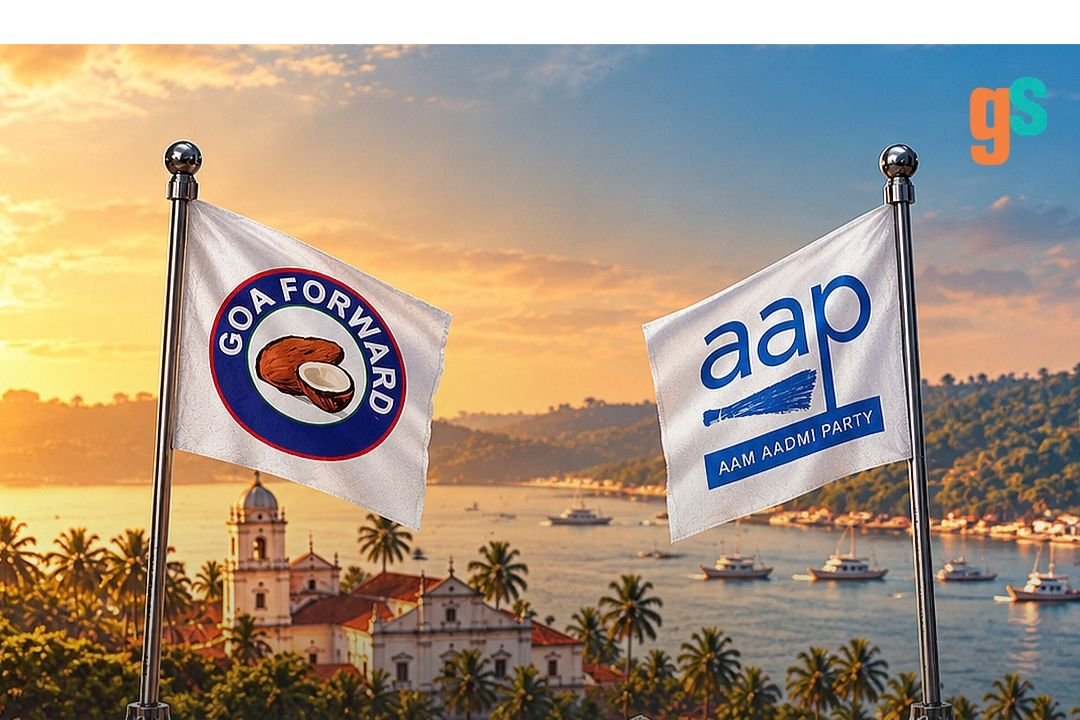
Panaji: AAP and the Goa Forward Party came together on September 13 to form the “Goa First” alliance for the 2027 Goa Assembly elections. The alliance was presented as a non-BJP, non-Congress alternative, with both parties projecting a common political platform.
Yet, within weeks of its formation, AAP has publicly sought clarity from its own alliance partner.
On October 5, AAP Goa president Valmiki Naik questioned GFP chief Vijai Sardesai over his political position in relation to what AAP described as a BJP-Congress “joint venture”. AAP also alleged attempts to weaken the Goa First alliance.
That raises a straightforward political question:
If Goa First is a united political front, why does one alliance partner need to publicly seek clarity from the other?
Read Also: “Outsiders Brought In, Goans Left Out”: CM Sawant Takes On Goy Rakhonn Yatra
A New Alliance, Different Political Signals
Every political alliance rests on a basic understanding between its partners. Parties can retain their separate identities, but voters need to understand what brings them together and what they intend to do if they receive a mandate.
This is where Goa First faces an important political question.
AAP has consistently described Goa First as a non-BJP, non-Congress platform. GFP chief Vijai Sardesai, however, has publicly used a broader description of the alliance.
Sardesai has spoken about political realignment based on what people want and has indicated that Goa First could serve as a broader platform for parties opposed to the BJP.
These statements do not necessarily establish a breakdown within the alliance. However, they indicate that AAP and GFP have not always communicated the alliance’s political boundaries in identical terms.
For voters, that distinction matters.
What Exactly Does Goa First Stand For?
The central issue is not whether AAP and GFP have the right to form an alliance. Political parties can make their own electoral arrangements.
The question is whether voters have received a sufficiently clear explanation of what Goa First represents.
Is it strictly a non-BJP, non-Congress alliance, as AAP maintains?
Or is it a broader opposition platform that could accommodate other parties, as Sardesai’s statements suggest?
If it is the latter, what are the political limits of that arrangement?
And if it is the former, do both alliance partners share that understanding?
These are reasonable questions for any alliance preparing to seek a public mandate.
Read Also: ECI Voter Verification Fact Check: What the New Rules Mean for Goa
Why Is AAP Seeking Clarity From Its Own Ally?
AAP’s latest statement makes the issue particularly noteworthy because its demand for clarity is directed at GFP, its own electoral partner.
This creates a political paradox. AAP is presenting Goa First as a common alternative while simultaneously asking one of its principal alliance partners to clarify his political position.
That does not, by itself, prove that the alliance is unstable. But it does highlight a difference that the partners may need to address publicly.
If Goa First wants voters to view it as a potential governing arrangement, its partners will need to demonstrate that they share a common understanding on fundamental political questions.
Political Clarity Matters
AAP has made political accountability and the question of what happens to a voter’s mandate central to its wider political messaging.
That same principle of clarity can reasonably be applied to Goa First itself.
If voters are being asked to support Goa First as a united alternative, they should know what the alliance stands for, where its political boundaries lie and whether both partners share the same basic direction.
AAP’s decision to publicly seek clarity from GFP therefore puts the alliance itself under the spotlight.
How united is Goa First? What exactly is the common political position of AAP and GFP? And can both parties give voters the same answer?
These questions do not require predicting what will happen to the alliance. They simply underline the importance of political clarity before an election.
As Goa moves towards the 2027 Assembly election, the larger test for every political alliance will be whether it can move beyond defining itself by whom it opposes and clearly explain the vision, policies and governing arrangement it is offering to the people of Goa.