


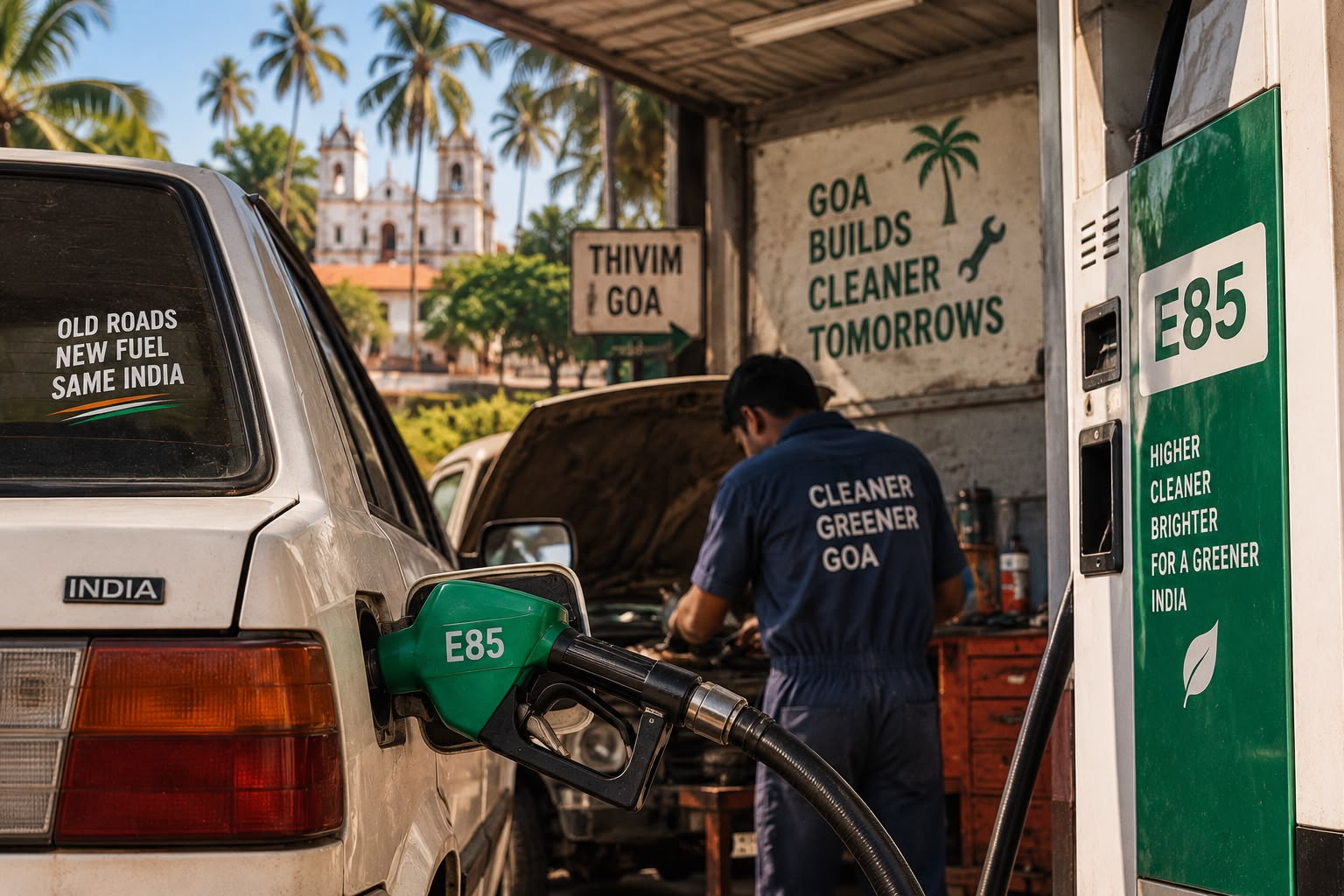
The indigenous Mastero fuel-management module helps legacy, non-flex-fuel vehicles run on ethanol blends from E20 to E85, as India moves toward a higher-ethanol fuel economy.
As India moves towards greater use of ethanol in its fuel mix, a less-discussed question is beginning to assume importance: what happens to the millions of vehicles already on the road that were never designed to run on high-ethanol blends?
In Thivim, Goa, an indigenous automotive innovation is attempting to address that challenge.
Called Mastero, the ethanol fuel management module has been developed as a retrofit system for older, non-flex-fuel vehicles. The technology is designed to enable legacy petrol engines to operate on ethanol blends ranging from E20 to E85, potentially giving older vehicles a way to adapt to an evolving fuel landscape.
The proposition goes beyond a technical modification. At its heart is a larger question: does India’s transition towards cleaner and more domestically sourced fuels also have to mean a transition away from older vehicles?
India’s ethanol programme has gathered considerable momentum in recent years. Higher ethanol blending has been promoted as a means of reducing dependence on imported fossil fuels, supporting the agricultural economy and diversifying the country’s energy mix. E20 has increasingly become part of the mainstream fuel conversation, while higher blends bring with them a different set of technical requirements.
India’s vehicle fleet, however, is far from uniform.
Read Also: From Family Support to Goan Heritage: How the CM Sawant Government Is Making Chavath More Meaningful
Thousands of cars and other petrol-powered vehicles on Indian roads were manufactured well before high-ethanol blends became a significant part of the country’s fuel policy. Their engines and fuel systems were designed around conventional petrol and comparatively lower ethanol concentrations. For their owners, therefore, the ethanol transition is not simply a matter of energy policy. It raises practical questions about compatibility, performance, maintenance and the cost of keeping an older vehicle on the road.
This is where the Mastero concept becomes relevant.
The retrofit approach seeks to alter the vehicle’s fuel-management system so that an older engine can accommodate substantially higher concentrations of ethanol. If proven effective across different vehicle models and operating conditions, such technology could offer owners an alternative to replacing an otherwise usable vehicle simply because the fuel environment has changed.
There is also an important economic dimension to the idea.
India’s shift towards alternative fuels will take place across a vast vehicle population, much of which will continue to consist of older vehicles for years to come. Extending the useful life of those vehicles, where technically safe and economically viable, could offer a more accessible pathway into the changing fuel ecosystem than replacing them outright.
Questions surrounding long-term engine durability, fuel economy, emissions, performance, maintenance requirements and safety will be central to determining whether high-ethanol retrofits can work reliably in everyday conditions. Independent testing, regulatory approvals and sustained real-world trials will therefore be critical to establishing the technology’s wider credibility.
There is another challenge: infrastructure.
A vehicle capable of operating on E85 is of limited practical value if the fuel is not readily available. India’s ethanol ecosystem is expanding, but the availability of blends above E20 remains an important part of the larger transition. Vehicle technology, fuel supply and distribution infrastructure will ultimately have to develop together.
That makes the innovation emerging from Thivim part of a much wider conversation about India’s energy transition.
Read Also: Goa Govt Takes Farming Digital: Social Media Push to Promote Sustainable Agriculture
The country’s move towards higher ethanol blending is often discussed in terms of new fuels, new engines and newer generations of vehicles. But the existing fleet presents a different and equally important challenge.
How do you bring older vehicles into a new fuel economy without making them technologically obsolete?
Mastero is one attempt to answer that question.
Its significance, therefore, lies not simply in the fact that an ethanol fuel-management technology has been developed in Goa, but in the problem it is attempting to solve: how can India’s existing vehicle fleet adapt to a fuel system that is changing faster than many of those vehicles were designed to?
What Mastero ultimately puts on the table is a question larger than one retrofit device: how can India move towards a new fuel economy without leaving its existing vehicle fleet behind?
The answer will depend on testing, regulation, affordability and real-world performance. But the innovation from Thivim is significant for precisely that reason. It is not merely looking at what the next generation of vehicles should be. It is asking whether the vehicles already on India’s roads can be engineered to remain part of that transition.