


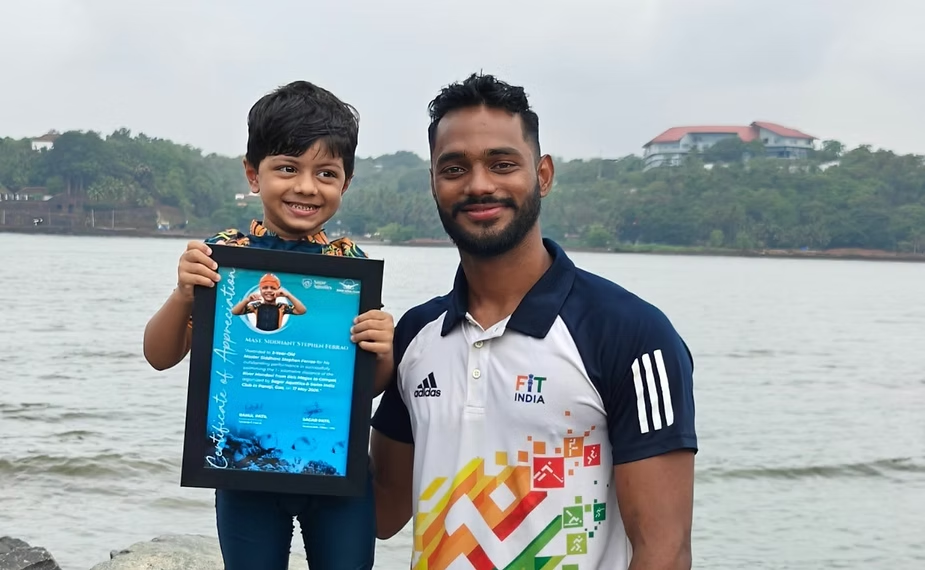
At just three years old, little Siddhant Ferrao has done the unimaginable by conquering the mighty Mandovi River. In an epic 85-minute test of pure grit and determination, this tiny Goan champion braved the strong currents, making history and making all of Goa incredibly proud.
His incredible feat is not just a testament to his parents’ dedicated training, but it perfectly captures the deep connection we Goans share with our waters. Our rivers run deep in our veins, shaping our culture, sports, and community spirit from the very beginning. Goan grit truly starts early, so let us flood the comments with love and support for our littlest champion. Drop a heart below to congratulate Siddhant and share this extraordinary local achievement.
When three-year-old Siddhant Ferrao stepped into the waters of the Mandovi River, he was not just dipping his toes into a local stream; he was entering a complex, dynamic estuarine system. His subsequent 85-minute, continuous swim is a story that captures the imagination, but to truly understand the magnitude of this feat, we must look beyond the sheer emotional inspiration. We have to examine the formidable geographical realities of the Mandovi and the intense physiological demands placed on a human body during prolonged open-water exposure. This is a narrative where Goan cultural grit meets the hard sciences of oceanography and pediatric endurance, painting a picture of an achievement that defies conventional expectations of early childhood capabilities.
The Mandovi River, often romanticized in Goan folklore and tourism brochures, is biologically and physically rigorous. It is not a placid, still body of water, but a highly active bay-estuarine system. Any swimmer attempting an endurance feat here is immediately subjected to severe hydrodynamic forces. The currents of the Mandovi are heavily tide-dominated, featuring semi-diurnal tides with a significant mean amplitude. This means the water level and the direction of the pull are in a constant state of flux. A swimmer is rarely cutting through still water; they are actively fighting or riding a conveyor belt of tidal influx and outflow. For a toddler to navigate this requires an instinctive understanding of how water moves and how to pace oneself when the current pushes back against forward progress.
Furthermore, the estuarine environment creates unique buoyancy challenges. During the monsoon and post-monsoon seasons, there is a massive seasonal freshwater influx that drastically alters the salinity of the water. Lower salinity means lower water density, which translates to reduced buoyancy for a swimmer. Siddhant did not just have to propel himself forward for 85 minutes; he had to expend significantly more energy simply to stay afloat compared to swimming in the highly saline, buoyant waters of the open Arabian Sea. The physical toll of fighting both the currents and the reduced buoyancy makes his sustained effort an anomaly in the realm of pediatric physical exertion.
Goa’s broader aquatic environment requires immense respect and navigational knowledge. While the estuarine confines of the Mandovi provide some shelter from oceanic swells, the waters of the region are notoriously volatile. Research into the coastal hydrodynamics of Goa reveals that the area is subject to highly complex littoral current systems, including dangerous rip currents that can exhaust even the most experienced adult swimmers. When a child is in these interconnected waters, the margin for error is absolutely zero. The safety protocols, escort boats, and tidal planning executed by Siddhant’s parents and support team would have required a deep, practical understanding of these local flow dynamics to ensure he was never caught in a sudden return flow or outgoing tidal rip.
The most astounding aspect of this achievement, however, lies in the realm of pediatric physiology. The body of a three-year-old is fundamentally different from that of an adult, making extreme endurance sports a highly unusual domain for toddlers. Children have a much higher surface-area-to-mass ratio than adults. In an aquatic environment, this means they lose body heat at an accelerated rate. Even in the relatively warm tropical waters of Goa, remaining submerged for an hour and a half risks hypothermia. Sustaining this effort required Siddhant’s body to generate enough metabolic heat through continuous movement to offset the rapid thermal leaching of the river, a delicate balancing act of energy expenditure and conservation.
Additionally, the metabolic demands placed on a toddler during such an event are staggering. Toddlers are in a highly anabolic state, meaning their bodies are constantly consuming energy just to fuel rapid physical and cognitive growth. Their muscles store far less glycogen, which is the primary fuel for endurance exercise, than mature muscles. An 85-minute continuous swim pushes right up against the absolute ceiling of a toddler’s energy reserves. This required impeccable pre-swim nutrition and highly efficient stroke mechanics to avoid a sudden and total depletion of energy. Poor form wastes energy, and a toddler simply does not have energy to waste over an hour and a half in moving water. His movements had to be smooth and purposeful, slicing through the water rather than fighting it.
Beyond the physical limitations, the neuromuscular focus required for this swim is extraordinary. At three years old, the human brain is optimized for short bursts of exploratory play, not sustained, repetitive aerobic output. Maintaining the psychological focus required to coordinate breathing and stroke mechanics without breaking form for 85 minutes is a marvel of pediatric development. Adults often rely on internal monologues, pacing strategies, or sheer willpower to get through endurance events. For a child, this level of sustained output is likely driven by a pure, unadulterated state of flow and an innate joy for the activity, shielded by the absolute trust he placed in the safety provided by his parents nearby.
How does a child overcome these staggering geographical and biological hurdles? The answer lies at the intersection of dedicated training and a profound cultural inheritance. In Goa, water is not a barrier; it is an extension of the land. The history of the state, from its ancient fishing communities to its modern identity, is intrinsically linked to its waterways. When children in this region are introduced to the water, they are not just learning a recreational skill. They are participating in a generational transfer of environmental knowledge. The ability to swim is often treated as a fundamental life skill, passed down from generation to generation alongside family traditions and local heritage.
Siddhant’s ability to remain calm amidst the tidal shifts of the Mandovi suggests a deep, early acclimatization to the sensory input of the water. His parents did not just teach him how to paddle; they taught him how to read the river, how to synchronize his breathing with the surface chop, and how to find comfort in an environment that naturally intimidates most humans. This preparation would have involved countless hours of building cardiovascular endurance and psychological trust. Water can be frightening, and a child must feel entirely safe to venture into deep, dark river water. His family built a foundation of absolute security, ensuring that whenever he was in the water, he felt confident and supported.
When the community looks at little Siddhant, they do not just see a child prodigy; they see a reflection of their own enduring heritage. They see the resilient spirit of the local fishermen who brave the unpredictable waters every single dawn. They see the legacy of traditional water sports that have defined local culture for centuries. By conquering the Mandovi at the tender age of three, Siddhant has tapped into a collective ancestral muscle memory. He has proven that the waters of Goa run deep in the veins of its people, shaping their character and fortitude from the very earliest stages of life. This deep-rooted connection turns a solitary athletic achievement into a powerful moment of communal celebration.
The news of this 85-minute swim rippled through Goa faster than the currents of the Mandovi itself. In an era where daily news cycles are often dominated by negativity and stress, the story of a local toddler achieving something so purely positive served as a massive boost to community morale. People from all walks of life found themselves inspired by his undeniable grit. The story serves as a powerful reminder to everyone that with dedication, the right support system, and a fearless heart, monumental obstacles can be overcome. It highlights the incredible outcomes that can arise when parents invest time, patience, and unwavering belief in their children.
Furthermore, this incredible swim brings renewed attention to the Mandovi River itself, fostering a sense of pride and stewardship for the local environment. When a community celebrates a river as the site of a historic, heartwarming achievement, they are far more likely to advocate for its protection, cleanliness, and preservation. The river challenges the people, and in turn, the people rise to the occasion, proving their resilience while recognizing the need to protect the natural resources that define their home. Siddhant’s swim is not just a personal victory; it is a catalyst for environmental appreciation and cultural pride.
Siddhant’s journey across the estuarine ecosystem of the Mandovi forces us to fundamentally re-evaluate our assumptions about early childhood physical limits. It highlights the profound physiological capabilities of the human body when it is nurtured with patience, protected by rigorous safety planning, and driven by a pure joy for movement. He has inadvertently provided a masterclass in human adaptability, showing that the boundaries of what is possible can be expanded even by the youngest among us. His story will undoubtedly be told and retold, serving as a benchmark for local endurance and a source of continuous inspiration.
As the cheers fade and life along the river returns to its usual rhythm, little Siddhant will go back to the simple joys of being a three-year-old. Yet, he will do so carrying a legacy that most people do not achieve in a lifetime. Whatever path he chooses in the future, the grit he demonstrated during those 85 minutes will stay with him forever. He has learned at the earliest possible age that he is capable of extraordinary things. This story is a beautiful, inspiring chapter in the rich history of Goa, a reminder that the biggest inspirations often come in the smallest packages, and that the local spirit is alive, well, and swimming incredibly strong in the next generation.