


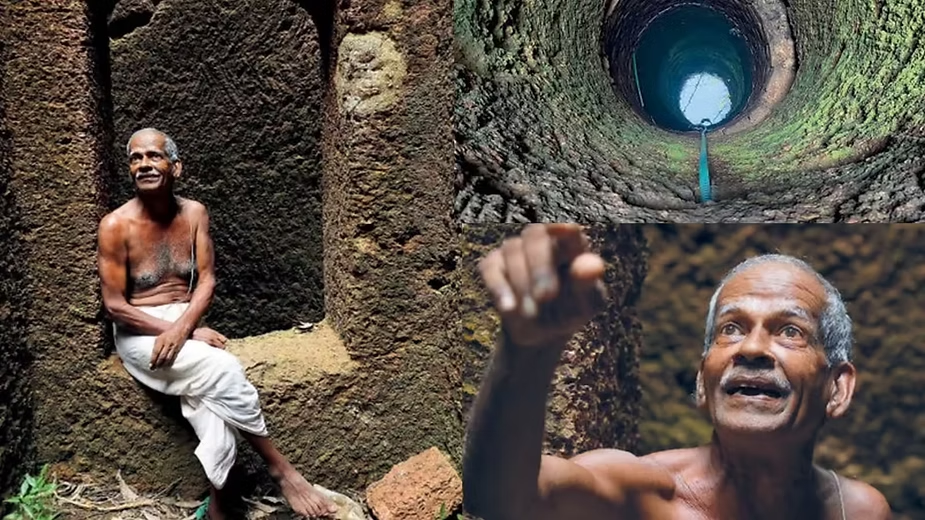
Goa is often celebrated as a land blessed by nature. Every year, monsoon clouds sweep across the Western Ghats, rivers overflow with fresh water, and lush green forests dominate the landscape. To millions of visitors, Goa appears to be a place where water is abundant and life flows effortlessly. Yet beyond the beaches and tourism hubs lies another Goa—one that struggles every summer with severe water scarcity. In the hinterlands of South Goa, particularly in the taluka of Canacona, entire communities have historically faced an annual battle for access to safe drinking water. As temperatures rise and rainfall becomes a distant memory, streams dry up, wells lose their yield, and villages that appear green and prosperous during the monsoon suddenly find themselves confronting a harsh reality.
For decades, residents of villages such as Loliem, Cotigao, Gaondongrim and surrounding settlements have lived with recurring water shortages. During peak summer, many traditional wells run dry while water supplied through pipelines often becomes irregular. In several remote pockets, residents have depended on tanker deliveries, which themselves are constrained by difficult terrain, narrow roads and rising demand. Families frequently spend hours collecting water, while women, children and elderly residents bear the greatest burden of securing enough water for daily use. In many cases, villagers have resorted to digging shallow pits in dry streambeds to access whatever groundwater remains beneath the surface. These seasonal hardships have long shaped life in the region, making water not merely a utility but a precious necessity.
It was against this backdrop that one retired school teacher decided to take extraordinary action. His name is Balkrishna Aiya, known affectionately across Canacona as Balkrishna Master. Unlike many public figures who gain recognition through official positions or large-scale projects, Balkrishna’s contribution emerged from a simple desire to help his neighbours. Faced with worsening water shortages in his locality, he chose not to wait for solutions to arrive. Instead, he became the solution himself.
Born in Loliem and respected throughout the region for his decades of service as a teacher at Shri Sharadhanand Vidyalaya, Balkrishna Aiya had already spent much of his life serving society. Beyond education, he was known as a gifted artisan and sculptor, creating idols of Lord Ganesh and Goddess Saraswati during festive seasons and practising traditional crafts rooted in Goa’s cultural heritage. Retirement could easily have been a time for rest and personal comfort. However, as he witnessed the growing water crisis affecting families around him, he felt compelled to act.
The settlement of Hundolle in Madditolop, where Balkrishna lived, was particularly vulnerable. Reliable natural water sources were scarce, and residents frequently struggled through long periods of water shortage. Every summer brought uncertainty. Families worried about whether tankers would arrive on time. Farmers feared for their crops and livestock. Daily routines revolved around securing enough water to survive. Watching his neighbours endure these hardships year after year left a deep impression on Balkrishna. He believed that a permanent solution had to be found.
Many people would have accepted the situation as unavoidable. Others might have waited for government intervention or infrastructure upgrades. Balkrishna chose a different path. Using his personal savings, he decided to construct a large open step-well on his own land. The idea seemed ambitious, especially given the difficult geology of the region. Canacona’s terrain consists largely of hard laterite rock, making excavation extremely demanding. Groundwater sources are often located deep beneath the surface, requiring significant effort and persistence to access.
Undeterred by skepticism from some villagers, Balkrishna began digging. What followed was an extraordinary demonstration of patience and determination. Day after day, he worked through layers of hard rock, gradually pushing deeper into the earth. The excavation process was physically exhausting and financially draining. Yet he remained convinced that water existed below. As the well deepened past ten metres, then twenty, then thirty, many questioned whether the effort would ever succeed. Balkrishna continued regardless.
Eventually, after excavating more than forty metres below ground level, his persistence paid off. The well struck a dependable source of groundwater. For a community that had spent years confronting water scarcity, the discovery was transformative. What emerged from beneath the earth was not merely water but hope. The successful completion of the well demonstrated that even in one of Goa’s most water-stressed localities, sustainable groundwater resources could be accessed through determination and careful observation of the landscape.
For many people, the story could have ended there. After all, Balkrishna had financed the project himself. The well was located on his property, and the water it produced could easily have been reserved for personal use. Yet the retired teacher saw the well differently. To him, water was not a private asset but a community resource. He understood that while his own household now had security, many neighbouring families continued to struggle.
Motivated by a deep sense of social responsibility, Balkrishna took the project even further. He purchased a motor pump and invested additional personal funds to create a network of pipelines connecting the well to nearby homes. What began as a solution for a handful of families gradually expanded into a community-wide water distribution system. The network eventually supplied drinking water to dozens of households in the Hundolle and Madditolop area, bringing relief to hundreds of residents.
The impact was immediate and profound. Women no longer needed to spend hours fetching water from distant locations. Children could focus on their education rather than assisting with daily water collection. Elderly residents gained a dependable supply of drinking water close to home. Small household gardens became easier to maintain, and livestock owners gained greater security during the harsh summer months. The project fundamentally changed daily life for the community.
Perhaps even more remarkable than the physical achievement was Balkrishna’s humility. Despite the scale of his contribution, he consistently described the gratitude of his neighbours as his greatest reward. For him, the true success of the project was measured not in recognition or awards but in the improved quality of life experienced by those around him. The smiles of families receiving clean water at their homes mattered more than any public honour.
Nevertheless, the significance of his work soon attracted wider attention. Across Goa, people began hearing about the retired teacher who had personally solved a water crisis affecting an entire settlement. His story became an example of grassroots environmental stewardship and community resilience. In May 2023, his efforts were formally recognised when he received the State Biodiversity Award. The award celebrated not only the construction of the well but also the broader environmental and social benefits generated by his initiative.
Even after receiving recognition, Balkrishna continued serving his community in numerous ways. Villagers describe him as someone who willingly shares agricultural knowledge, assists with grafting mango trees, supports local cultural traditions and remains actively involved in community welfare. His commitment to public service extends far beyond water conservation. In many ways, he embodies a traditional model of community leadership rooted in action, generosity and personal responsibility.
The story reached an even larger audience on May 31, 2026, when Prime Minister Narendra Modi highlighted Balkrishna Aiya’s work during the 134th episode of Mann Ki Baat. Discussing water conservation and citizen-led initiatives across Bharat, the Prime Minister praised the retired teacher’s determination and described how he had addressed severe drinking water shortages through personal initiative. Millions of listeners across the country heard about the well, the pump and the pipeline network that transformed life in a remote corner of Goa.
For Balkrishna, the national recognition was deeply meaningful. Yet his response reflected the same humility that had guided him throughout the project. While he expressed gratitude that his efforts had been acknowledged at the national level, he reiterated that the appreciation of his neighbours remained his greatest source of satisfaction. Their improved lives, he said, were the real reward for years of hard work and sacrifice.
At a time when discussions about development often focus on large infrastructure projects and government programmes, the story of Balkrishna Aiya offers a powerful reminder of the impact that individual citizens can have on their communities. His achievement demonstrates that meaningful change does not always require vast resources or institutional authority. Sometimes, it begins with a single person willing to take responsibility for a problem and commit fully to solving it.
The forty-metre-deep well in Hundolle stands today as far more than a source of water. It is a symbol of perseverance, compassion and civic responsibility. It represents the idea that leadership is defined not by position or title but by action. Through his determination and selflessness, Balkrishna Aiya transformed the lives of dozens of families and inspired countless others across Goa and Bharat. In an age often dominated by stories of division and challenge, his journey reminds us that one individual, armed with conviction and a willingness to serve, can create extraordinary change.