


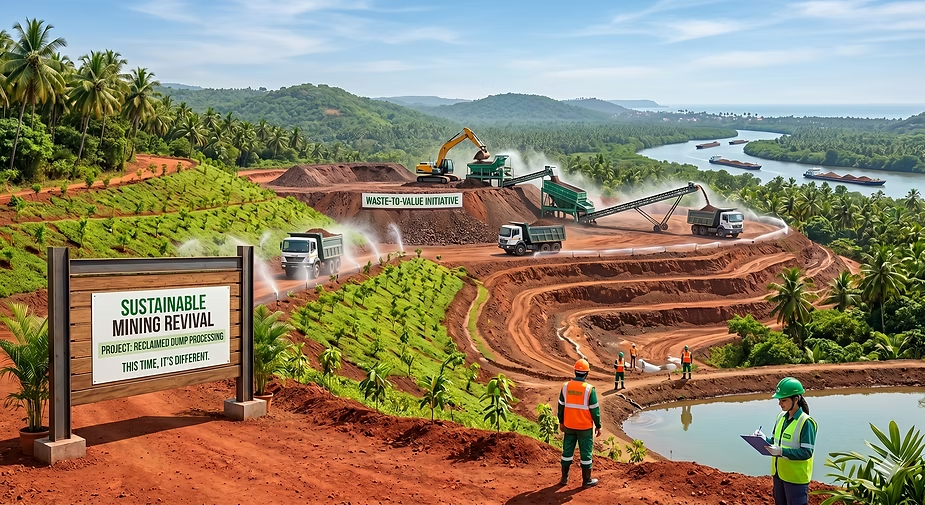
Mining has long been one of the defining pillars of Goa’s economy. For decades, the industry supported thousands of livelihoods directly and indirectly through transportation, barge operations, port activity, machine maintenance, trade, and local businesses spread across mining regions. Entire communities depended on the economic ecosystem built around iron ore extraction and exports. From village truck operators to dock workers and small business owners, mining played a central role in shaping the economic landscape of the state.
At the same time, mining also became one of Goa’s most debated industries. While it generated employment and revenue, it also raised serious environmental and social concerns over the years. Questions surrounding dust pollution, damaged roads, water contamination, deforestation, and the impact on nearby villages became increasingly important in public discourse. In several mining belts, residents raised concerns about blasting activity, degraded agricultural land, and ecological imbalance caused by unregulated practices in the past.
These concerns eventually led to legal scrutiny, regulatory interventions, and a major pause in mining activity. The slowdown deeply affected thousands of families dependent on the sector, creating economic uncertainty across multiple industries linked to mining. However, the disruption also became a turning point in Goa’s development conversation. It forced policymakers, administrators, and industry stakeholders to rethink the future of mining and the need for a more accountable and sustainable framework.
Today, mining is gradually returning to Goa, but under a significantly different approach. The focus is no longer only on extraction and exports. The emphasis is now on balancing economic revival with environmental responsibility, scientific planning, and stricter governance systems. The current revival is increasingly being positioned as a transition towards responsible mining practices rather than a return to the older model.
One of the biggest shifts in the new approach is the stronger focus on environmental safeguards. Mining operations are now expected to function under tighter monitoring and compliance systems. Environmental clearances, scientific assessments, and operational regulations have become central to the functioning of the sector. Dust control systems, water management practices, regulated transportation routes, and structured operational planning are now receiving far greater importance than before.
Scientific mining has also emerged as a key part of the new framework. Instead of uncontrolled expansion and poorly monitored extraction practices, the current emphasis is on planned operations supported by modern systems and regulatory oversight. Structured excavation methods, monitored transportation, and operational accountability are intended to reduce unnecessary environmental damage while improving efficiency within the sector.
Water conservation has become another important priority in the mining revival process. In a state like Goa, where agriculture, biodiversity, and local ecosystems are deeply connected to environmental health, water management is critical. Authorities and stakeholders are increasingly focusing on runoff management, water recycling systems, stream protection, and measures aimed at reducing contamination risks around mining zones.
The conversation around rehabilitation and restoration has also gained prominence. Earlier mining activity often left behind visibly damaged landscapes and neglected areas. The current framework places greater importance on restoring affected land, developing greenery around mining zones, and ensuring that environmental restoration becomes part of long-term planning rather than an afterthought.
A major component of Goa’s new mining narrative is the reuse of old iron ore dumps. For years, these dumps remained both an environmental challenge and a reminder of unresolved mining-related issues. Now, the approach is gradually shifting towards processing and utilising these existing ore deposits scientifically. This “waste to value” model seeks to recover usable resources while reducing unmanaged waste accumulation and limiting pressure on fresh extraction in certain areas.
The revival of mining also has major implications for employment generation and economic activity. Thousands of workers across Goa rely directly or indirectly on mining-linked industries for income and livelihood support. Truck-owners, machine operators, barge workers, mechanics, loading staff, and local businesses all stand to benefit from renewed movement within the sector. For many communities, especially in mining belts, the return of regulated mining activity represents renewed economic stability after years of uncertainty.
Goa’s mining sector also connects to Bharat’s larger infrastructure and industrial growth story. Across the country, demand for steel and raw materials continues to rise due to highway projects, rail infrastructure, ports, urban development, renewable energy expansion, and manufacturing growth. Iron ore remains an essential raw material for steel production, making Goa strategically important within the broader national supply chain supporting infrastructure development.
At the same time, Goa occupies a unique position because tourism, ecology, agriculture, and industry coexist within a relatively small geographical space. This makes the balance between development and environmental protection especially important. Any industrial activity in the state inevitably faces greater public scrutiny because environmental quality directly affects tourism, village life, biodiversity, and overall quality of life. Beaches, rivers, forests, and agricultural land are deeply connected to Goa’s identity and economy.
This is why the current mining revival is being framed differently from the past. The focus now is increasingly on demonstrating that economic growth and environmental responsibility can move together rather than function as opposing priorities. Governance discussions surrounding mining now consistently emphasise regulated operations, sustainability, scientific systems, accountability, and livelihood protection.
The success of this new framework will ultimately depend on implementation. Strong policies alone will not be enough unless environmental safeguards, monitoring systems, transport management, and compliance mechanisms are enforced effectively on the ground. Public trust in the sector will largely depend on transparency, accountability, and the visible reduction of past environmental concerns.
Goa’s mining revival is therefore about more than restarting an industry. It represents an attempt to build a more balanced development model where livelihoods, economic growth, and environmental sustainability can coexist responsibly. The industry that once symbolised both prosperity and controversy is now being repositioned as part of a broader governance effort to create growth with accountability.
Mining helped shape Goa’s economic history for decades. Today, the state is attempting to shape a new chapter where development is linked not only to economic output but also to sustainability and responsible governance. That larger transition is what makes this phase of Goa’s mining revival significantly different from the past.