


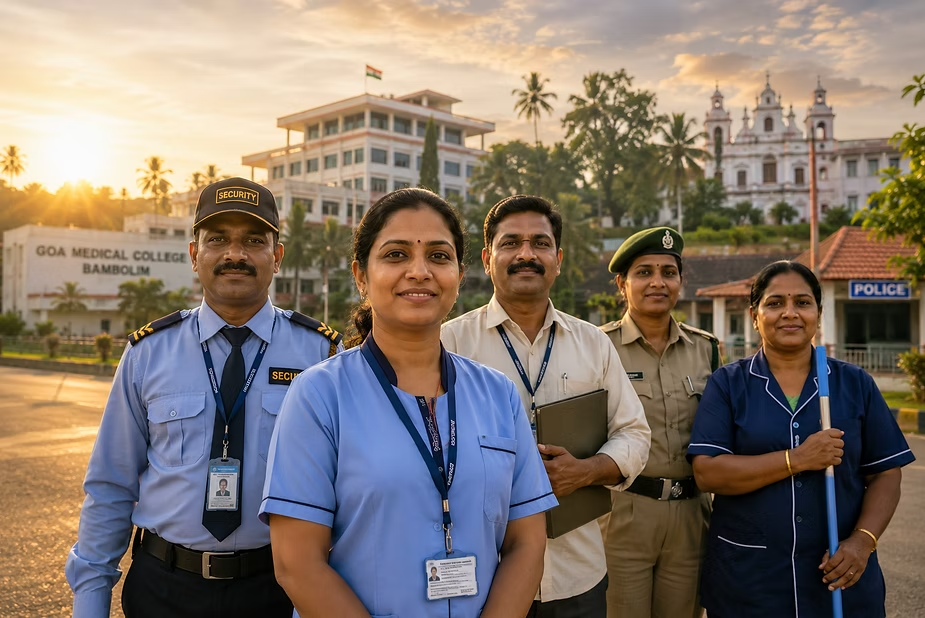
For many government employees, public service is measured not only in years worked but also in the dignity, security and recognition that come with long-term service. In Goa, an important step in that direction has emerged with the state government’s decision to extend 6th Pay Commission benefits to eligible employees of the Goa Human Resource Development Corporation (GHRDC), a move that goes beyond salary revisions and reflects a broader shift in how the state views workforce welfare, institutional stability and employee motivation.
At first glance, the announcement appears to be a routine administrative decision. Pay commission revisions are often viewed as technical matters involving salary structures, allowances and government accounting. Yet beneath the numbers lies a much larger governance story. The decision signals a growing recognition that the quality of public service delivery is closely linked to the well-being of the people who form the backbone of that service. When employees feel valued, recognised and financially secure, institutions become stronger, more accountable and better equipped to serve citizens.
The Goa Human Resource Development Corporation occupies a unique position in the state’s employment ecosystem. Over the years, it has become one of the most significant channels through which manpower is deployed across government departments, public institutions and service-oriented sectors. Thousands of employees working through the corporation support critical functions across administration, public services and citizen-facing operations. While their work often remains behind the scenes, their contribution is central to the smooth functioning of government systems.
The government’s decision to extend 6th Pay Commission benefits to eligible GHRDC employees therefore carries significance that extends far beyond payroll calculations. It represents an acknowledgement that employees who have dedicated years of service deserve compensation structures that better reflect their contribution and experience. According to reports, the move will align the pay structure of eligible employees with revised government standards, providing financial relief and improving long-term earning potential.
To understand the importance of this development, it is necessary to look at the broader evolution of workforce policies in Goa. Over the past several years, the state has increasingly focused on balancing employment generation with employee welfare. While creating jobs remains a priority, there has also been growing recognition that sustainable employment must include pathways for career progression, skill development and financial security. The latest announcement fits squarely within that philosophy.
The significance becomes clearer when viewed alongside other measures announced for GHRDC employees. Earlier, the government announced that employees completing probation would be confirmed in service, signalling a move towards greater employment stability. Women employees were extended maternity benefits, while support for higher education and skill enhancement was also introduced. Additionally, the government assumed responsibility for salary-related GST burdens that had previously affected take-home earnings for employees. Together, these initiatives reflect an emerging workforce policy framework that seeks not merely to employ people but to create conditions for professional growth and economic stability.
The extension of 6th Pay Commission benefits should therefore be viewed as part of a continuum rather than an isolated decision. Each policy measure addresses a different dimension of workforce welfare. Confirmation in service addresses job security. Educational support addresses professional growth. Maternity benefits strengthen workplace inclusivity. Salary improvements address financial stability. When combined, these measures contribute to a more resilient and motivated workforce.
There is also an important economic dimension to the decision. Employee welfare measures are often discussed in social terms, but they carry substantial economic implications. Improved salaries increase household purchasing power, support local consumption and contribute to broader economic activity. In a state like Goa, where domestic spending plays a significant role in sustaining local businesses, higher disposable incomes among thousands of employees can create ripple effects across communities. Better earnings support family expenses, education, healthcare and housing while strengthening consumer confidence.
Beyond economics, the announcement reflects a wider shift in governance thinking. Modern public administration increasingly recognises that government effectiveness depends on human capital. Infrastructure projects, welfare schemes and citizen services ultimately rely on people for implementation. Roads may be constructed through budgets and contracts, but inspections, administration and service delivery depend on employees. Healthcare programmes require healthcare workers. Welfare programmes require administrative staff. Public safety initiatives require trained personnel. Strengthening institutions therefore begins with strengthening the people who operate them.
This principle has become increasingly relevant as governments across India seek to modernise governance systems. States are competing not only to attract investment and improve infrastructure but also to build administrative capacity. Human resources have become a strategic asset. Employee motivation, retention and productivity are now recognised as key factors influencing governance outcomes. In that context, workforce welfare policies are no longer viewed solely as employee benefits; they are investments in institutional performance.
For Goa, the decision is particularly noteworthy because of the expanding role envisioned for GHRDC. Previous announcements indicated plans to significantly increase the corporation’s workforce in the coming years, potentially doubling employment numbers. Such expansion requires a credible and attractive employment framework capable of retaining talent and maintaining morale. Policies that improve compensation and recognise long-term service help build confidence among existing employees while making the organisation more attractive to future recruits.
The announcement also carries symbolic value. Recognition matters in any workplace. Employees who spend years contributing to an organisation often seek acknowledgment that their commitment has value. Financial benefits are one form of recognition, but they also communicate a broader institutional message: that long-term service is appreciated and rewarded. This can have a profound impact on organisational culture by reinforcing commitment, loyalty and professionalism.
In governance discussions, attention frequently gravitates toward large infrastructure projects, investment summits and major policy reforms. These initiatives are important, but the quieter stories of workforce welfare often receive less attention despite having equally significant implications. Effective governance depends not only on ambitious projects but also on the strength of the institutions responsible for executing them. Those institutions are ultimately built on people.
Goa’s approach increasingly suggests an understanding of this reality. The state has simultaneously pursued infrastructure development, tourism growth, digital governance and investment promotion while introducing measures aimed at improving employee welfare. This dual focus reflects a governance model that recognises both physical and human infrastructure as essential components of development.
The extension of 6th Pay Commission benefits also contributes to public confidence. Citizens are more likely to trust institutions that demonstrate fairness and consistency in their treatment of employees. When governments invest in workforce welfare, it signals a commitment to building capable institutions rather than simply managing administrative systems. Strong institutions generate better outcomes, and better outcomes strengthen public trust.
For younger Goans entering the workforce, the decision sends another important message. Public-sector and government-linked employment continue to play a significant role in the state’s labour market. Policies that improve career prospects, job stability and compensation make these opportunities more attractive. At a time when many regions face challenges related to talent retention and workforce migration, creating meaningful and secure employment pathways can contribute to broader socio-economic stability.
As Goa continues to chart its development trajectory, conversations about governance will increasingly revolve around outcomes rather than announcements. Citizens want efficient services, responsive institutions and accountable administration. Achieving those outcomes requires motivated employees who feel valued by the systems they serve. The extension of 6th Pay Commission benefits to eligible GHRDC employees may appear administrative on the surface, but its implications reach much further.
It reflects a governance philosophy that recognises the connection between employee welfare and institutional performance. It strengthens financial security for workers, reinforces the value of long-term service and supports the creation of a more stable workforce. Most importantly, it highlights an often-overlooked truth about development: the strength of any institution ultimately depends on the people who power it.
In that sense, this announcement is not merely about salaries. It is about recognition, stability and the gradual strengthening of the human foundations upon which effective governance is built. For Goa, it represents another step toward creating institutions that are not only efficient but also people-centric, resilient and prepared to meet the demands of a rapidly evolving future.