


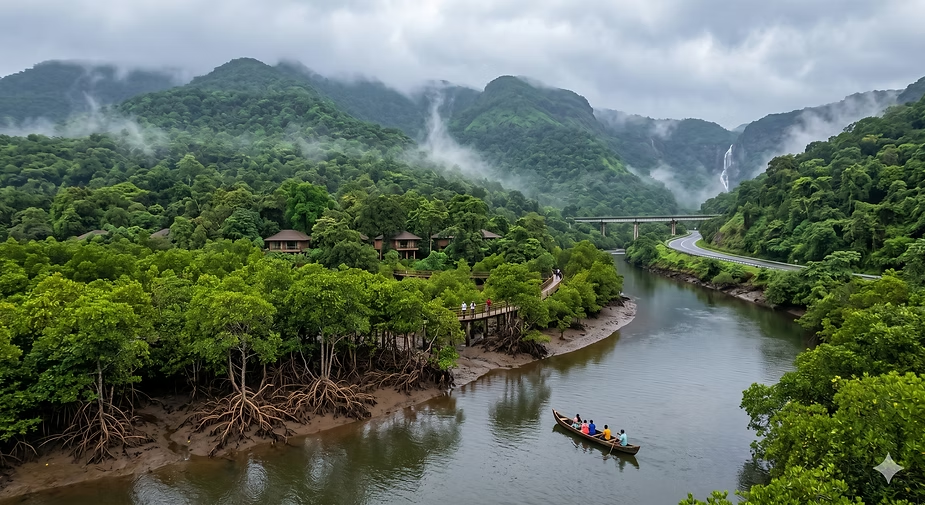
Goa has been marketed to the world through a singular image: beaches, nightlife, shacks, sunsets, and the Arabian Sea. The global imagination has reduced the state to a narrow coastal strip, often overlooking the fact that the true geographical and ecological identity of Goa lies far beyond the shoreline.
The reality is staggering. Nearly sixty percent of Goa’s geographical area is under forest cover, making it one of the greenest states in Bharat and the greenest among all coastal states. Stretching across the foothills of the Western Ghats, these forests are not merely scenic landscapes. They are ecological engines that regulate rainfall, recharge groundwater, support biodiversity, store carbon, and sustain the rivers that power the state’s economy and daily life.
Today, as Goa undergoes rapid modernization through new highways, upgraded airports, tourism infrastructure, logistics corridors, and digital connectivity projects, the state faces a defining challenge. Can economic growth coexist with ecological preservation? Can a tourism-dependent economy expand without destroying the very ecosystems that make Goa unique? Increasingly, Goa is attempting to answer that question with a model rooted in sustainability, regeneration, and technological monitoring rather than unchecked expansion.
The scale of Goa’s forest wealth is extraordinary for a state of its size. According to the India State of Forest Report (ISFR) 2023, Goa’s forest cover stands at approximately 2,219 square kilometres, accounting for nearly 59.94 percent of the state’s geographical area. Additional tree cover contributes another 334 square kilometres, pushing the broader green cover even higher. This is significantly above the national average and places Goa among the most densely forested regions in the country. The forests range from moist deciduous forests in lower elevations to dense semi-evergreen and evergreen forests in the Western Ghats belt.
These ecosystems host remarkable biodiversity, including species such as the Indian Gaur, Malabar Giant Squirrel, Slender Loris, Black Panther sightings in protected regions, and hundreds of endemic bird and amphibian species. The Western Ghats themselves are globally recognized as one of the world’s eight “hottest hotspots” of biological diversity.
These forests are also central to Goa’s hydrological security. Major rivers including the Mandovi, Zuari, Terekhol, Chapora, Sal, and Galgibaga originate or are sustained by the Ghats and surrounding forest systems. During the monsoon season, the forests act like massive sponges, slowing water runoff, reducing soil erosion, and replenishing aquifers. Without them, Goa’s water security would collapse under the pressures of urbanization and seasonal tourism demand.
Yet modern Goa is expanding rapidly. The state receives millions of domestic and international visitors annually, placing enormous stress on transport infrastructure, waste systems, water resources, and coastal ecosystems. Traditional tourism concentrated heavily around beach belts in North Goa and parts of South Goa, leading to overcrowding, rising land pressures, traffic congestion, and environmental degradation along the coast. Policymakers increasingly recognized that the future of tourism could not rely solely on the beach economy. The answer lay inland.
Over the last few years, Goa has aggressively repositioned itself through the “Goa Beyond Beaches” strategy. Instead of viewing forests as inaccessible reserve spaces, the state has begun developing carefully regulated eco-tourism infrastructure in the hinterlands. The objective is not mass tourism deep inside forests, but controlled, low-impact tourism that generates local livelihoods while preserving ecological integrity. Monsoon tourism, biodiversity tourism, birdwatching, forest trekking, waterfall circuits, spice plantation tourism, and village homestays have emerged as central pillars of this transformation.
What makes this transition particularly significant is the emphasis on regenerative tourism rather than extractive tourism. Traditional tourism models often remove wealth from local communities and centralize profits among large hotel operators. Regenerative tourism attempts the opposite. It seeks to ensure that tourism strengthens local ecosystems and local economies simultaneously. In Goa’s hinterlands, this has translated into increasing support for community-led homestays, local guides, eco-cottages, forest interpretation centres, and village-level tourism enterprises. Instead of constructing massive resort clusters deep inside fragile ecosystems, the focus is shifting toward smaller-scale infrastructure integrated with local landscapes.
This shift has become especially visible during the monsoon season. Historically considered the tourism “off-season,” monsoon Goa is now being rebranded as a premium eco-tourism experience. Mist-covered forests, overflowing waterfalls, river trails, biodiversity walks, and heritage villages are attracting a different category of traveler — one seeking nature, wellness, culture, and sustainability rather than only nightlife and beaches.
One of the most important ecological assets supporting this transformation is Goa’s mangrove ecosystem. Mangroves occupy the delicate estuarine zones where rivers meet the Arabian Sea. Though often overlooked, they function as natural coastal defense systems. Their dense aerial root structures stabilize sediments, reduce coastal erosion, buffer against tidal surges, and create breeding grounds for fish and marine biodiversity. Mangroves are also among the planet’s most efficient carbon sinks, capable of storing immense quantities of “blue carbon.”
According to the India State of Forest Report 2023, Goa’s mangrove cover increased from approximately 26 square kilometres in 2019 to over 31 square kilometres in recent assessments. This growth is particularly significant at a time when many coastal ecosystems across the world are shrinking due to urbanization and climate change. Goa’s mangrove expansion has been driven by a combination of stricter regulation, plantation drives, and restoration initiatives under schemes such as MISHTI — the Mangrove Initiative for Shoreline Habitats and Tangible Incomes launched by the Union Government.
The legal protection around mangroves in Goa is exceptionally stringent. Under Coastal Regulation Zone (CRZ) Rules, mangrove zones are classified as Ecologically Sensitive Areas. Construction activities near dense mangrove patches face severe restrictions, including mandatory buffer zones. When infrastructure projects require unavoidable diversion of mangrove areas, compensatory plantation rules apply. In many cases, developers are required to undertake multiple-times replantation for every mangrove tree removed. This framework reflects a broader recognition that mangroves are not wastelands to be reclaimed, but climate infrastructure essential to coastal survival.
Simultaneously, inland forest conservation mechanisms have become increasingly technology-driven. Goa’s Forest Department now uses Geographic Information Systems (GIS), satellite mapping, drone surveys, and digital forest monitoring systems to track land-use change and monitor plantation compliance. Under tree preservation and compensatory afforestation rules, developers must digitally map plantation sites using KML coordinates, enabling authorities to verify survival rates remotely. Forest fire monitoring systems linked to satellite alerts allow near real-time response during dry months, significantly reducing wildfire spread in remote forest divisions.
Another major pillar supporting ecological restoration is the Compensatory Afforestation Fund Management and Planning Authority, widely known as CAMPA. Whenever forest land is legally diverted for non-forest purposes such as highways, transmission corridors, rail infrastructure, or public utilities, project authorities must provide financial compensation for afforestation and ecosystem restoration. These CAMPA funds are then used for plantation drives, wildlife habitat improvement, soil conservation, anti-poaching systems, water conservation structures, and forest regeneration programs. In Goa, CAMPA-funded projects have become an important financial backbone for sustaining large-scale ecological interventions.
Critically, Goa’s environmental governance is increasingly being tied to climate resilience. Climate change poses major risks to the state, including sea-level rise, coastal erosion, saltwater intrusion, erratic rainfall patterns, and biodiversity stress. Mangroves and forests therefore serve not just ecological purposes but climate adaptation functions. Forests reduce heat intensity, improve water retention, and stabilize fragile hill slopes during extreme rainfall events. Mangroves protect low-lying coastal settlements from flooding and tidal surges. In this context, conservation is no longer merely an environmental concern. It is infrastructure planning for climate survival.
Goa’s development model also reflects an important political and economic calculation. The state understands that environmental destruction would directly undermine tourism itself. Unlike industrial economies that can relocate production elsewhere, Goa’s economic identity is inseparable from its landscapes. The forests, rivers, coastlines, and biodiversity are not peripheral assets. They are the core of the state’s long-term economic competitiveness. Preserving them is therefore not anti-development; it is essential for sustaining development.
This philosophy is increasingly visible in policy discussions surrounding mobility, tourism planning, and regional growth. Infrastructure projects are now often accompanied by environmental mitigation mechanisms, biodiversity assessments, and afforestation requirements. The emphasis is shifting toward smarter integration rather than absolute exclusion of development. Digital permit systems for eco-tourism activities, regulated trekking routes, carrying-capacity management, and decentralized tourism promotion are all part of this transition.
The socioeconomic implications are equally important. Rural Goa historically remained disconnected from mainstream tourism revenues concentrated in coastal belts. The new eco-tourism model attempts to redirect economic benefits toward interior talukas and village communities. Homestays, spice plantation tours, local handicrafts, forest guides, traditional food enterprises, and eco-cultural experiences are generating alternative income streams for rural families. Women-led tourism entrepreneurship in particular has emerged as an important dimension of this shift.
Importantly, this transition also helps preserve cultural heritage. Goa’s hinterlands contain ancient temples, sacred groves, traditional agricultural systems, indigenous knowledge networks, and village ecosystems that are deeply intertwined with the forests. Regenerative tourism creates financial incentives to preserve these traditions instead of replacing them with homogenized commercial tourism infrastructure.
Nationally, Goa’s environmental performance continues to receive attention. The state consistently performs strongly in sustainability-related governance indicators and remains one of Bharat’s most forest-rich regions relative to land area. Despite periodic pressures from infrastructure expansion and urban growth, a substantial portion of Goa’s government-owned forests remains protected under wildlife and conservation laws, including one National Park and multiple Wildlife Sanctuaries where commercial exploitation is heavily restricted.
The global development narrative often frames economic growth and environmental conservation as opposing forces locked in permanent conflict. Goa is attempting to challenge that assumption. The state’s evolving model suggests that with strong regulation, digital monitoring, community participation, and ecological planning, development can occur without annihilating natural systems. The process is neither perfect nor free of debate. Environmental concerns around specific infrastructure projects continue to generate public scrutiny and civic activism. Yet the broader direction of policy increasingly reflects an understanding that ecological destruction is not a viable growth strategy for Goa.
As the monsoons transform the state into a vast emerald landscape each year, Goa is beginning to redefine itself for the future. The beaches may remain globally iconic, but they are no longer the entirety of Goa’s identity. Beyond the coastline lies a living ecological civilization of forests, rivers, mangroves, waterfalls, wildlife, and villages that continue to shape the state’s soul.
The future of Goa may ultimately depend on how successfully it protects this green heart. If the current balance between conservation and modernization can be sustained, Goa could emerge not merely as Bharat’s tourism capital, but as one of the country’s most important models for climate-resilient and environmentally conscious development. In an era where much of the world is losing its natural ecosystems to uncontrolled expansion, Goa is trying to prove that growth does not have to come at the cost of nature. The state is building a future where the green beyond the blue remains protected for generations to come.
References:
India State of Forest Report 2023 – Forest Survey of Bharat
Goa Forest Department – Forest & Tree Cover Data
Mangrove Initiative for Shoreline Habitats and Tangible Incomes (MISHTI)
Compensatory Afforestation Fund Management and Planning Authority (CAMPA)
Gokhale, C. S. (2024). Conservation, Restoration and Development of Mangrove Forests in Goa.
Singh, S., Rangarajan, S., & Thattai, D. (2022). Mangroves: Sea level rise and elevation – A review.