


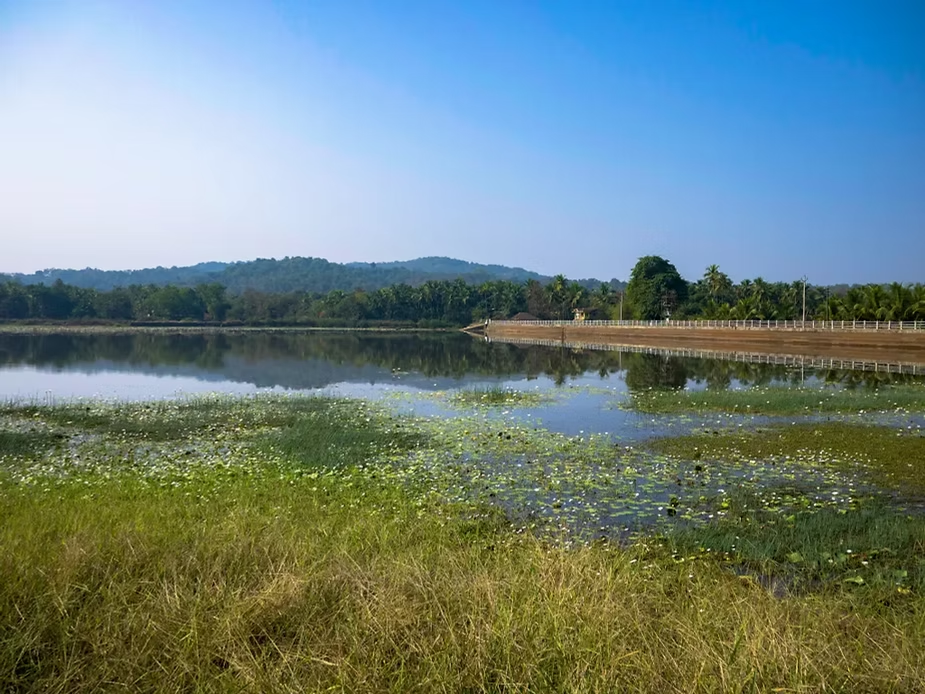
Goa occupies a unique position in Bharat’s environmental landscape. While rapid urbanisation, industrial expansion and population growth have placed increasing pressure on natural ecosystems across the country, Goa continues to retain one of the highest proportions of green cover among all Indian states. Chief Minister Pramod Sawant recently highlighted this distinction, stating that nearly 61% of Goa’s geographical area remains under forest cover while announcing an ambitious initiative to revive approximately 18,000 hectares of khazan land through a partnership with technical experts. This announcement is significant not merely because of the numbers involved but because it signals a governance approach that seeks to combine conservation, traditional ecological knowledge and climate resilience into a single long-term development strategy.
Goa’s environmental identity has always been closely linked to its forests. According to official figures published by the Goa Forest Department, the state possesses approximately 2,219 square kilometres of forest cover, representing nearly 60% of its geographical area. When tree cover is included, the green footprint expands even further. Independent assessments have also consistently shown that Goa remains among the most forest-rich regions in Bharat despite being one of the country’s smallest states geographically. This extensive green cover serves as a critical ecological asset, supporting biodiversity, regulating water cycles, reducing soil erosion and acting as a major carbon sink.
The significance of Goa’s forests extends far beyond their visual appeal. The forests of the Western Ghats, portions of which run through Goa, are recognised globally as one of the world’s biodiversity hotspots. These ecosystems host thousands of plant species, numerous endemic animals and critical wildlife habitats. Forests play a central role in maintaining river systems, replenishing groundwater reserves and stabilising local climatic conditions. In a state heavily dependent on tourism, forests also contribute directly to the attractiveness of eco-tourism destinations and nature-based recreational activities.
The environmental value of forests is increasingly important in the context of climate change. Scientific studies worldwide have demonstrated that forest ecosystems act as natural carbon sinks by absorbing atmospheric carbon dioxide. This helps moderate the impacts of global warming while simultaneously improving air quality. For a coastal state like Goa, where climate-related risks such as extreme rainfall, flooding, sea-level rise and coastal erosion are becoming more prominent, maintaining extensive forest cover is an important component of long-term resilience planning.
Yet the Chief Minister’s announcement was not limited to celebrating existing forest cover. Equally significant was the declaration that approximately 18,000 hectares of khazan land would be revived through a structured restoration programme involving technical expertise and scientific guidance. To understand the importance of this initiative, one must first understand what khazan lands represent within Goa’s environmental and cultural history.
From Uncertainty to Ownership: How the Mhaje Ghar Scheme Is Transforming Housing Security for Thousands of Goan Families
Khazan lands are among Goa’s most remarkable examples of traditional ecological engineering. Developed over centuries, these reclaimed coastal wetlands were created through sophisticated systems of embankments, sluice gates and drainage channels designed to regulate the movement of saline and freshwater. These systems allowed communities to cultivate agricultural land in low-lying coastal regions while simultaneously supporting fisheries and preventing saltwater intrusion.
Unlike conventional agricultural landscapes, khazan ecosystems function as integrated environmental systems. They support farming, aquaculture, flood management and biodiversity conservation simultaneously. During monsoon seasons, they help regulate water flow and reduce flooding risks. During dry periods, they support agricultural activity and fish production. The intricate balance maintained by these systems demonstrates the depth of environmental knowledge possessed by earlier generations of Goans.
Over time, however, many khazan areas have deteriorated. Urbanisation, changes in land use patterns, weakening maintenance systems, encroachments and reduced agricultural activity have contributed to the decline of several khazan networks. Siltation, damaged bunds and malfunctioning sluice gates have further reduced their effectiveness. As a result, some areas have experienced reduced agricultural productivity, increased flooding risks and ecological degradation.
The proposed revival of 18,000 hectares therefore represents one of the largest ecosystem restoration efforts undertaken in Goa in recent years. Rather than creating entirely new infrastructure, the initiative focuses on restoring and modernising an existing environmental asset that has served the state for centuries. This approach aligns closely with emerging international best practices in climate adaptation, which increasingly emphasise nature-based solutions over purely engineered interventions.
Nature-based solutions have gained prominence worldwide because they deliver multiple benefits simultaneously. Restored wetlands can improve water quality, reduce flood risks, support biodiversity, enhance carbon sequestration and strengthen livelihoods. Khazan restoration embodies all these objectives. By reviving these systems, Goa has the opportunity to strengthen agricultural productivity while improving environmental resilience and supporting rural economies.
The agricultural implications are substantial. Khazan lands have historically supported rice cultivation, one of Goa’s traditional agricultural activities. Improved water management through restored embankments and sluice systems can help increase productivity while reducing vulnerability to salinity intrusion. This can contribute to greater agricultural sustainability and help preserve traditional farming landscapes that form an important part of Goa’s heritage.
The fisheries sector also stands to benefit significantly. Many khazan systems support brackish-water aquaculture and fish breeding habitats. Restored water circulation patterns can improve aquatic ecosystems and support fish production, creating economic opportunities for local communities. Given the importance of fisheries to coastal livelihoods, this aspect of restoration carries both environmental and economic significance.
Flood management is another critical benefit. Climate projections suggest that many coastal regions will experience more intense rainfall events in the coming decades. Traditional khazan systems function as natural flood buffers by regulating water movement and temporarily storing excess water during heavy rainfall. Reviving these systems can therefore strengthen Goa’s capacity to manage climate-related risks without relying exclusively on expensive grey infrastructure projects.
Goa’s Export Gateway Expands: How the India–Oman CEPA Creates New Opportunities for Goan Businesses
The biodiversity dimension should not be overlooked. Wetland ecosystems support diverse bird populations, aquatic species, insects and plant communities. Restored khazan areas can function as important ecological corridors connecting coastal habitats and supporting species conservation. This biodiversity value also enhances eco-tourism potential, creating additional opportunities for sustainable economic activity.
From a governance perspective, the initiative reflects an increasingly integrated approach to environmental management. Historically, conservation, agriculture, water management and economic development have often been treated as separate policy domains. The khazan restoration programme demonstrates how these objectives can be pursued simultaneously. Environmental protection becomes compatible with economic development rather than being viewed as a competing priority.
The decision to involve expert institutions is particularly important. Successful ecosystem restoration requires scientific planning, hydrological assessments, engineering expertise and community participation. Technical partnerships can help ensure that restoration interventions are based on sound ecological principles while remaining responsive to local conditions. This combination of traditional knowledge and modern expertise offers the best prospects for long-term success.
The announcement also reinforces Goa’s broader positioning as a state seeking to balance development with environmental stewardship. As economic activity expands, governments increasingly face pressure to accommodate infrastructure projects, housing demand and industrial growth. Maintaining high levels of forest cover while investing in ecosystem restoration demonstrates an effort to pursue development without compromising critical environmental assets.
This balance is especially important because environmental quality is directly linked to Goa’s economic competitiveness. Tourism remains a major pillar of the state’s economy, and visitors are drawn not only by beaches but also by landscapes, biodiversity, waterways and natural beauty. Protecting these assets is therefore not merely an ecological objective but also an economic necessity.
There is also an important public health dimension. Forests and wetlands contribute to cleaner air, improved water quality and reduced urban heat effects. As climate change increases the frequency of extreme weather events, healthy ecosystems can provide natural protection that supports community well-being. Investments in environmental resilience ultimately generate social benefits that extend far beyond conservation metrics.
The restoration of 18,000 hectares of khazan land may therefore be viewed as an investment in Goa’s future. It combines environmental conservation, climate adaptation, agricultural sustainability, fisheries development and rural economic support within a single framework. When combined with the state’s substantial forest cover, it presents a vision of development that recognises nature as productive infrastructure rather than unused land.
The broader message emerging from this initiative is that environmental assets are not obstacles to progress. They are foundational resources that support economic growth, community resilience and quality of life. Goa’s forests regulate climate, protect biodiversity and sustain water systems. Khazan lands manage floods, support agriculture and preserve ecological balance. Together, they form an environmental network that underpins the state’s prosperity.
As climate challenges intensify across the world, regions that successfully protect and restore natural ecosystems will possess significant long-term advantages. Goa’s combination of extensive forest cover and large-scale wetland restoration positions it favourably within this emerging paradigm. The challenge ahead will be ensuring effective implementation, sustained maintenance and continued community participation.
If successfully executed, the revival of 18,000 hectares of khazan land could become a model for ecosystem-based development in coastal regions across Bharat. Combined with the preservation of one of the country’s highest levels of forest cover, it demonstrates how governance can align environmental protection with economic and social objectives. For Goa, this is not simply a conservation story. It is a story about resilience, sustainability and preparing the state for the opportunities and challenges of the decades ahead.