


At a Glance
Goa has formally launched the Goa CARES Longitudinal Cohort Study 2025 through a collaboration between the Directorate of Health Services (DHS), Tata Memorial Centre’s Centre for Cancer Epidemiology and the University of Oxford.
The study will track one lakh adults aged between 25 and 70 years across Goa for ten years.
Researchers will monitor medical history, lifestyle, environmental exposure, genetics and biological markers to better understand why non-communicable diseases develop and how they can be prevented.
Officials believe the findings will strengthen preventive healthcare, improve disease screening, guide investments in healthcare infrastructure and influence public policy.
There is a quiet transformation taking place inside Goa’s healthcare system.
It is not a new super-speciality hospital. It is not a new medical device or breakthrough treatment. Instead, it is something less visible but potentially far more influential, knowledge.
For decades, healthcare has largely focused on treating disease after it appears. A patient develops diabetes, treatment begins. A heart attack occurs, intervention follows. Cancer is detected, therapy starts.
Goa now wants to reverse that equation.
Rather than waiting for disease, the state wants to understand exactly why people fall sick in the first place.
That ambition has taken shape through the Goa CARES Longitudinal Cohort Study 2025, one of the largest population-based public health research projects ever undertaken in the state. The initiative represents a significant shift from reactive healthcare to preventive, evidence-driven policymaking.
The study is not designed to deliver immediate headlines. Its success will be measured over years rather than months. Yet, if it achieves its objectives, the findings could influence everything from screening programmes and healthcare infrastructure to medical education and disease prevention strategies across Goa.
The Memorandum of Understanding for the initiative was signed on June 22 between the Directorate of Health Services, the Centre for Cancer Epidemiology at Tata Memorial Centre in Mumbai and the University of Oxford, marking the beginning of what officials describe as a landmark public health collaboration.
What Happened?
The Goa CARES study will recruit approximately one lakh adults between the ages of 25 and 70 from both rural and urban Goa.
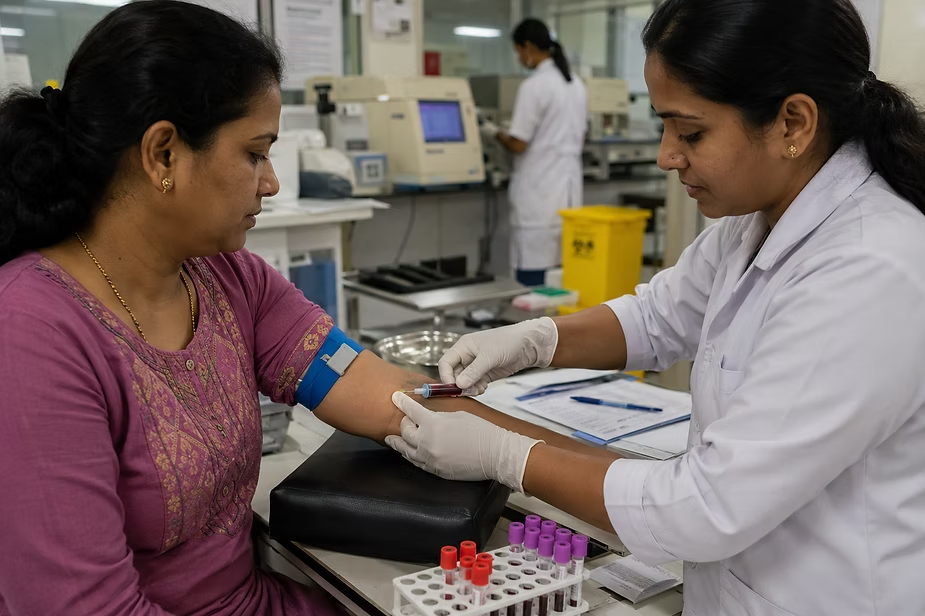
Participants will undergo comprehensive health assessments that extend far beyond routine medical check-ups. Researchers will collect information about family history, lifestyle choices, dietary habits, occupational exposure, environmental conditions, physical activity, tobacco and alcohol use, alongside biological measurements including blood pressure, blood glucose and cholesterol levels.
Unlike conventional surveys that provide only a snapshot in time, this is a longitudinal cohort study. Participants will be followed over a period of ten years, allowing researchers to observe how health changes over time and identify the factors that contribute to disease development.
Initial enrolment will include participants from areas such as Sankhalim, Valpoi, Margao and Canacona before expanding further.
Such studies are regarded internationally as among the strongest forms of population health research because they allow scientists to establish relationships between risk factors and long-term health outcomes.
Why It Matters
The timing of the initiative is significant. Goa has undergone rapid demographic and lifestyle changes over the past three decades. Rising incomes, urbanisation, changing dietary patterns, increasingly sedentary lifestyles and longer life expectancy have all contributed to a shift in disease patterns.
Today, infectious diseases no longer account for the majority of illness.
Instead, non-communicable diseases, heart disease, diabetes, chronic respiratory illness and cancer, have emerged as the state’s biggest healthcare challenge.
According to the Goa CARES concept note, nearly 74.71 percent of Goa’s total disease burden is now attributed to non-communicable diseases, while injuries account for another 10.28 percent. More than 56 percent of the disease burden arises from premature deaths, with the remainder resulting from years lived with disability or chronic illness.
These numbers reflect a broader epidemiological transition taking place across India. As living standards improve, countries often experience a decline in infectious diseases but a sharp increase in chronic illnesses linked to ageing, diet, pollution and lifestyle.
Goa is now firmly in that phase.
High blood pressure, obesity, elevated cholesterol and environmental exposures have emerged as some of the state’s leading health risks. Left unaddressed, they place increasing pressure on hospitals, families and public finances.
Healthcare systems built primarily around treatment eventually become overwhelmed when chronic disease prevalence rises.
Preventing disease therefore becomes not only a public health priority but also an economic necessity.
Background
Around the world, several landmark longitudinal cohort studies have fundamentally changed medicine.
The Framingham Heart Study in the United States transformed global understanding of cardiovascular disease by identifying major risk factors such as smoking, hypertension and high cholesterol.
The UK Biobank has enrolled around half a million volunteers, creating one of the world’s most valuable biomedical research resources.
Large population cohorts in Scandinavia, Japan and Australia have similarly informed national health policy for decades.
Goa CARES seeks to establish a comparable evidence base tailored specifically to Goa’s population.
Rather than relying solely on international research, which may not fully reflect local genetics, climate, diet or environmental exposures, the state aims to generate data directly from its own communities.
This local evidence is expected to improve public health decision-making in ways that imported research cannot always achieve.
The partnership itself is equally noteworthy.
The Directorate of Health Services brings administrative leadership and statewide implementation capacity.
Tata Memorial Centre contributes internationally recognised expertise in epidemiology and cancer research.
The University of Oxford adds experience in designing and analysing large-scale cohort studies that have shaped healthcare policies worldwide.
Together, the collaboration combines government implementation with national scientific expertise and international research standards.
Goa’s policymakers increasingly emphasise evidence-based governance across sectors, and healthcare is becoming one of its strongest examples.
Rather than introducing programmes based solely on assumptions, future interventions may increasingly be informed by locally generated scientific evidence.
That represents an important evolution in public administration.
Healthcare planning could become more precise.
Resources could be allocated more efficiently.
Screening programmes could target communities facing the highest risks.
Preventive campaigns could focus on behaviours demonstrated, through Goan data, to have the greatest impact.
In many ways, the true value of Goa CARES will not lie in the information it gathers alone.
Its greatest contribution may be changing how public health decisions are made.
For a state known internationally for tourism, Goa is now positioning itself as a contributor to another global conversation, population health research.
And if the next decade delivers the insights researchers hope for, the benefits may extend well beyond Goa’s borders, informing healthcare strategies across India and contributing to international understanding of chronic disease prevention.
Sources & References
- Directorate of Health Services, Government of Goa. Press Release: Goa CARES Longitudinal Cohort Study 2025, 22 June 2026. (Official Government Press Release)
- Directorate of Health Services, Government of Goa. Goa CARES: Establishing Goa as a Leader in Population Health Research. Official Concept Note.
- Ministry of Health and Family Welfare, Government of India. National Programme for Prevention and Control of Non-Communicable Diseases (NP-NCD).
- Indian Council of Medical Research (ICMR). India: Health of the Nation’s States – Disease Burden Initiative.
- World Health Organization (WHO). Noncommunicable Diseases (NCDs) – Key Facts.
- University of Oxford. Population Health and Longitudinal Cohort Research Programmes.
- Tata Memorial Centre, Centre for Cancer Epidemiology (CCE). Population-Based Cancer Epidemiology and Public Health Research.
- Institute for Health Metrics and Evaluation (IHME). Global Burden of Disease Study.