


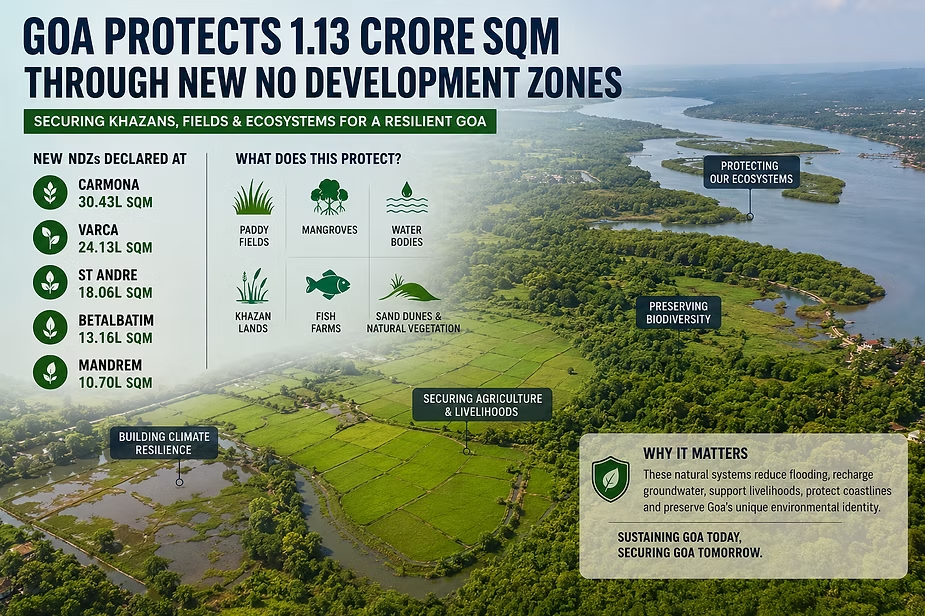
In recent years, as rapid urbanisation and land conversion have accelerated, the question has shifted from whether Goa should develop to how it can develop without compromising the natural systems that make the state unique. Against this backdrop, the Government of Goa’s latest decision to notify nearly 1.13 crore square metres of environmentally sensitive land as No Development Zones (NDZs) marks one of the state’s most significant land conservation measures in recent years.
The notification, issued by the Town and Country Planning (TCP) Department following the recommendations of the State Town and Country Planning Board, proposes bringing large tracts of ecologically sensitive land under statutory protection. The areas include paddy fields, khazan lands, mangroves, rivers, water bodies, nallas, fish farms, orchards, salt pans, sand dunes and natural vegetation.
Among the largest beneficiaries is Carmona in South Goa, where approximately 30.43 lakh square metres have been proposed for NDZ status. Varca follows with 24.13 lakh square metres, while St. Andre accounts for 18.06 lakh square metres. Betalbatim contributes another 13.16 lakh square metres, and Mandrem, already known for its fragile coastal ecosystem, adds 10.70 lakh square metres. Together, these five locations account for a substantial share of the newly proposed protected landscape, reflecting an emphasis on safeguarding low-lying agricultural systems and coastal ecological buffers.
The notification extends beyond these villages. Additional ecologically important lands across Colva, Sernabatim, Cortalim, Sancoale, Dabolim, Chinchinim, Telaulim, Deussua, Cavelossim, Maem, Aldona, Corjuem, Chorao, Ella, Amona, Bandora, Panchawadi, Guirim, Tivim and several other locations have also been identified for protection. The geographical spread demonstrates that the initiative is not confined to one taluka or one ecosystem but represents a broader state-wide conservation strategy.
The significance of this notification lies not merely in the area being protected but in the type of land being preserved. Khazan lands are among Goa’s most remarkable examples of traditional ecological engineering. Developed centuries ago through embankments, sluice gates and carefully managed water systems, these reclaimed estuarine landscapes enable agriculture while protecting inland settlements from saline intrusion. They support rice cultivation, aquaculture and biodiversity simultaneously, making them one of the state’s most valuable yet vulnerable ecosystems.
Similarly, paddy fields perform functions extending far beyond agriculture. During the monsoon, they serve as natural floodplains, allowing rainwater to percolate into the ground and reducing surface runoff.
Mangroves form another critical component of the notification. These ecosystems stabilise coastlines, trap sediment, support fisheries and protect coastal settlements from erosion and storm surges.
The timing of the decision is equally notable. Goa has witnessed sustained public debate over land use, Regional Plans, zoning regulations and balancing economic growth with environmental protection. Over the past several years, concerns over indiscriminate hill cutting, wetland conversion and pressure on agricultural land have increasingly shaped public discourse. Against this backdrop, expanding statutory protection through NDZ notifications represents an attempt to provide greater certainty regarding land that should remain ecologically intact.
Importantly, the present notification forms part of a broader sequence of conservation measures undertaken during 2026. Earlier this year, the state notified over 82 lakh square metres of hill slopes and mound areas as No Development Zones to prevent flattening and unregulated construction. Separately, environmentally sensitive stretches along the Mandovi and Zuari river systems, covering approximately 6.72 crore square metres, also received enhanced ecological protection through coordinated efforts involving the Forest Department and environmental authorities. The latest 1.13 crore square metre notification therefore builds upon an expanding conservation framework rather than standing as an isolated decision.
One of the defining features of the current notification is its reliance on scientific land classification rather than administrative convenience. For farmers, the decision could have long-term significance in preserving agricultural landscapes from speculative land conversion. Goa has witnessed a gradual decline in cultivated agricultural land over the past decades as economic incentives shifted towards construction and real estate. Tourism, one of Goa’s largest economic sectors, also stands to benefit indirectly. Increasingly, international travellers seek destinations that retain authentic landscapes rather than heavily urbanised coastlines. Protecting traditional agricultural fields, estuarine ecosystems and natural coastal environments strengthens Goa’s long-term tourism competitiveness by preserving the environmental assets that differentiate it from other destinations.
For Goa, where environmental quality forms the foundation of multiple economic sectors, integrating conservation within planning policy is particularly important. The state has limited land resources, high development pressure and globally recognised biodiversity. Decisions concerning land use therefore carry consequences extending well beyond individual projects or villages.
The emphasis on khazan lands deserves particular attention because these landscapes represent an extraordinary combination of cultural heritage and ecological function. Developed over centuries through community-managed water control systems, khazan agriculture illustrates how traditional knowledge can coexist with environmental sustainability. Protecting these areas is therefore not only about conserving biodiversity but also about preserving Goa’s historical relationship with land and water.
As the consultation period progresses, public participation will play an important role in shaping the final notification. Suggestions and objections submitted during this phase will be examined before the TCP Board makes its final recommendations. This ensures that environmental priorities remain balanced with legitimate stakeholder concerns while maintaining procedural accountability.
In choosing to safeguard over one crore square metres of environmentally sensitive land, Goa has taken another significant step towards ensuring that economic progress and ecological stewardship move forward together rather than in conflict.
Sources: Official Gazette Notification of the Town and Country Planning Department (18 June 2026); Goa Town and Country Planning Board proceedings; PTI reports; Goa News Hub; The New Indian Express.