


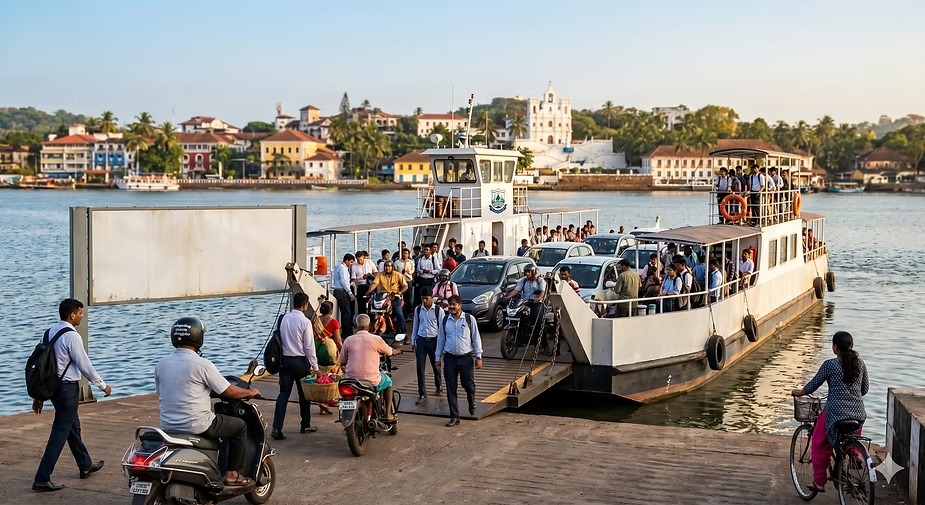
As fuel prices, global energy uncertainty, and environmental concerns continue to dominate conversations worldwide, fuel conservation has become more than just an economic necessity. It is increasingly being viewed as a responsibility to our nation, connected to sustainability, energy security, and smarter public behaviour. In this backdrop, Prime Minister Narendra Modi’s appeal for fuel conservation has triggered conversations across Bharat about how ordinary citizens can contribute through small but meaningful lifestyle changes.
In Goa, that response is beginning to take visible shape in everyday life.
Across cities, towns, and local communities, more people are gradually becoming conscious of how they travel, how much fuel they consume, and how small adjustments in commuting habits can collectively make a large difference. From carpooling among colleagues to choosing buses, shared transport, and ferry services over unnecessary solo drives, there is a noticeable shift towards more practical and efficient mobility choices.
What makes this especially important is that Goa’s response is not being driven only by restrictions or enforcement. Instead, the transition is increasingly happening through convenience, awareness, and improved public infrastructure that makes fuel-saving alternatives easier to adopt.
For a state like Goa, where tourism, daily commuting, and inter-city travel play a major role in economic and social life, fuel conservation carries both immediate and long-term significance. More vehicles on roads mean greater fuel consumption, rising congestion, longer travel time, and increased environmental pressure. Urban centres such as Panaji already experience traffic build-up during peak hours, while tourist movement further adds to transportation demand across major routes.
In this context, even small changes in daily mobility habits can create meaningful impact over time.
One of the most visible examples of this shift is the growing public attention around Goa’s ferry system. Traditionally viewed as a routine part of local transport, ferries are now being recognised as an efficient and fuel-conscious mobility solution that naturally aligns with the broader goal of reducing road congestion and unnecessary fuel usage.
The recent launch of upgraded ferries such as Kushavati and Salaulim between Panaji and Betim reflects this evolving approach towards smarter transportation infrastructure. These ferries are not merely transport upgrades. They represent a practical governance intervention aimed at improving mobility while encouraging more sustainable travel behaviour.
The Panaji-Betim crossing, which can now be completed in approximately three minutes, offers commuters a fast and efficient alternative to congested road routes. Each ferry can carry over 150 passengers along with multiple vehicles, reducing waiting times and improving the overall commuting experience for residents and visitors alike.
Importantly, the ferry system demonstrates how fuel conservation does not necessarily require sacrifice or inconvenience. In fact, many commuters find ferry travel more relaxed, efficient, and time-saving compared to navigating heavy traffic on roads. The experience itself becomes part of the appeal — smooth river crossings, open-air travel, scenic views, and lower commuting stress all contribute to making public transport more attractive.
This is where Goa’s approach becomes especially interesting.
Rather than framing fuel conservation purely as a restriction, the state is gradually encouraging behavioural change by making smarter alternatives more accessible and practical. When public infrastructure improves, people naturally begin shifting towards more efficient travel choices without feeling forced to do so.
The ferry system also highlights Goa’s geographical advantage. Unlike many urban regions that rely almost entirely on road-based movement, Goa’s rivers and waterways create opportunities for sustainable water-based transport systems. By strengthening ferry infrastructure, the state can reduce pressure on roads while improving connectivity between key areas.
At a national level, conversations around fuel conservation are increasingly linked to larger economic realities. Global fuel price fluctuations, geopolitical instability, and rising energy demand continue to affect countries across the world. Reducing unnecessary fuel consumption therefore contributes not only to individual savings but also to broader economic resilience.
Every litre of fuel saved through carpooling, shared transport, or reduced congestion contributes incrementally towards lowering overall demand pressure. While individual actions may appear small in isolation, their cumulative impact across communities and cities can become substantial over time.
In Goa, the cultural shift towards fuel-conscious behaviour is also becoming more socially visible. Office colleagues sharing rides, students choosing buses more frequently, tourists exploring public mobility options, and residents opting for ferries instead of longer road routes all reflect changing commuter patterns.
Interestingly, many of these shifts are being driven not only by fuel prices but also by convenience and practicality. Long traffic delays, parking challenges, and rising commute stress have pushed many commuters to reconsider whether solo driving is always the most efficient choice.
The growing acceptance of shared mobility reflects a broader evolution in urban thinking. Increasingly, convenience is no longer being measured only by personal vehicle ownership but by how efficiently people can move from one place to another.
This transition also aligns with larger sustainability goals.
Reduced vehicle congestion can contribute to lower emissions, better air quality, smoother traffic movement, and reduced urban stress. In a state like Goa, where tourism and environmental quality are deeply connected, sustainable mobility solutions carry additional importance.
Goa’s identity is closely tied to its natural environment, coastal beauty, and relatively relaxed lifestyle. Preserving that balance while accommodating rising transportation demand requires infrastructure models that reduce pressure on roads and encourage more efficient movement systems.
The government’s emphasis on upgraded ferry services reflects an understanding that mobility planning must adapt to modern realities. As cities grow and commuter volumes increase, relying entirely on road expansion alone may not always be sufficient or sustainable. Water-based transport offers a complementary solution that fits naturally within Goa’s geography.
At the same time, public participation remains central to the success of any fuel conservation effort.
Government infrastructure can create opportunities, but behavioural change ultimately depends on citizens themselves. Whether through carpooling, using ferries, choosing buses, avoiding unnecessary trips, or planning travel more efficiently, everyday decisions collectively determine how effective fuel-saving efforts become.
What stands out in Goa’s evolving response is that fuel conservation is increasingly being discussed in positive terms rather than as a burden. Instead of focusing only on restrictions or shortages, the conversation is gradually shifting towards smarter living, better commuting, lower stress, and more sustainable habits.
That psychological shift matters.
People are often more willing to adopt changes when they experience direct personal benefits such as saving time, reducing expenses, or improving convenience. Goa’s ferry upgrades illustrate this clearly. Commuters are not simply “saving fuel.” They are also enjoying smoother and faster travel experiences.
For tourists as well, ferries offer an attractive alternative that combines transportation with scenic value. Visitors increasingly appreciate river crossings as part of the Goan experience itself, adding another layer of utility to the system.
Importantly, Goa’s response to fuel conservation also reflects how local governance and citizen behaviour can complement each other effectively. Infrastructure improvements alone are not enough without public participation, and public willingness alone is difficult without practical alternatives. When both move together, meaningful behavioural transitions become more achievable.
The broader message emerging from Goa is therefore simple but significant: sustainability does not always require dramatic lifestyle changes. Sometimes, it begins with small everyday decisions — sharing a ride, choosing a ferry, reducing unnecessary travel, or using public transport more often.
These actions may appear modest individually, but collectively they contribute towards smarter cities, lower fuel dependency, and more sustainable urban life.
In many ways, Goa’s ferry revival has become symbolic of this larger shift. A transport system deeply connected to the state’s identity is now being modernised to meet present-day economic and environmental priorities. The result is a solution that feels local, practical, and future-oriented at the same time.
As Bharat continues discussing energy conservation and sustainable mobility, Goa’s evolving commuter culture offers an important example of how governance, infrastructure, and citizen participation can work together without making daily life more difficult.
Fuel conservation ultimately succeeds not when people are forced into change, but when better systems make smarter choices easier.
That is precisely the direction Goa now appears to be moving towards.
And sometimes, the strongest response to a national call begins not with grand speeches, but with ordinary people quietly changing how they travel every single day.