


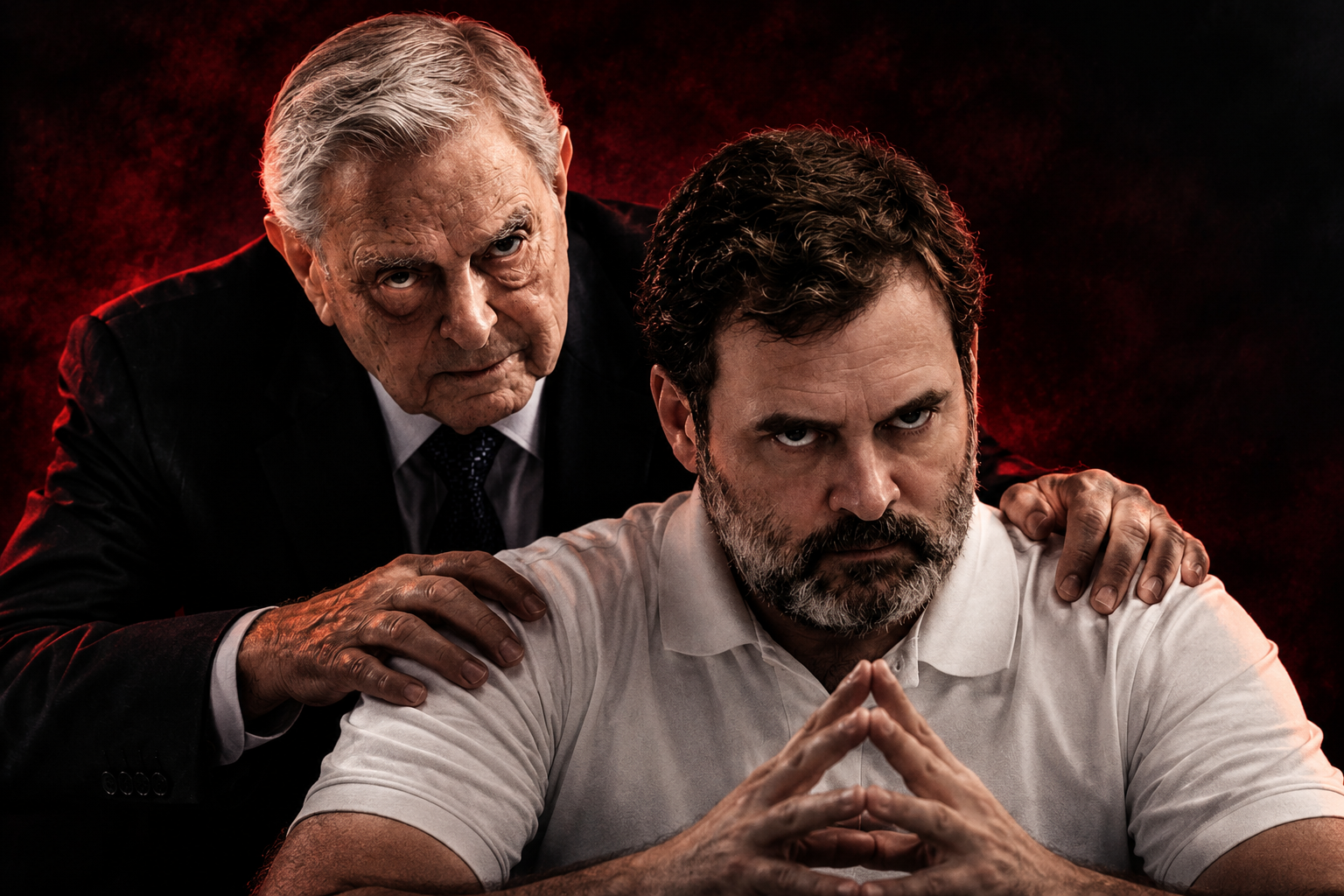
Goa: India’s political battles are no longer confined to Parliament, election rallies or television studios. They are being fought through courtrooms, social media campaigns, international advocacy networks and competing narratives about the credibility of the country’s institutions. At the centre of this increasingly complex contest lies a serious question: Are these developments independent expressions of democratic dissent, or do identifiable links exist between domestic political campaigns and international networks seeking to influence India’s political trajectory?
The question becomes particularly contentious when the legal interventions of activist-lawyer Prashant Bhushan, the Congress party’s sustained criticism of constitutional institutions and the international activities of organisations associated with billionaire philanthropist George Soros are examined within the same political debate.
Critics of the ruling establishment have repeatedly challenged the suggestion that these developments form part of a wider effort to destabilise India. But the opposite claim—that they constitute a coordinated, foreign-funded operation, also requires evidence capable of establishing the connections.
The stakes are considerable. If coordination and unlawful foreign interference can be demonstrated, the country deserves a full account of how the network operates, who finances it and what objectives it pursues. If the alleged links cannot be established, political proximity and ideological alignment cannot be presented as proof of a conspiracy.
Prashant Bhushan and Rahul Gandhi: Parallel Campaigns, Common Battlegrounds?
Prashant Bhushan’s legal activism and Rahul Gandhi’s political campaigns have, at different times, brought questions concerning electoral transparency, institutional independence and government accountability into the public domain.
Bhushan has pursued legal challenges and publicly criticised aspects of government functioning. Rahul Gandhi and the Congress have similarly raised questions about electoral processes, constitutional institutions and the conduct of the BJP-led government.
Their activities operate through different channels. One involves legal proceedings and public-interest litigation; the other involves political mobilisation, parliamentary opposition and public campaigning.
Yet both can influence the same arena: public confidence in institutions responsible for governing the country.
That overlap is politically significant, but it does not, by itself, establish a pre-planned script or direct coordination between the two.
The critical questions are more specific. Have particular campaigns been coordinated? Is there documentary evidence of shared planning, common funding or organised communication? Have legal proceedings and political messaging been deliberately synchronised by identifiable actors?
If evidence answers those questions affirmatively, the relationships deserve close examination. If not, similarities in criticism must not be mistaken for proof of operational coordination.
The issue is not whether government critics are entitled to challenge institutions. It is whether any identifiable network is coordinating political and legal activity through concealed relationships or unlawful funding.
That is a question for evidence-driven investigation, not political assumption.
George Soros and the Foreign Funding Question
George Soros and his Open Society Foundations have become recurring subjects in India’s political debate over foreign influence. His philanthropic network supports civil society initiatives and advocacy work internationally, while critics have questioned the political implications of such funding.
Those questions deserve scrutiny. International funding can influence the priorities, capacity and reach of organisations working on public policy and institutional reform. Transparency about donors, recipients and the purposes for which money is used is therefore essential.
But the distinction between documented philanthropy and alleged political interference must remain clear.
To establish that a foreign billionaire or foundation financed a campaign intended to weaken Indian institutions, investigators would need evidence tracing the funding to the relevant recipients and activities, alongside evidence demonstrating the purpose and nature of the intervention.
To establish a connection between such funding and Rahul Gandhi’s political campaigns or Bhushan’s legal interventions would require further evidence linking the individuals, organisations or operations involved.
A funding relationship must be demonstrated, not inferred from a shared political position.
If financial records, communications or investigative findings establish such links, they should be brought into the public domain. If organisations have violated India’s foreign-funding laws, the authorities should act in accordance with the law.
The question of foreign influence is too serious to be settled by either blanket dismissal or sweeping accusation.
From Courtrooms to Campaigns: How Influence Can Travel
Political influence does not always require a single organisation to direct every participant. In a connected information environment, research organisations, advocacy groups, legal campaigns, political parties and media platforms can amplify similar arguments through different channels.
A legal challenge can generate public debate. Political leaders can cite concerns raised in that debate. Media coverage can carry the arguments to wider audiences, while international organisations may assess or comment on the resulting controversy.
Such a sequence can produce a powerful political narrative. However, a sequence of events is not proof that the participants are working from a common plan.
The distinction is crucial when examining claims of a coordinated campaign against India’s institutions.
Investigators would need to establish whether the apparent convergence reflects independent activity or identifiable coordination. Relevant evidence could include financial transactions, communications, shared operational planning, undisclosed relationships or other verifiable links.
Without such evidence, claims of a unified command structure remain allegations. With credible evidence, the case for investigation becomes substantially stronger.
The objective should be to establish the facts behind the network—not simply to construct a narrative from the names of people who have criticised the government.
Why India’s Economic Rise Is Part of the Debate
India’s expanding economic and geopolitical influence has made its domestic stability, regulatory environment and institutional credibility matters of international interest.
Political uncertainty and declining institutional trust can affect public confidence, investment decisions and perceptions of economic risk. That makes the question of foreign interference relevant to the country’s long-term interests.
However, criticism of the government does not automatically undermine economic growth, just as every international advocacy campaign cannot be presumed to have an anti-India objective.
The real concern is whether any actors are deliberately using covert funding, disinformation or unlawful coordination to damage institutional credibility or disrupt legitimate constitutional processes.
If that conduct can be established, it warrants a serious response. The government must protect India’s sovereignty while ensuring that investigations are based on evidence and conducted under the law.
A confident democracy should be capable of defending itself against genuine interference without treating every critic as an adversary.
The Bottom Line: Follow the Funding, Establish the Links
The convergence of activist-led legal challenges, Congress campaigns and international debates about Indian democracy raises questions that deserve careful examination. But establishing that these activities form part of a foreign-funded operation requires more than ideological similarities, overlapping criticisms or political suspicions.
The decisive evidence would lie in the relationships themselves: who financed whom, which activities were supported, whether campaigns were coordinated, and whether any identifiable actor sought to influence Indian institutions through unlawful means.
If the evidence establishes a coordinated operation involving foreign funding and domestic political actors, the public deserves to know the full chain of responsibility. No individual, organisation or political party should be shielded from lawful scrutiny.
But the standard must be equally clear: allegations cannot substitute for proof, and political disagreement cannot automatically be classified as subversion.
India must follow the money, examine the communications and establish the connections. If there is a network working to undermine the country’s institutions, expose it through evidence. If the alleged connections do not withstand scrutiny, the public deserves that truth as well.
Because defending India’s sovereignty demands more than identifying an enemy. It demands establishing, beyond political rhetoric, who is actually working against the country’s interests and what evidence proves it.