


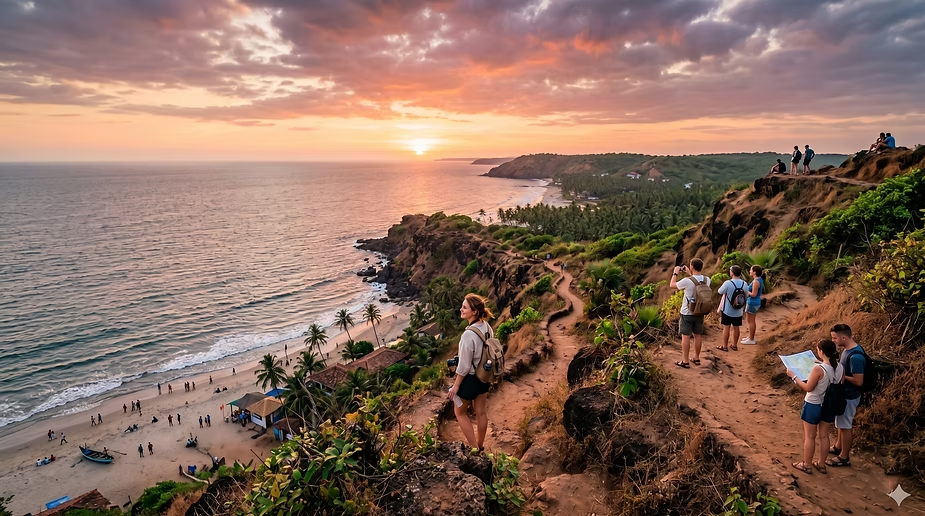
There was a time when conversations about Goa’s tourism revolved around beaches, nightlife and holiday memories. Today, another story is quietly unfolding behind the scenes; one that begins not at the shoreline but on highways, bridges, airports and transport corridors. Modern tourism is increasingly dependent on accessibility, reliability and mobility. For a destination that welcomes millions of visitors every year, the journey has become almost as important as the destination itself. Goa’s recent tourism performance suggests that investments in connectivity are creating an ecosystem capable of supporting sustained growth rather than merely seasonal popularity.
The latest figures released by the Department of Tourism, Government of Goa, underline the scale of that growth. In 2025, the state recorded 1,08,02,410 tourist arrivals, comprising 1,02,84,608 domestic visitors and 5,17,802 international visitors, the highest annual total reported by the state to date. The significance of this milestone lies not merely in crossing the one-crore mark but in demonstrating a consistent recovery and expansion after the disruption caused by the pandemic. The numbers indicate that Goa has moved beyond recovery and entered a new phase of tourism growth driven overwhelmingly by domestic demand while international arrivals continue their gradual revival.
Looking at the trend over several years tells an even more compelling story. Official statistics show that Goa welcomed approximately 77.86 lakh tourists in 2017, followed by 80.15 lakh in 2018 and 80.64 lakh in 2019 before global travel restrictions disrupted the sector. The post-pandemic rebound has been significant, with 86.28 lakh visitors in 2023, 1.04 crore in 2024, and 1.08 crore in 2025. Rather than a one-year spike, the figures reflect a sustained upward trajectory that suggests structural improvements in the tourism ecosystem.
Infrastructure plays an important role in that ecosystem because tourism depends on the ease with which people can reach a destination and move within it. A traveller deciding between competing destinations often evaluates travel time, road quality, airport connectivity and overall convenience. For Goa, whose economy is closely linked to tourism and hospitality, reducing transport bottlenecks has implications that extend far beyond visitor comfort. Better connectivity improves logistics for hotels and restaurants, supports local businesses, enhances commuting for residents and strengthens investor confidence.
Perhaps the most visible symbol of this transformation is the New Zuari Bridge, also known as Manohar Setu. Carrying NH-66 across the Zuari River and linking North and South Goa, the cable-stayed bridge was inaugurated in phases between December 2022 and December 2023. At approximately 640 metres in length, it is among India’s longest cable-stayed bridges and was developed under the National Highways Authority of India. Its primary objective was to decongest the older bridge and improve the movement of passenger and freight traffic across one of Goa’s busiest transport corridors.
It is important, however, to distinguish between evidence and assumption. There is currently no official study demonstrating that the New Zuari Bridge by itself caused Goa’s tourism numbers to rise. Such a claim would oversimplify a complex economic phenomenon. Tourism depends on multiple variables including marketing, airline capacity, accommodation supply, economic conditions, traveller preferences and government policy. What can reasonably be concluded is that improved infrastructure reduces friction in travel and strengthens the state’s ability to accommodate growing visitor numbers. In economic terms, infrastructure increases capacity; it does not operate in isolation.
The expansion of air connectivity provides another illustration of this broader transformation. The operationalisation of Manohar International Airport at Mopa added a second international airport to the state alongside Dabolim, increasing network resilience and expanding opportunities for airlines and travellers. Official tourism data shows that in 2025, 1,784 international scheduled flights operated through the two airports 643 through Dabolim and 1,141 through Mopa carrying 2,35,798 foreign tourists. The existence of two functioning gateways distributes passenger traffic and offers greater flexibility for airlines and tourism operators.
The composition of Goa’s tourism market is also changing. The latest data shows that domestic travellers account for the overwhelming majority of visitors, with more than 1.02 crore domestic tourists compared to 5.17 lakh international tourists in 2025. This demonstrates that Goa’s growth is increasingly anchored in the expanding Indian travel market. Rising incomes, improved road and air connectivity, flexible work patterns and the popularity of short-duration leisure trips have collectively strengthened domestic tourism, making it a powerful stabilising force for the state’s economy.
The growth of tourism in Goa should therefore be understood not as the success of a single project but as the cumulative effect of multiple investments in public infrastructure. Roads, bridges, airports, utilities and urban services form the backbone of a visitor economy. A traveller who lands at an airport, drives on a modern highway, crosses a congestion-free bridge and reaches a hotel on time experiences a seamless journey that quietly shapes their perception of the destination. While these improvements may appear ordinary to residents who use them every day, they significantly influence tourism competitiveness when compared with other destinations across Bharat and abroad.
The New Zuari Bridge is a notable example of infrastructure designed primarily to solve a mobility challenge. For decades, the old Zuari Bridge served as one of the most critical links between North and South Goa, carrying commuters, freight vehicles and tourists along National Highway 66. As traffic volumes increased, congestion became a recurring issue, particularly during peak travel periods and holiday seasons. The new cable-stayed bridge was conceived to add capacity, improve safety and ensure uninterrupted movement along one of the state’s busiest corridors. By reducing bottlenecks, it supports not only tourism but also daily economic activity for residents, logistics operators and businesses.
From an economic perspective, infrastructure functions as an enabler rather than a direct generator of demand. Economists often describe transport infrastructure as reducing the “cost of distance.” Better roads shorten travel times, airports increase accessibility, and bridges remove physical constraints on movement. When these elements come together, they lower the overall cost and inconvenience of travel, making a destination more attractive to visitors and investors alike. Goa’s experience over the last few years reflects this principle. Record tourist arrivals have coincided with expanded aviation capacity, improved highway connectivity and modern transport infrastructure that collectively increase the state’s ability to accommodate larger visitor volumes.
Another important aspect of Goa’s tourism performance is diversification. Historically, the state was known internationally for its beaches and seasonal charter tourism. Today, tourism is increasingly spread across multiple segments including family holidays, wellness tourism, weddings, meetings and conferences, culinary experiences, adventure tourism, hinterland exploration and cultural festivals. This diversification reduces dependence on any single market and creates opportunities for tourism throughout the year rather than during a limited peak season. Better connectivity plays a critical role in enabling this shift because it allows visitors to travel more conveniently across different regions of the state.
Cruise tourism has also emerged as an area of growing interest. According to the Department of Tourism, Goa recorded cruise passenger movement through both domestic and international services, adding another dimension to its visitor economy. Cruise tourism introduces a different category of traveller who contributes to local transport, shopping, food services and sightseeing activities. While the volume remains smaller than conventional tourism, it demonstrates the state’s efforts to diversify its tourism portfolio and leverage its coastal geography.
The benefits of tourism extend far beyond hotels and beach shacks. Every additional visitor generates demand across a network of local enterprises that includes taxi operators, restaurants, handicraft sellers, event organisers, tour guides, photographers, water sports operators, retail outlets and countless small businesses. Tourism spending circulates through the local economy, supporting employment and entrepreneurship in both urban centres and rural communities. This multiplier effect explains why infrastructure investments that facilitate tourism can have broader developmental implications. When travel becomes easier, economic opportunities expand across multiple sectors.
Official and independent economic assessments have consistently recognised tourism as one of Goa’s major economic pillars. The India Brand Equity Foundation has estimated that tourism contributes approximately 16.43% of the state’s Gross State Domestic Product, while also supporting a substantial share of employment directly and indirectly. Although precise employment estimates vary across studies, the broader conclusion remains clear: tourism is not merely a leisure industry but a significant contributor to Goa’s economic ecosystem. Strengthening the infrastructure that supports this sector therefore has implications for growth, investment and livelihoods.
At the same time, growth brings responsibilities. Increased tourist arrivals place additional pressure on roads, water resources, waste management systems, beaches and public services. Infrastructure expansion must therefore be accompanied by sustainable planning. Goa’s long-term success will depend not only on attracting more visitors but also on ensuring that development preserves the environmental and cultural assets that make the state unique. Modern governance increasingly requires balancing economic growth with ecological resilience and quality of life for residents.
This balance is particularly relevant because today’s travellers are increasingly conscious of sustainability, cleanliness and authentic local experiences. Global tourism trends indicate that visitors value destinations that combine accessibility with environmental responsibility. Investments in better public transport, waste management, heritage conservation and water infrastructure can therefore enhance both resident welfare and tourism competitiveness. Infrastructure should be viewed as part of a broader ecosystem that supports sustainable development rather than simply as isolated construction projects.
Looking ahead, Goa’s challenge is not merely to maintain high visitor numbers but to improve the quality and value of tourism. Higher spending per visitor, longer average stays and wider geographic distribution of tourism can generate greater economic benefits without necessarily relying on unlimited growth in arrivals. Better connectivity supports this objective by making hinterland attractions, cultural circuits and emerging destinations more accessible, encouraging visitors to explore beyond traditional coastal areas.
Ultimately, the story of Goa’s infrastructure is not a story about concrete and steel; it is a story about connectivity. The New Zuari Bridge, Manohar International Airport, improved highway networks and expanding transport links represent investments that enhance the state’s capacity to move people efficiently. The official tourism figures for 2025 1,08,02,410 visitors demonstrate that Goa continues to attract travellers at record levels. While it would be inaccurate to attribute this achievement to any single project, it is reasonable to conclude that modern infrastructure has strengthened the foundation on which tourism growth can be sustained.
For Goa, every bridge shortens a journey, every airport connection expands opportunity and every improvement in mobility strengthens the state’s ability to compete in an increasingly dynamic tourism economy. The evolution of Goa’s tourism story is therefore not only about where people choose to holiday but also about how strategic investments in connectivity are helping shape the future of one of Bharat’s most important visitor destinations.