


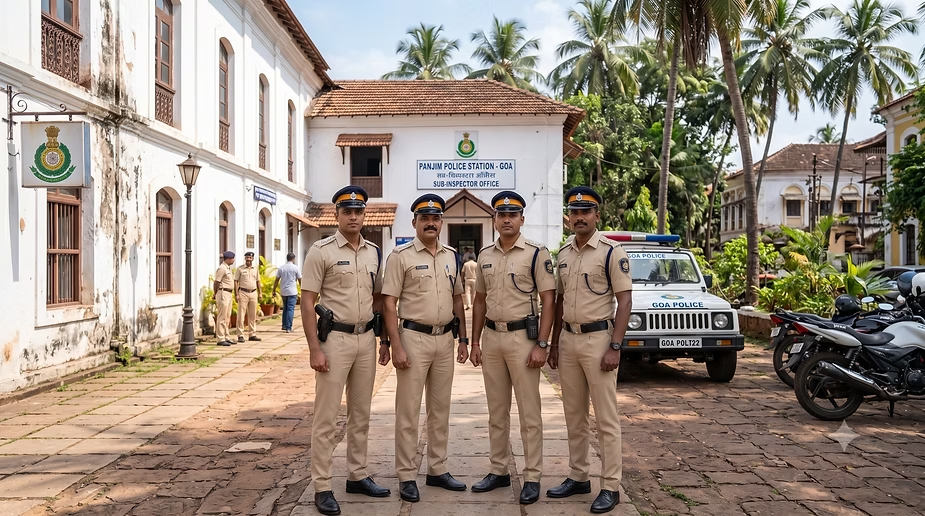
When governments speak about governance reforms, the discussion often revolves around major infrastructure projects, welfare schemes, investment announcements or policy changes. Yet some of the most important reforms are those that quietly strengthen public institutions. The recent issuance of offer letters to 126 Police Sub-Inspector (PSI) candidates in Goa is one such example. While the event itself marked the beginning of professional careers for 126 young Goans, the larger story lies in what the recruitment process represents: the strengthening of transparent, merit-based public recruitment through institutional reform.
The Goa Government recently issued offer letters to 126 candidates selected for the post of Police Sub-Inspector through the Staff Selection Commission recruitment process. The selected batch includes 121 male candidates and 5 female candidates, all of whom will undergo structured training in Delhi before formally joining the Goa Police Force. The appointments are expected to enhance policing capacity while supporting the state’s broader objective of building a modern, professional and citizen-focused law enforcement system.
However, the significance of the recruitment exercise extends far beyond the numbers. The appointment of 126 new officers is a visible outcome of a governance philosophy that seeks to reduce discretion, increase transparency and institutionalise meritocracy within public sector recruitment. Speaking during the distribution of offer letters, Chief Minister Dr. Pramod Sawant stated that the recruitment process had been conducted through a fully transparent and merit-based mechanism under the Staff Selection Commission framework. He emphasized that the system was designed to provide fair opportunities to Goa’s youth while ensuring that public institutions receive capable and deserving candidates.
Across Bharat, recruitment to government services has historically been one of the most closely watched functions of governance. Public employment carries significant social and economic value, particularly among young graduates seeking stable careers and opportunities for professional advancement. As a result, the credibility of recruitment systems directly influences public trust in government institutions. Citizens are more likely to have confidence in governance when recruitment is perceived as fair, competitive and transparent.
This is precisely where institutional mechanisms such as the Goa Staff Selection Commission assume importance. The Commission was established with the objective of creating a structured recruitment framework that minimizes subjectivity and maximizes accountability.
Rather than relying on fragmented or department-specific selection processes, recruitment can be conducted through standardized procedures designed to ensure equal opportunity for all eligible candidates. According to the Chief Minister, the establishment and strengthening of the Commission reflects the government’s commitment to transparent and merit-based recruitment across sectors.
The selection of Police Sub-Inspectors is particularly significant because policing remains one of the most visible interfaces between citizens and the state. Every traffic management operation, crime investigation, law-and-order deployment and community outreach programme ultimately depends on the competence and professionalism of police personnel. Recruitment therefore becomes the first step in determining the future quality of policing services.
Goa has witnessed rapid social and economic transformation over the past decade. Increased tourism, rising urbanisation, expanding infrastructure and growing economic activity have created new policing challenges. Law enforcement agencies today are expected not only to maintain public order but also to handle cybercrime, financial fraud, tourism-related incidents, narcotics control, traffic management and disaster response. Modern policing requires officers who are physically fit, professionally trained and capable of adapting to evolving challenges.
The induction of 126 new PSI recruits contributes directly to this objective. Sub-Inspectors serve as frontline leadership personnel within the police hierarchy. They supervise investigations, coordinate operational activities, interact with citizens and implement law enforcement responsibilities at the ground level. Their performance has a direct impact on the efficiency and effectiveness of policing outcomes. By recruiting candidates through a structured competitive process, the state aims to strengthen the quality of leadership entering the force.
Equally important is the message this sends to aspiring candidates across Goa. A transparent recruitment framework encourages young people to invest in skill development, academic preparation and competitive examination performance. When candidates believe that selection depends primarily on merit, they are more likely to dedicate time and effort towards achieving success through legitimate means. This creates a virtuous cycle where talent, preparation and performance become the primary determinants of career advancement.
Chief Minister Dr. Pramod Sawant highlighted this aspect while encouraging youth to prepare for competitive examinations conducted by institutions such as the Goa Public Service Commission and the Goa Staff Selection Commission. His remarks underscored the government’s broader emphasis on skill development and competitive readiness among young Goans.
The governance significance of this approach extends beyond police recruitment. Transparent recruitment systems contribute to institutional capacity across departments. Whether in engineering services, administration, healthcare, education or law enforcement, the quality of public service delivery depends heavily on the quality of personnel entering government service. Merit-based recruitment creates a foundation upon which effective governance can be built.
Public administration experts often note that institutions become stronger when systems are designed to function independently of individual discretion. In practical terms, this means creating processes that are predictable, standardized and accountable. Recruitment commissions serve this purpose by establishing clear procedures, objective evaluation mechanisms and transparent selection criteria. Such systems help reduce uncertainty while improving confidence among applicants and the public.
For Goa, a state with a relatively young and educated population, transparent recruitment carries additional importance. Thousands of young people compete annually for opportunities in government service. A trusted recruitment framework can help ensure that aspirations are channelled into productive preparation rather than uncertainty. This not only benefits individual candidates but also contributes to social stability and confidence in public institutions.
The recruitment of 126 Police Sub-Inspectors also aligns with broader efforts to modernise governance in Goa. Contemporary governance increasingly focuses on outcomes rather than intentions. Citizens evaluate governments based on tangible improvements in service delivery, institutional responsiveness and administrative efficiency. Recruitment reforms, while less visible than roads or buildings, play a crucial role in achieving these outcomes because human resources ultimately drive institutional performance.
Another notable aspect of the recruitment exercise is the inclusion of women among the selected candidates. Although the batch comprises predominantly male recruits, the presence of women officers reflects the continuing expansion of opportunities within policing. Gender diversity in law enforcement contributes to broader representation and can enhance the ability of police organisations to engage with diverse communities.
The selected candidates will now proceed for structured professional training in Delhi before joining active service. Training serves as the bridge between recruitment and performance. It equips recruits with legal knowledge, operational skills, leadership capabilities and professional ethics necessary for effective policing. The combination of merit-based selection and structured training is intended to produce officers capable of meeting contemporary policing demands.
The event was attended by senior government and police officials, including Chief Secretary Dr. V. Candavelou, Director General of Police Alok Kumar and Inspector General of Police K.R. Chaurasia, highlighting the importance attached to the recruitment process by the state’s administrative and law enforcement leadership.
Ultimately, the story of these 126 appointments is not merely about employment generation. It is about institution building. Strong institutions are created when recruitment is fair, training is rigorous and public service is guided by accountability. Every transparent recruitment process reinforces the principle that opportunities should be earned through merit and dedication.
For the newly selected candidates, the offer letters represent the beginning of a demanding professional journey. For Goa’s youth, they represent proof that competitive preparation can translate into meaningful opportunities. For citizens, they represent an investment in stronger policing and better public services. And for governance, they represent the continuing evolution of systems designed to strengthen trust between the state and the people it serves.
The recruitment of 126 Police Sub-Inspectors may appear at first glance to be a routine administrative exercise. In reality, it reflects a larger transformation in the way public institutions are being strengthened. By placing transparency, merit and accountability at the centre of recruitment, Goa is reinforcing the foundations upon which effective governance is built. The appointment letters handed over this week therefore symbolize much more than individual success stories. They symbolize confidence in institutions, trust in fair processes and a vision of governance where opportunity is determined by merit.