


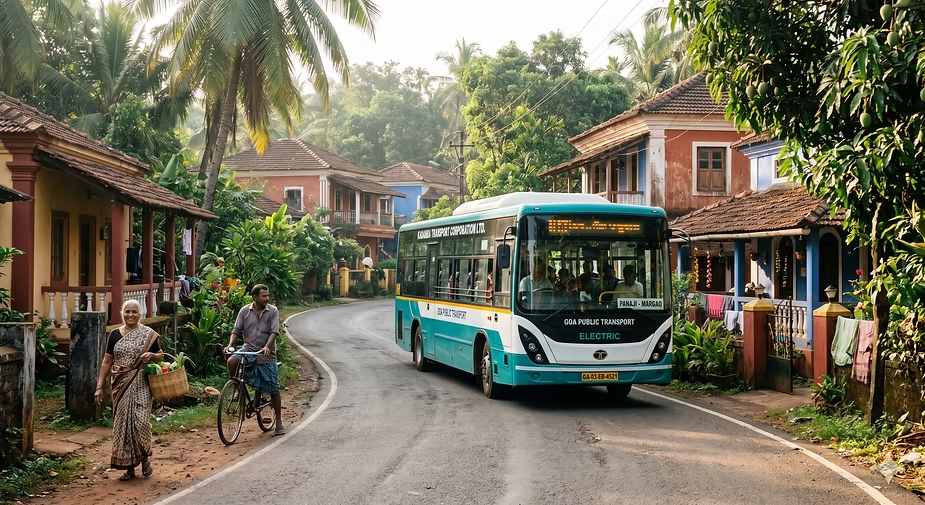
For many villages across Goa, public buses are more than just transportation. They are daily lifelines connecting people to schools, colleges, markets, hospitals, offices, and towns. In rural regions especially, Kadamba Transport Corporation Limited (KTCL) buses remain one of the most important and accessible forms of public mobility for thousands of residents every single day.
Now, Goa’s public transport system is beginning to move towards a cleaner and more environmentally conscious future.
The introduction of new Kadamba buses, including electric vehicles (EVs), across rural routes marks an important shift in how public transport infrastructure is evolving within the state. While the upgrade may appear modest at first glance, its long-term impact could extend far beyond transportation alone.
The focus is no longer only on moving people from one place to another. Increasingly, the conversation is also about how transportation affects the environment, fuel consumption, air quality, and the everyday quality of life within local communities.
For rural Goa, this transition towards cleaner buses carries special significance.
Many village routes pass through narrow roads, residential communities, agricultural areas, and ecologically sensitive zones where excessive vehicle pollution and noise can directly affect daily life. Traditional diesel-heavy transport systems often contribute to smoke emissions, engine noise, and environmental stress, especially in areas where natural surroundings remain closely integrated with residential life.
Electric buses offer a different model.
With zero tailpipe emissions and significantly lower operational noise, EV buses can reduce both visible pollution and sound disturbance across village routes. The difference may not always appear dramatic immediately, but over time quieter and cleaner transport systems can noticeably improve local commuting environments.
For passengers, this also changes the travel experience itself.
Electric buses generally provide smoother acceleration, lower vibration, and quieter interiors compared to conventional diesel vehicles. In rural areas where people often travel longer distances daily for work, education, and essential services, even small improvements in comfort and noise reduction can make public transport feel significantly better.
The environmental importance of the shift is equally significant.
Transportation remains one of the largest contributors to urban and regional emissions globally. As governments across Bharat increasingly focus on sustainable infrastructure and cleaner mobility systems, public transport electrification has become a major policy direction.
Goa’s move towards introducing EV buses on village routes aligns with this broader transition towards low-emission public transportation.
Importantly, public buses have a multiplier effect when it comes to environmental benefits. A single bus carrying dozens of passengers reduces the number of individual vehicles on the road, helping lower overall traffic movement, fuel consumption, and emissions simultaneously.
When that bus itself becomes electric, the environmental gains become even greater.
For Goa, where environmental preservation remains deeply connected to both identity and economy, cleaner transport infrastructure carries additional importance. The state’s villages, greenery, biodiversity, and ecological balance are central not only to local life but also to tourism and long-term sustainability.
Reducing smoke emissions and noise pollution within these environments therefore becomes part of a larger effort to protect Goa’s natural character while still improving connectivity and mobility.
The upgrade also reflects changing expectations from public transport systems themselves.
Modern commuters increasingly expect transportation to be cleaner, quieter, more comfortable, and environmentally responsible. Public infrastructure is no longer judged only by availability, but also by sustainability and user experience.
By introducing EV buses into rural operations, KTCL appears to be gradually aligning with this evolving expectation.
At the same time, the initiative highlights an important governance approach: improving rural infrastructure instead of concentrating only on urban centres.
Public discussions around modernisation often focus heavily on cities, airports, highways, or large urban projects. However, for many ordinary citizens, smaller improvements in daily transport systems create far more direct and meaningful impact.
Reliable village bus connectivity affects education access, work opportunities, healthcare access, and mobility for senior citizens, students, and working families. Cleaner buses therefore contribute not only to sustainability goals but also to everyday quality of life.
The emphasis on quieter transport is especially relevant in rural settings.
Noise pollution is often underestimated despite having a direct impact on stress levels, community comfort, and environmental quality. Electric buses help reduce engine-heavy sound levels that are common with conventional diesel transport, making village routes feel calmer and less disruptive.
This becomes particularly important in residential and ecologically sensitive areas where maintaining environmental balance matters deeply to local communities.
The transition towards EV public transport also supports Bharat’s larger mobility and energy goals.
Across the country, governments are increasingly encouraging electric mobility to reduce fuel dependency, improve air quality, and strengthen sustainable infrastructure systems. Public transport electrification forms a major part of this transition because buses move large numbers of people daily and therefore create meaningful environmental impact at scale.
Goa’s EV bus rollout, even at a smaller regional level, contributes to this wider national movement towards cleaner mobility.
Importantly, such projects also influence public perception and behavioural acceptance around electric mobility itself. As more people begin using EV buses in everyday life, electric transport gradually becomes normalised rather than viewed as experimental or limited to premium urban spaces.
That public familiarity can eventually support broader adoption of electric mobility across other sectors as well.
For younger commuters especially, cleaner public transport increasingly represents the kind of infrastructure expected from future-ready governance. Sustainability is no longer seen only as an environmental issue but also as a quality-of-life issue connected to health, convenience, and long-term urban planning.
The symbolism of EV buses running through Goa’s villages is therefore quite powerful.
It reflects the idea that sustainability and development do not have to remain limited to large cities or elite infrastructure projects. Cleaner technology can also improve ordinary daily life in smaller communities and rural routes.
At the same time, the success of such initiatives will depend on operational consistency, maintenance standards, charging infrastructure, route efficiency, and long-term investment in public transport quality.
Introducing cleaner buses is only one step. Building a reliable and sustainable rural transport ecosystem requires continued planning and support over time.
Nevertheless, the direction itself is significant.
Goa’s villages are not simply receiving more buses.
They are gradually becoming part of a larger transition towards cleaner mobility, quieter transport, and more sustainable public infrastructure.
Sometimes, progress is not always visible through massive projects alone.
Sometimes, it arrives quietly — through a cleaner bus passing through a village road without smoke, without noise, and with the promise of a greener future for the communities it connects.