


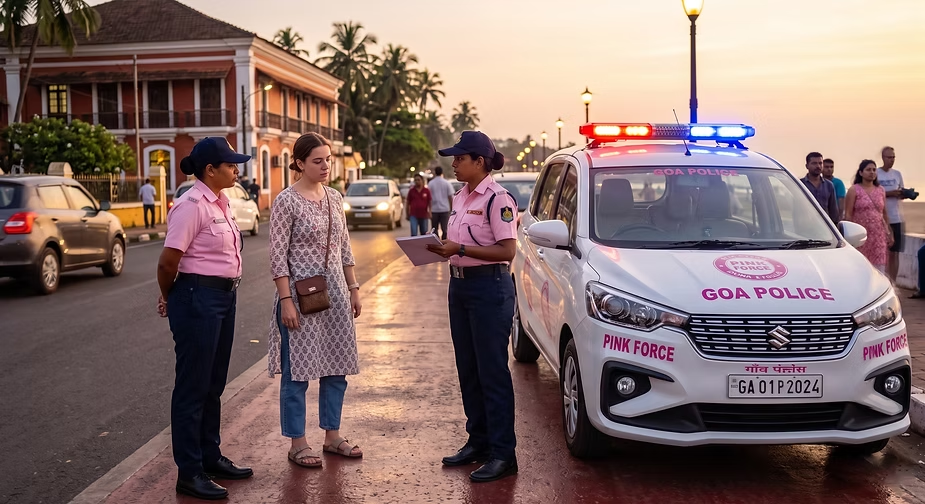
A city reveals its true character not during festivals or tourist seasons, but during moments of crisis. It reveals itself in the minutes between a distress call and the arrival of help. It reveals itself in whether frightened citizens feel abandoned, judged, ignored or protected. On a tense evening overlooking the Mandovi River, a young woman stood dangerously close to the edge of the Old Patto bridge holding her infant child. Witnesses later described the silence around her as deeply unsettling. It was the kind of moment where hesitation could become an irreversible tragedy within seconds. Then a call was placed to the police control room.
Within minutes, a patrol vehicle arrived. But what unfolded next was not the aggressive, chaotic emergency response many people associate with policing. Female officers stepped out calmly. They approached slowly, speaking gently, maintaining distance, carefully reading the emotional state of the distressed mother before engaging further. There were no loud confrontations. No intimidation. No panic.
The officers listened. They de-escalated. They were reassured.
Two lives were saved that night.
Across Goa today, stories like these are becoming increasingly associated with one specialized policing initiative quietly transforming public safety across the state, the Pink Force. Operating as a dedicated women-led emergency response unit under the Goa Police, the Pink Force has evolved into one of the most visible examples of trauma-informed policing in India. Built specifically around women and child safety, the unit has already responded to nearly 19,000 emergency calls, intervening in situations ranging from harassment and stalking to domestic violence, mental health crises, public distress, and immediate threats to life.
But the true significance of the Pink Force lies not merely in the number of calls handled. It lies in how Goa is redefining what emergency response itself can look like.
Why Goa Needed a Different Kind of Policing Model
Goa occupies a uniquely complex position in India’s social and policing landscape. It is simultaneously a deeply rooted local society and one of the country’s largest international tourism destinations. Millions of domestic and foreign tourists move through the state annually. Solo female travelers, hospitality workers, nightlife economies, beach tourism, student populations, and migrant workforces all intersect within relatively compact urban and coastal zones. Traditional policing frameworks were never fully designed for these layered realities.
In many situations involving women in distress, victims often hesitated to seek help due to fear of judgment, embarrassment, procedural complexity, or intimidation. Cases involving domestic abuse, harassment, stalking, or psychological trauma frequently require more than rapid deployment. They require emotional intelligence, de-escalation capability, and psychological sensitivity.
The Pink Force emerged as a response to this gap.
Designed as a dedicated women-centric policing initiative, the unit was strategically deployed across vulnerable urban zones, coastal belts, nightlife districts, and high-tourism corridors where women frequently required immediate support. Unlike standard policing patrols focused primarily on law enforcement visibility, the Pink Force was conceptualized around accessibility and trust.
The message was simple: help should not feel frightening.
Understanding the Scale: Nearly 19,000 Emergency Responses
The numbers surrounding the Pink Force are extraordinary by any policing benchmark.
According to available operational data, the unit has responded to approximately 18,947 emergency calls since its scaling across Goa. These responses include interventions related to harassment, domestic violence, psychological distress, abandoned children, missing persons, public threats, unsafe transit situations, and emergency assistance requests from tourists.
Importantly, the high number of calls should not be interpreted solely as a crime statistic. In criminology and public safety studies, increased reporting often signals increased trust in institutional response systems. Women are more likely to seek help when they believe intervention will be timely, respectful, and effective.
That trust appears to be growing steadily in Goa.
The Pink Force today functions not merely as a policing unit, but as a highly visible reassurance mechanism integrated directly into public life. Patrol vehicles positioned near beaches, urban junctions, nightlife districts, isolated roads, and crowded public areas create a persistent sense of institutional presence. And in emergency response psychology, presence itself can prevent escalation before crimes even occur.
Beyond Speed: The Rise of Trauma-Informed Policing
Modern policing debates increasingly recognize that response quality matters as much as response time.
Historically, emergency policing models prioritized rapid containment and command authority. While effective in many criminal situations, these methods often proved counterproductive in emotionally sensitive cases involving trauma victims, domestic violence survivors, suicidal individuals, or women experiencing psychological distress.
The Pink Force represents a shift toward trauma-informed policing. Personnel receive training extending beyond conventional enforcement protocols. Officers are specifically trained in de-escalation techniques, psychological first aid, crisis communication, victim-sensitive interviewing, and emergency emotional stabilization. This training dramatically changes the nature of interactions between officers and vulnerable individuals.
For example, domestic violence interventions require separating victims from aggressors without escalating volatile emotional environments. Suicidal intervention requires officers to reduce panic rather than intensify pressure. Harassment victims often require reassurance and emotional validation before procedural action begins.
The Pink Force operates on the understanding that emotional safety is inseparable from physical safety.
This is particularly significant for women and children experiencing acute distress. Research in trauma psychology consistently shows that calm body language, soft communication, predictable movement, and non-threatening engagement significantly improve cooperation and reduce psychological shock during crisis response.
In practical terms, this means the first few minutes of interaction can determine whether victims feel protected or retraumatized.
Tourism, Women’s Safety, and Goa’s Public Image
Women’s safety today carries enormous implications not just socially, but economically.
Goa’s tourism economy depends heavily on perceptions of accessibility, comfort, and public confidence. Solo female travelers, international tourists, digital nomads, hospitality workers, and long-stay visitors increasingly evaluate destinations based on safety ecosystems rather than scenic value alone.
The visibility of the Pink Force directly contributes to this perception architecture.
A woman walking through Panaji late in the evening, traveling alone through Calangute, navigating nightlife zones in Anjuna, or driving through isolated roads near Morjim experiences the environment differently when she knows specialized emergency support exists within minutes.
This psychological transformation matters deeply.
Safety is not merely the statistical absence of crime. It is the reduction of fear. It is the confidence that if something goes wrong, competent help will arrive quickly and respectfully.
That confidence fundamentally changes how public spaces are experienced.
Building a Larger Women’s Safety Ecosystem
The Pink Force operates within a broader governance framework increasingly focused on women’s safety and institutional responsiveness across Goa.
The state has simultaneously expanded women-focused policing infrastructure through dedicated women police stations operating in both North and South Goa. These stations provide female-led environments for reporting sensitive crimes involving domestic abuse, harassment, assault, and exploitation.
Goa has also consistently maintained strong performance metrics on the Investigation Tracking System for Sexual Offences (ITSSO) portal monitored through the National Crime Records Bureau. The state has reportedly achieved 100% compliance in filing charge sheets within the mandated 60-day period for sexual offence investigations, reflecting emphasis on procedural speed and judicial accountability.
This matters because delayed investigations frequently weaken public confidence and discourage victims from reporting offences.
Parallel legislative initiatives are also reshaping workplace safety standards. Proposed occupational safety regulations in Goa now increasingly focus on protections for women working late-night shifts in hospitality, tourism, retail, and service industries. Employers are being encouraged or mandated to provide secure transportation, CCTV monitoring, proper lighting infrastructure, and monitored work environments.
Collectively, these systems form layered protection architecture extending from streets and workplaces to investigation and prosecution processes.
The Psychology of Presence
One of the most powerful aspects of the Pink Force is not reactive policing — it is preventive visibility.
Law enforcement experts often describe this concept as “psychological deterrence through omnipresence.” The visible movement of trained women officers through vulnerable public zones changes environmental behavior patterns. Potential offenders perceive increased risk. Women perceive increased security. Public spaces psychologically transform.
This shift becomes especially important in tourism-driven states where nightlife economies and transient populations create fluctuating risk environments. The mere visibility of specialized patrol units can significantly reduce opportunistic harassment, intimidation, and predatory behavior.
For many women, knowing help exists nearby fundamentally alters mobility patterns. It changes whether they avoid certain roads, whether they stay out later, whether they travel alone, and whether they feel entitled to occupy public space confidently.
In that sense, the Pink Force is not only responding to emergencies. It is quietly reclaiming public space itself.
The Human Side of Emergency Policing
The emotional burden carried by emergency response personnel often remains invisible.
Pink Force officers routinely enter situations involving psychological trauma, violence, family conflict, panic, intoxication-related distress, missing children, abandonment, mental health emergencies, and attempted self-harm. Unlike conventional patrol systems where enforcement dominates interaction, these officers frequently function as first responders, counselors, mediators, protectors, and emotional stabilizers simultaneously.
The cumulative emotional labor involved in such policing models is immense.
This has led to growing discussions around advanced mental health support systems for emergency personnel themselves, including periodic counseling, resilience training, psychological decompression, and occupational emotional wellness mechanisms.
As trauma-informed policing expands globally, police welfare itself is increasingly recognized as critical to sustainable compassionate policing.
Technology, Expansion, and the Road Ahead
Goa’s women’s safety framework continues to evolve.
Discussions are underway regarding upgraded patrol fleets, improved coastal mobility systems, expanded surveillance integration, advanced communication tools, and enhanced emergency dispatch coordination. There have also been conversations around strengthening cyber harassment response capacity as online abuse increasingly intersects with physical safety concerns.
Future training modules are expected to include digital crime response, child psychology, advanced negotiation techniques, and evolving behavioral threat assessment protocols.
The broader objective appears clear: move from reactive incident response toward integrated predictive public safety systems.
As Goa’s population, tourism economy, and urban complexity continue growing, the Pink Force will likely become even more central to the state’s policing identity.
A Model Other States Are Watching
Across India, discussions around women’s safety frequently focus almost exclusively on punishment frameworks — harsher sentencing, stricter laws, faster courts.
While legal accountability remains essential, Goa’s Pink Force demonstrates another equally important reality: prevention, accessibility, and trust save lives before judicial systems even become necessary.
The intervention on the Old Patto bridge illustrates this perfectly.
No law could have reversed tragedy after it occurred. What mattered was presence. Speed. Sensitivity. Human engagement.
That is the deeper lesson emerging from Goa’s experiment with trauma-informed emergency response.
The Pink Force is not simply a policing initiative. It is an institutional acknowledgment that safety is emotional as much as physical. That women in distress need empathy alongside enforcement. That trust itself can become a public safety mechanism.
And perhaps most importantly, it demonstrates that sometimes the difference between tragedy and survival is not measured in weapons, arrests, or force.
Sometimes, it is measured in whether someone kind arrives in time.