


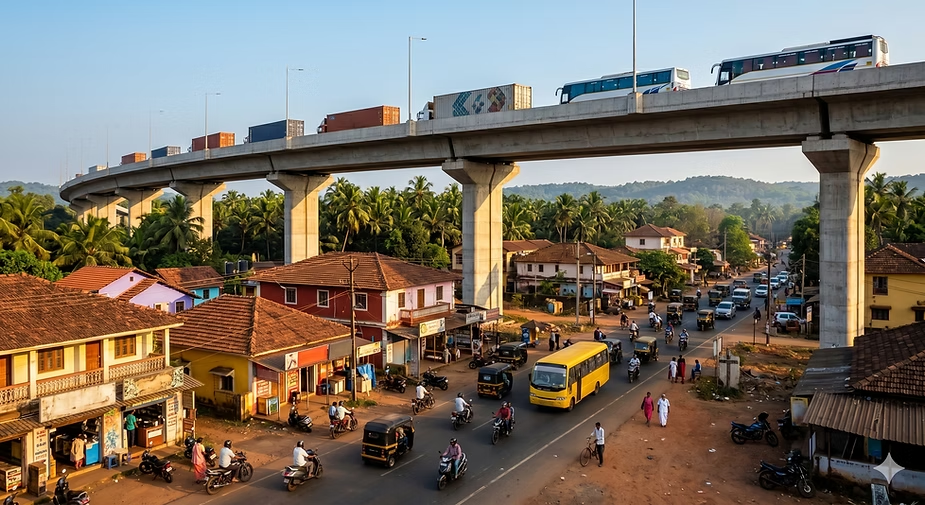
The National Highway 66 has been one of the most important roads in Goa and simultaneously one of its biggest infrastructural headaches. Every major movement across the state eventually converges onto NH-66 in some form. Tourists entering Goa by road from Mumbai, Pune, Bengaluru, or Karnataka depend on it. Interstate freight carriers transporting industrial goods and essential commodities move through it daily. Local commuters travelling between Pernem, Mapusa, Porvorim, Panaji, Margao, Cuncolim, and Canacona rely on it constantly. Businesses, hotels, restaurants, ports, logistics operators, airport passengers, and commercial supply chains all depend on the efficiency of this single corridor.
But over the years, Goa’s growth began overwhelming the highway’s original design capacity.
The state’s tourism sector expanded rapidly. Urbanization accelerated in both North and South Goa. Vehicle ownership increased dramatically. Interstate trade movement intensified along India’s western coast. Yet large stretches of NH-66 inside Goa remained narrow, congested, poorly segregated, and deeply integrated into dense local settlements.
What should have functioned as a high-speed national transport artery increasingly became a chaotic mix of freight trucks, tourist vehicles, local traffic, pedestrians, school buses, railway crossings, village junctions, and urban bottlenecks.
The consequences became visible everywhere.
Daily traffic congestion became normalized across major stretches. Accident-prone zones developed grim reputations. Interstate freight movement slowed dramatically. Railway crossings caused unpredictable delays. Pollution levels increased in residential areas located beside highway corridors. Entire towns gradually found themselves overwhelmed by traffic they were never designed to handle.
Today, however, Goa is witnessing the most ambitious highway transformation in its history.
Across the state, NH-66 is being comprehensively redesigned through elevated corridors, bypasses, four-laning projects, airport connector highways, railway overbridges, service roads, urban flyovers, and traffic segregation systems that together will fundamentally redefine mobility across Goa for decades to come.
This is no longer just about widening roads.
It is about redesigning how Goa itself functions.
The clearest example of this transformation is the newly sanctioned ₹1,880 crore Cuncolim-Bendordem NH-66 upgradation project in South Goa. For years, the Cuncolim and Balli stretch symbolized some of the worst infrastructural problems on Goa’s highway network. Massive interstate freight trucks moving between Maharashtra, Goa, and Karnataka were forced directly through dense village settlements, sharing roads with local residents, two-wheelers, school buses, pedestrians, and market traffic.
The result was daily chaos.
Traffic bottlenecks became routine. Dangerous overtakes became common. Accident-prone zones such as Uskinibandh and Panzorconi witnessed repeated fatal crashes. Residents living along the highway dealt with constant noise pollution, exhaust fumes, vibrations, and severe traffic pressure around the clock.
What made the situation especially problematic was that the highway effectively cut through the middle of local community life. Children walking to school, elderly residents crossing roads, shoppers accessing markets, and local commuters travelling short distances all had to coexist alongside high-speed interstate freight movement.
The newly approved project aims to permanently solve this conflict through one of the most ambitious traffic segregation systems ever undertaken in Goa.
At the centre of the project lies a massive 5.78-kilometre six-lane elevated corridor designed to lift long-distance highway traffic above local roads entirely. Instead of aggressively widening surface roads through demolition-heavy expansion, planners opted for a vertical mobility solution. Interstate freight vehicles, tourist buses, and through-traffic will move through the elevated skyway while local communities retain safer and less congested ground-level roads below.
The project also includes bypasses, upgraded service roads, pedestrian infrastructure, improved junction engineering, and a six-lane Railway Overbridge that will eliminate one of the corridor’s biggest causes of unpredictable delays.
This infrastructure model reflects a major philosophical shift in how highways are now being designed inside Goa. Earlier approaches often forced communities to adapt around expanding traffic movement. The new model instead redesigns traffic movement around communities.
The importance of the Cuncolim-Bendordem corridor extends beyond traffic relief alone. The project effectively completes one of the final major missing links in South Goa’s broader highway modernization effort.
Earlier this year, another major NH-66 project — the Bendordem-to-Canacona four-laning corridor — was awarded at an estimated cost exceeding ₹1,300 crore. This 22-kilometre stretch is strategically critical because it strengthens direct connectivity toward Goa’s southern tourism belt, including Canacona, Agonda, Palolem, and nearby coastal regions.
Historically, South Goa’s tourism expansion has often been constrained by road accessibility. While South Goa is internationally known for its beaches, resorts, and quieter tourism ecosystem, travel times from Central Goa frequently became inconsistent due to bottlenecks, narrow roads, and congestion on NH-66.
The upgraded corridor is expected to change that dramatically.
Once completed, travel between Margao and Canacona is likely to become substantially faster, safer, and more predictable. Tourism movement toward South Goa will become easier. Interstate freight movement toward Karnataka will improve significantly. Logistics efficiency will increase. Local businesses along the southern belt may experience stronger commercial activity due to improved accessibility.
Together, the Cuncolim elevated corridor and the Bendordem-Canacona expansion effectively create an entirely new mobility spine for South Goa.
While South Goa struggled largely with freight congestion and bottlenecks inside settlements, North Goa faced a different kind of crisis: urban traffic saturation.
This is where the Porvorim elevated corridor becomes one of the most strategically important infrastructure projects in Goa today.
Over the past decade, Porvorim transformed rapidly into one of the state’s busiest urban-commercial zones. Residential expansion surged. Educational institutions multiplied. Government offices increased. Hospitality infrastructure expanded. Commercial activity intensified. Simultaneously, NH-66 continued carrying interstate highway traffic directly through the same corridor.
The result was near-daily gridlock.
Traffic congestion around Porvorim became one of the defining mobility problems of North Goa. Commutes between Panaji and Mapusa became increasingly unpredictable, particularly during peak tourist seasons.
The six-lane Porvorim elevated corridor has been designed specifically to solve this challenge by separating through-traffic from local urban traffic movement. The elevated structure will allow long-distance highway vehicles to bypass urban congestion while local commuters continue using surface roads below.
Once operational, the corridor is expected to dramatically improve traffic movement across North Goa, reduce congestion pressure inside Porvorim, improve airport access timings, and strengthen the efficiency of NH-66 across the northern region of the state.
Another transformative project linked to NH-66 has been the development of the Mopa airport connector highway, officially designated as NH-166S.
The opening of Manohar International Airport fundamentally changed Goa’s transportation priorities. The state now required a high-speed access-controlled corridor capable of directly linking the airport to the national highway network without routing traffic through congested village roads.
The six-lane NH-166S connector was developed precisely for this purpose.
Designed as a controlled-access highway, the corridor significantly improves airport accessibility while bypassing local settlements entirely. Travel times to Mopa airport have reduced substantially, and the project has already become one of North Goa’s most strategically important transport assets.
Its importance will only grow further over the next decade as passenger traffic through Mopa increases and the airport evolves into a major aviation hub along India’s western coast.
Earlier infrastructure interventions such as Atal Setu also continue playing a foundational role in Goa’s mobility transformation.
The cable-stayed bridge connecting Panaji and Porvorim dramatically improved regional connectivity across the Mandovi River while reducing traffic pressure on older bridges. More importantly, Atal Setu enabled broader traffic redistribution patterns that made future NH-66 modernization projects in North Goa structurally feasible.
Without that intervention, current urban highway upgrades would likely have faced even greater congestion challenges.
Beyond Goa itself, the broader Mumbai-Goa NH-66 modernization effort is also reshaping regional connectivity in important ways.
For years, the Mumbai-Goa highway was notorious for dangerous conditions, slow movement, poor road quality, and severe bottlenecks across multiple stretches in Maharashtra and the Konkan region. Ongoing four-laning and modernization efforts across this broader corridor are steadily reducing travel times between Goa, Mumbai, Pune, and western Maharashtra.
For Goa, this carries enormous economic implications.
Tourism inflows from Maharashtra remain among the state’s largest revenue drivers. Faster road connectivity encourages higher tourist movement, smoother freight transportation, and stronger interstate commercial integration.
As these highway upgrades continue progressing, Goa is gradually becoming more deeply integrated into western India’s broader economic and logistics ecosystem.
The combined impact of all these projects extends far beyond transportation alone.
Efficient highways reduce fuel consumption, improve logistics efficiency, lower transportation costs, shorten delivery timelines, and increase economic competitiveness across multiple sectors. Tourism benefits from easier access and smoother mobility. Businesses gain operational efficiency. Industrial movement becomes faster. Urban commuting improves. Regional accessibility expands.
At the same time, these projects are likely to reshape Goa’s long-term urban geography.
As connectivity improves and travel times shrink, areas previously considered distant from Panaji or Margao may emerge as viable residential and commercial hubs. Real estate development patterns may shift accordingly. Tourism growth may expand deeper into South Goa instead of remaining concentrated in traditional hotspots.
Perhaps most importantly, many local communities may finally reclaim safer and quieter public spaces after decades of living beside overloaded freight corridors.
This human dimension of the NH-66 transformation is often overlooked.
For years, many settlements across Goa effectively functioned as unwilling extensions of the national highway system. Heavy freight traffic moved through village centres. Pedestrians navigated dangerous intersections daily. Pollution and noise became normalized parts of urban life.
The new infrastructure model attempts to reverse that reality through traffic segregation, elevated mobility systems, bypasses, and redesigned urban corridors that reduce direct conflict between communities and interstate highway movement.
This is not simply a highway expansion program.
It is a complete redesign of Goa’s mobility architecture.
NH-66 once represented many of the state’s biggest infrastructural limitations — congestion, bottlenecks, freight pressure, delayed travel, accident-prone zones, and urban saturation.
Today, it is rapidly becoming the backbone of Goa’s next phase of development.
When these projects are completed over the coming years, the transformation will not merely be visible through smoother traffic flow or shorter journeys. It will reshape how Goa grows economically, how tourism expands geographically, how freight moves across the state, how urban centres evolve, and how local communities coexist with modern infrastructure.
For the first time in decades, Goa’s highway network is no longer simply reacting to growth.
It is finally being built ahead of it.