


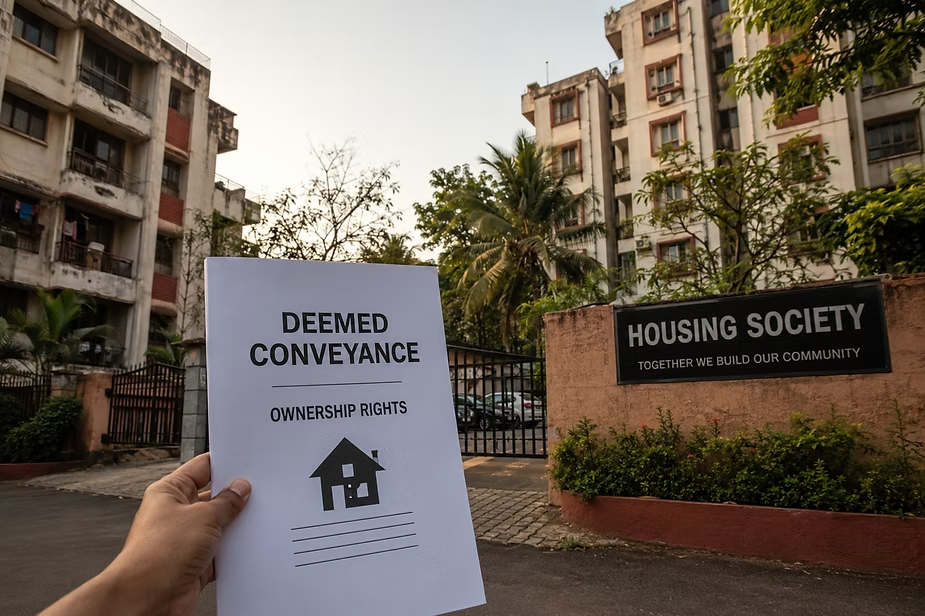
A home is more than four walls. It is security, identity and peace of mind. Goa’s new Mhajo Flat initiative seeks to resolve one of the state’s oldest housing challenges by helping thousands of apartment owners finally secure legal ownership of the homes they have lived in for years.
At a Glance
- Goa Cabinet has approved the Mhajo Flat initiative to address long-pending ownership issues affecting apartment owners.
- The scheme introduces deemed conveyance, enabling housing societies to obtain ownership even when builders fail to transfer it.
- It proposes major reductions in stamp duty and registration charges for eligible societies.
- The reform is expected to benefit an estimated 30,000 to 40,000 flats across Goa, according to Chief Minister Pramod Sawant.
- The initiative also aims to unlock redevelopment of ageing housing societies that have remained stuck because of ownership disputes.
A Home You Paid For. Ownership You Never Received.
Imagine buying a flat with your life’s savings.
You receive the keys, move in with your family, pay property taxes every year, maintain the building, contribute to your housing society and spend decades building memories inside those four walls.
Yet legally, the land beneath your home still does not belong to your housing society.
It sounds unbelievable, but for thousands of apartment owners across Goa, this has been reality for years.
Many families have spent decades living in homes where builders never completed the final legal transfer of ownership. Others found themselves trapped because developers disappeared, landowners refused to cooperate or housing societies were never formally constituted.
The result was a peculiar situation. Residents occupied their homes, but without proper conveyance, their societies could not fully exercise ownership rights. Redevelopment stalled, repairs became difficult and legal uncertainty lingered over properties that people believed they already owned.
This is the gap that the Goa Government now hopes to bridge through Mhajo Flat, a housing reform that seeks to convert possession into legally recognised ownership. Approved by the State Cabinet, the initiative combines legislative amendments, reduced transaction costs and administrative reforms to resolve one of Goa’s longest-running property issues.
Unlike many housing schemes that focus on constructing new homes, Mhajo Flat focuses on protecting existing homeowners.
Its objective is simple.
If you have already bought a home, the law should help ensure that you can truly own it.
A New Housing Reform Takes Aim at a Decades-Old Ownership Problem
On July 1, the Goa Cabinet approved the Mhajo Flat scheme, paving the way for legal reforms designed to help apartment owners secure ownership rights where builders or developers failed to execute conveyance deeds.
At the centre of the initiative is a legal mechanism known as deemed conveyance.
Ordinarily, once flats are sold, the builder is expected to transfer ownership of the land and common areas to the cooperative housing society or association of apartment owners. In many cases across Goa, however, that final step never took place.
Some builders left the state. Some projects changed hands. In other cases, societies were never formed or legal formalities remained incomplete.
Without conveyance, housing societies lacked clear title over the property despite residents occupying the flats for years.
Mhajo Flat seeks to resolve this by allowing societies to obtain ownership through a government-backed legal process even where the original developer fails to cooperate.
The Cabinet also approved measures to significantly reduce stamp duty and registration charges associated with deemed conveyance, making the process financially accessible for affected societies.
Chief Minister Pramod Sawant has described the initiative as an effort to provide rightful ownership to thousands of families who have waited years for legal certainty.
Ownership Is More Than Paperwork. It Determines What You Can Do With Your Home.
For most homeowners, ownership is often assumed to begin the day they receive the keys.
Legally, however, ownership involves more than occupying a flat.
Without conveyance, housing societies often face significant limitations. Redevelopment proposals become difficult to execute because the society does not possess clear title over the land. Banks may seek additional documentation during financing. Major repairs requiring collective approvals become more complicated. Property disputes become harder to resolve.
The issue becomes even more serious as buildings age.
Across Goa, many apartment complexes constructed decades ago are approaching the stage where structural repairs or complete redevelopment may become necessary.
Yet redevelopment requires legal ownership.
Without it, societies struggle to obtain approvals, appoint developers or negotiate redevelopment agreements.
That is why Mhajo Flat is being viewed as more than a documentation exercise.
It is an attempt to remove one of the biggest legal bottlenecks preventing housing societies from planning for the future.
For thousands of residents, the scheme promises something fundamental: confidence that the homes they have invested in are legally secure.
How Years of Incomplete Conveyance Created a Statewide Housing Challenge
The roots of the problem stretch back decades.
During periods of rapid urbanisation, numerous apartment complexes were constructed across Goa. While flats were sold to buyers, the legal transfer of ownership from builders to cooperative housing societies often remained incomplete.
In some projects, societies were never registered.
In others, developers ceased operations or could not be traced.
Sometimes disputes between builders and original landowners prevented conveyance altogether.
Over time, these unfinished transactions accumulated into a widespread governance challenge affecting thousands of apartment owners across the state.
Recognising the scale of the issue, the Goa Government began examining legal reforms that could provide an alternative route to ownership where conventional conveyance had failed.
Chief Minister Pramod Sawant has estimated that between 30,000 and 40,000 flats across Goa may be affected by incomplete ownership transfers.
Rather than treating every case individually through prolonged litigation, Mhajo Flat attempts to establish a structured legal framework capable of resolving ownership issues at scale.
In doing so, Goa joins a growing number of states that have turned to deemed conveyance as a practical solution for long-pending housing disputes.
For Thousands of Families, This Is About Security, Not Just Paperwork
For many Goans, owning a flat has never been the problem. Proving ownership has.
Over the years, apartment owners have paid EMIs, contributed to maintenance, elected managing committees and raised families in homes they believed were fully theirs. Yet many cooperative housing societies remained without legal conveyance of the land and common areas from the builder. While day-to-day life continued, the absence of clear ownership became a serious obstacle whenever major decisions had to be taken.
That obstacle became most visible when buildings began to age.
Across Goa, several residential complexes constructed in the 1980s, 1990s and early 2000s are now approaching the stage where structural repairs, retrofitting or complete redevelopment may become necessary. Without legal ownership, societies often find themselves unable to appoint developers, obtain statutory permissions or enter into legally enforceable redevelopment agreements.
The impact extends beyond redevelopment.
Housing societies without conveyance often face difficulties in resolving property disputes, managing common assets or dealing with future land-related issues. In certain cases, uncertainty over ownership can also complicate financial transactions involving the property.
The Mhajo Flat initiative seeks to remove these barriers by creating a structured pathway for housing societies to obtain legal ownership through deemed conveyance where the original developer has failed to execute the transfer. According to the Government, the objective is not only to regularise ownership but also to strengthen long-term housing security for residents.
For citizens, the reform promises three tangible outcomes.
First, greater legal certainty over the homes they already occupy.
Second, a clearer pathway to redevelop ageing buildings when required.
Third, reduced financial burden through concessional stamp duty and registration charges, making the ownership process more affordable for housing societies.
For thousands of families, the significance of the scheme lies in a simple principle. The home they purchased years ago should also be the home they legally own.
The State Says It Is Correcting a Long-Pending Injustice
The Goa Government has consistently presented Mhajo Flat as a citizen-centric reform rather than a conventional housing scheme.
Chief Minister Pramod Sawant has stated that the initiative is intended to resolve a long-standing problem affecting an estimated 30,000 to 40,000 flats across the state. According to him, thousands of homeowners have remained without legal ownership because developers failed to complete conveyance even after selling the flats. The scheme, he said, seeks to ensure that ordinary citizens are not forced to suffer because of procedural failures that occurred years ago.
The government has also emphasised that the initiative is the result of coordinated work between the Departments of Cooperation, Revenue and Registration. Instead of treating ownership, redevelopment and stamp duty as separate issues, Mhajo Flat attempts to integrate them into a single policy framework.
According to the official concept note, the reforms include:
- Enabling formation of cooperative housing societies where none exist.
- Introducing deemed conveyance for societies that never received ownership from builders.
- Creating a statutory framework for redevelopment of ageing housing societies.
- Rationalising stamp duty on redevelopment-related instruments.
- Reducing registration charges for deemed conveyance.
Officials argue that these changes will reduce procedural complexity while encouraging more housing societies to regularise ownership.
The Government has also clarified that the initiative is primarily aimed at residential complexes constructed before the Real Estate (Regulation and Development) Act, 2016 came into force, recognising that newer projects operate under a different regulatory environment.
From the government’s perspective, the reform is ultimately about restoring legal certainty to homeowners who have waited years for ownership that should have been transferred long ago.
Support for the Objective, Questions on the Rollout
Unlike several recent governance reforms that triggered immediate political confrontation, the Mhajo Flat initiative has so far generated relatively measured reactions.
There has been broad acknowledgement that incomplete conveyance is a genuine issue affecting apartment owners across Goa. However, political voices and civil society observers have raised questions about implementation rather than intent.
Some have asked whether the administrative machinery will be equipped to process a potentially large number of applications within reasonable timelines.
Others have questioned how disputed projects, incomplete documentation or cases involving multiple landowners will be handled.
There have also been calls for complete transparency during implementation. Housing societies are expected to seek clarity on eligibility, documentation requirements, application timelines and grievance redressal mechanisms once detailed rules are notified.
Opposition leaders have indicated that while resolving ownership disputes is necessary, the true measure of success will be whether ordinary residents are able to complete the process without prolonged delays or bureaucratic hurdles.
As the scheme moves from Cabinet approval to implementation, political scrutiny is likely to shift from legislative intent to administrative delivery.
Property Experts Say Legal Ownership Is the Foundation of Redevelopment
Housing policy specialists have long argued that conveyance is one of the most overlooked aspects of apartment ownership in India.
While homebuyers generally focus on possession, legal experts point out that the transfer of land and common areas to the housing society is equally important because it establishes collective ownership over the property.
Without that transfer, societies face practical limitations that become increasingly visible as buildings grow older.
Urban planners note that redevelopment projects require clear title before financial institutions, developers and regulatory authorities can proceed with approvals. Without ownership, even well-maintained societies may struggle to undertake major reconstruction despite the willingness of residents.
Legal experts also point to another advantage of deemed conveyance.
Instead of forcing every housing society into prolonged civil litigation against developers, the mechanism creates an administrative route to establish ownership where legal conditions are satisfied. This significantly reduces both time and uncertainty for residents.
The concept is not entirely new.
States such as Maharashtra introduced deemed conveyance several years ago to resolve similar ownership disputes affecting cooperative housing societies. While implementation has varied, the policy demonstrated that government intervention can help unlock stalled ownership transfers that would otherwise remain unresolved for decades.
Experts believe Goa’s success will depend on execution rather than legislation alone.
Efficient processing, digital workflows, clear timelines and coordinated functioning across departments will determine whether Mhajo Flat becomes a landmark housing reform or another policy with limited on-ground impact.
One thing, however, commands broad agreement.
Ownership is not merely a legal formality.
It is the foundation upon which every future decision about a housing society rests, from repairs and redevelopment to financial planning and long-term community stability.
More Than a Housing Scheme, It Is About Completing the Promise of Homeownership
For decades, thousands of Goans have lived in homes they purchased in good faith but never fully owned in the eyes of the law.
The buildings became communities. Children grew up. Families invested their savings. Housing societies managed maintenance and shared responsibilities. Yet one crucial legal step remained incomplete.
Mhajo Flat seeks to close that gap.
By enabling deemed conveyance, reducing financial barriers and creating a framework for redevelopment, the Government is attempting to convert long-standing possession into legally recognised ownership.
The reform will not solve every housing issue overnight. Its success will depend on efficient implementation, administrative coordination and public awareness.
But if it delivers on its objectives, it has the potential to transform the lives of thousands of homeowners who have spent years waiting for legal certainty.
In the end, ownership is not just about a document.
It is about giving people confidence that the home they built their lives around is, in every legal sense, truly theirs.