


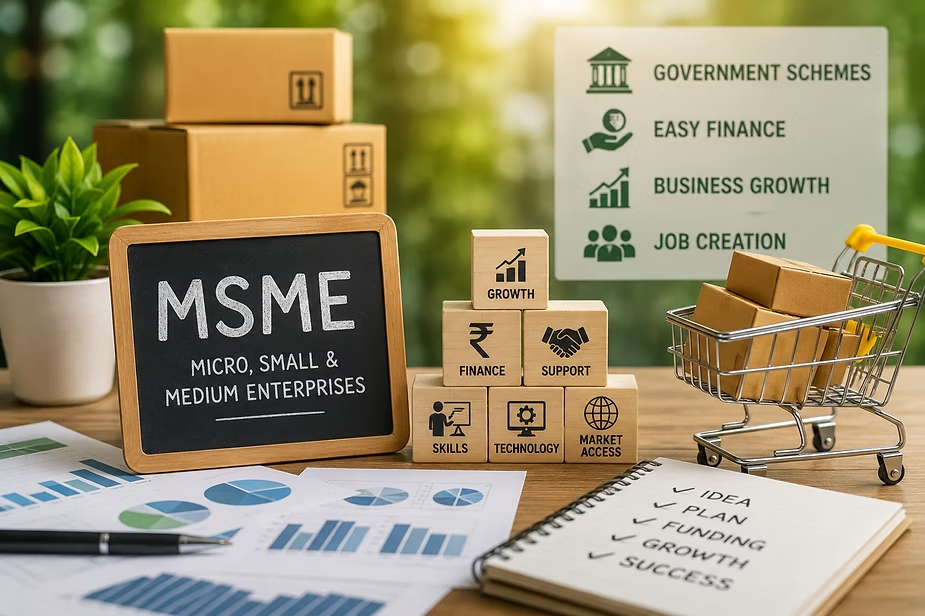
From nurseries and dairy businesses to technology startups, government-backed MSME schemes are helping Goan entrepreneurs access finance, modernise operations and create employment. Here’s how the ecosystem is evolving and what it means for the state’s economy.
At a Glance
- Goa has 91,034 MSMEs registered on the Udyam portal as of March 31, 2026.
- Around 98% are micro enterprises.
- Nearly 83% operate in services and retail, while 17.2% are in manufacturing.
- The government is now focusing on manufacturing, food processing, technology and export-oriented businesses.
- Entrepreneurs across sectors are using financial assistance, subsidies, interest rebates, skilling programmes and digital services to expand operations.
From Financial Assistance to Business Growth, Goa’s MSME Ecosystem Is Expanding
Every successful business has an origin story. Some begin in a garage, others in a family kitchen, a rented shop or a small workshop. What separates an idea from a sustainable enterprise is often access to finance, mentorship and the confidence to take the first step.
That is the gap Goa’s MSME ecosystem is increasingly trying to bridge.
Speaking on World MSME Day 2026, Chief Minister Pramod Sawant announced that Goa now has 91,034 MSMEs registered on the Udyam portal, making small businesses one of the largest drivers of the state’s economy. Nearly 98 percent of these enterprises are micro businesses, demonstrating that entrepreneurship in Goa is overwhelmingly built by individuals, families and first-generation business owners rather than large corporations.
The government has now outlined its next phase of industrial growth. While the service sector continues to dominate, accounting for nearly 82.8 percent of registered MSMEs, policymakers want to encourage more entrepreneurs to enter manufacturing, food processing, electronics, green industries and export-oriented businesses.
Behind these numbers are thousands of individual stories.
Entrepreneurs like Maya Shirodkar of Maya Green Nursery, Sanket Parab of Merry Milk Foods and Eeshan Keni of Velocilabs represent three very different sectors. One works with plants, another with food products and the third with technology. Yet all three reflect the same reality. Government support, when combined with entrepreneurial drive, can reduce barriers that often prevent small businesses from growing.
Across Goa, entrepreneurs today can access support through a combination of Central and State Government initiatives. These include financial assistance under the Prime Minister’s Employment Generation Programme (PMEGP), concessional loans through the Chief Minister’s Rojgar Yojana (CMRY), interest rebate schemes operated through the Economic Development Corporation (EDC), startup incentives under the Goa Startup Policy and several sector-specific subsidies that reduce operational costs and encourage innovation.
The emphasis is no longer only on helping people start businesses.
Increasingly, policy is shifting towards helping entrepreneurs scale, adopt technology, improve productivity, access larger markets and generate employment within Goa.
That represents an important evolution. Earlier schemes largely focused on self-employment. Today’s ecosystem aims to build enterprises capable of creating jobs for others, strengthening local supply chains and contributing to Goa’s long-term economic resilience.
For aspiring entrepreneurs, the message is becoming clearer than ever.
Starting a business no longer depends only on personal savings or family resources. With structured government support, easier digital registration through Udyam, subsidised finance and targeted incentives, more Goans are finding opportunities to transform business ideas into sustainable enterprises.
When Small Businesses Grow, Goa’s Economy Grows With Them
Every economy has its large employers, but it is often small businesses that create the widest ripple effect. A neighbourhood bakery hires local staff. A nursery sources plants from nearby growers. A dairy enterprise supports farmers. A technology startup creates opportunities for young professionals who might otherwise leave the state.
This is why MSMEs are often described as the backbone of India’s economy. Nationally, the sector contributes nearly 30 percent of India’s Gross Domestic Product, accounts for around 36 percent of manufacturing output and generates more than 45 percent of the country’s exports. It is also one of the largest sources of non-farm employment in India, supporting millions of livelihoods across urban and rural areas.
Goa reflects this national trend in its own way.
Unlike larger industrial states, Goa’s economy has traditionally been driven by tourism, mining, hospitality and services. While these sectors remain vital, they are also vulnerable to seasonal fluctuations, global economic conditions and external shocks. The COVID-19 pandemic demonstrated how quickly tourism-dependent economies can be disrupted, affecting businesses, employment and household incomes.
A stronger MSME ecosystem helps diversify that risk.
When entrepreneurs establish businesses in manufacturing, food processing, engineering, healthcare, information technology, renewable energy or creative industries, they create new sources of economic activity that operate throughout the year. This broadens the state’s economic base and makes growth more resilient.
The numbers also reveal where the next opportunity lies.
With more than four out of every five registered MSMEs operating in services and retail, manufacturing remains comparatively underrepresented. Recognising this, the Goa Government has announced a greater policy focus on encouraging value-added production, export-oriented enterprises, electronics, food processing and green industries.
The objective is not to replace services but to strengthen the second pillar of Goa’s economy.
Manufacturing businesses often generate wider economic benefits because they require suppliers, logistics providers, packaging companies, transport operators, maintenance services, technology solutions and skilled workers. A single manufacturing unit can therefore support an entire ecosystem of smaller enterprises around it.
For young entrepreneurs, this creates opportunities beyond conventional career choices.
Instead of viewing entrepreneurship only as opening a restaurant or retail outlet, there is growing encouragement to explore precision engineering, medical devices, food innovation, agri-processing, clean technology, software products and advanced manufacturing. These sectors typically offer greater scalability, stronger export potential and higher value addition.
Government support is playing an increasingly important role in reducing the barriers that first-generation entrepreneurs often face. Access to subsidised finance, digital registrations through the Udyam portal, startup incubation, skill development programmes and market linkages can significantly reduce the cost and complexity of establishing a business.
For women entrepreneurs, these interventions are equally significant. Many enterprises that begin as home-based ventures in food products, handicrafts, floriculture or wellness services are now finding pathways to formalisation, branding and larger markets through structured institutional support.
The impact extends well beyond individual businesses.
Every successful MSME generates employment, creates demand for local suppliers, strengthens household incomes and keeps more economic value circulating within Goa. As these enterprises expand, they also contribute to tax revenues, encourage innovation and help develop local talent.
This multiplier effect explains why policymakers increasingly view MSMEs not simply as beneficiaries of government schemes, but as long-term partners in economic development.
For Goa, where entrepreneurship has always been part of the social fabric, strengthening the MSME ecosystem is about creating more opportunities for local talent to build businesses at home rather than seeking opportunities elsewhere. It is an investment in innovation, employment and sustainable economic growth that can shape the state’s future for decades to come.