


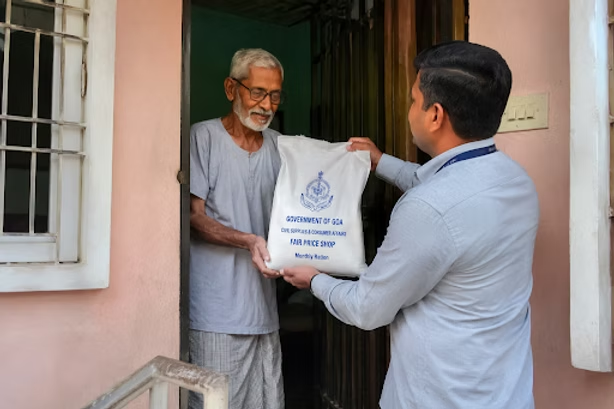
For thousands of elderly citizens and persons with disabilities, the biggest challenge was never getting ration. It was getting to the ration shop. Goa’s doorstep ration delivery initiative is quietly rewriting that story, one home at a time.
At a Glance
- Over 3,000 beneficiaries are currently receiving doorstep ration deliveries in Goa.
- The initiative targets senior citizens aged 75+, persons with disabilities, bed-ridden citizens and those with chronic mobility challenges.
- The service has been rolled out in Tiswadi, Bicholim and Ponda.
- Fair Price Shop dealers receive ₹100 per doorstep delivery as service compensation.
- The initiative aims to make the Public Distribution System more accessible while reducing hardship for vulnerable citizens.
The Monthly Journey That Was Never Meant to Be This Difficult
There are some struggles that rarely make headlines.
Not because they are small.
But because they happen quietly, behind closed doors.
An elderly couple wondering how to reach the ration shop. A wheelchair user waiting for someone to become free so they can be accompanied. A bed-ridden citizen depending entirely on family members for something as basic as collecting food grains.
For years, these stories remained invisible.
Every month, thousands of Goans faced a challenge many of us never stop to think about. The ration itself was available. The real problem was the journey.
Today, that journey is disappearing.
Across Goa, a quiet welfare initiative is ensuring that ration reaches the people instead of forcing the people to reach the ration shop.
It may not be the state’s biggest infrastructure project.
It may never dominate political debates.
Yet for thousands of families, it may be one of the most meaningful changes happening today.
From Welfare to Accessibility: What Actually Changed?
The Department of Civil Supplies has expanded doorstep delivery of ration to eligible beneficiaries under the Public Distribution System.
Instead of requiring vulnerable citizens to visit Fair Price Shops every month, authorised dealers now deliver essential food grains directly to their homes.
The scheme presently covers more than 3,000 beneficiaries, primarily in Tiswadi, Bicholim and Ponda, with eligibility extending to senior citizens above 75 years, persons with disabilities, bed-ridden citizens and residents facing severe mobility constraints. Dealers are compensated ₹100 for each successful delivery, ensuring that the service remains viable while keeping beneficiaries’ entitlements intact.
Why This Matters More Than It First Appears
Governments often measure welfare through the number of schemes announced.
Citizens measure welfare differently.
They ask one simple question:
“Did my life become easier?”
For an able-bodied person, travelling to collect monthly ration may seem routine.
For someone with arthritis, paralysis, advanced age or a permanent disability, that same journey can involve hiring transport, depending on relatives, missing work, or postponing collection altogether.
Accessibility is often discussed in the context of ramps, elevators and public buildings.
This initiative expands that idea into everyday governance.
Rather than asking vulnerable citizens to overcome physical barriers, the system adapts to meet them where they live.
That is a subtle but significant shift in how public services are delivered.
The Bigger Story Started Long Before This Scheme
India’s Public Distribution System remains one of the world’s largest food security networks, supplying subsidised food grains to millions of households every month.
While availability of food has steadily improved over the years through digitisation, Aadhaar authentication and electronic Point of Sale systems, the “last mile” challenge has persisted.
Possessing a ration card never guaranteed that collecting the ration was easy.
Distance, age, disability and lack of transport continued to affect access for many vulnerable households.
Goa’s doorstep delivery initiative addresses that final gap.
Instead of focusing only on distribution, it focuses on accessibility.
That distinction could become increasingly important as India’s population ages and demand for citizen-centric public services grows.
For Citizens, Relief Arrives With a Knock on the Door
During visits across Tiswadi, beneficiaries described something remarkably simple.
Less stress.
Less dependence.
Less anxiety every month.
For many elderly citizens, the service removes the uncertainty of arranging transport or requesting neighbours and relatives for assistance.
For persons with disabilities, it offers something equally valuable.
Independence.
What appears to be a routine delivery can mean avoiding physical pain, reducing travel expenses and ensuring food security without relying on others.
Sometimes governance is measured not by grand announcements, but by the number of unnecessary journeys it eliminates.
Government Says This Is About Inclusive Service Delivery
Officials from the Department of Civil Supplies have positioned the initiative as an effort to make the Public Distribution System more inclusive and accessible.
Eligibility has been focused on citizens who face genuine mobility challenges, while the compensation paid to Fair Price Shop dealers helps sustain the logistics involved in home delivery.
The department has indicated that the service is already benefiting more than 3,000 citizens in the current implementation areas.
Political Response Has Been Relatively Muted
Unlike many welfare announcements that quickly become political flashpoints, doorstep ration delivery has generated comparatively little political controversy in the public domain.
There have been no major reported objections to the concept itself.
Instead, public discussion has largely centred on implementation, coverage and whether the service can eventually reach every eligible beneficiary across Goa.
Experts Say Accessibility May Become the Next Frontier of Governance
Public policy experts increasingly argue that future welfare programmes will be judged not only by budget allocations but by how easily citizens can access them.
Digital governance solved paperwork.
Doorstep governance addresses physical access.
For elderly populations, persons with disabilities and those living with chronic illnesses, this shift could significantly improve utilisation of welfare schemes that already exist but remain difficult to access.
In many ways, convenience itself becomes a form of social inclusion.
By the Numbers
| Metric | Data |
| Current Beneficiaries | 3,000+ |
| Current Coverage | Tiswadi, Bicholim, Ponda |
| Eligible Groups | 75+ Senior Citizens, PwDs, Bed-ridden Citizens, Mobility Challenges |
| Dealer Compensation | ₹100 per doorstep delivery |
| Delivery Model | Through Fair Price Shops |
The Questions That Still Need Answers
As the initiative expands, several important questions remain.
- Can the programme be extended to every taluka in Goa?
- How will new beneficiaries be identified and verified?
- Will digital tracking allow families to monitor deliveries?
- Can the model be integrated with other welfare services for vulnerable citizens?
- How will demand evolve as Goa’s elderly population grows?
The answers will determine whether this remains a successful pilot or evolves into a long-term transformation of public service delivery.
What Happens Next?
The success of the current rollout is likely to shape future expansion decisions.
If beneficiary numbers continue to grow and implementation remains efficient, doorstep ration delivery could become a permanent feature of Goa’s welfare architecture.
More importantly, it may redefine how citizens expect government services to reach those who need them most.
Sometimes the biggest reforms are not measured in kilometres of highways or crores of investment.
Sometimes they are measured in the distance an elderly citizen no longer has to walk.