


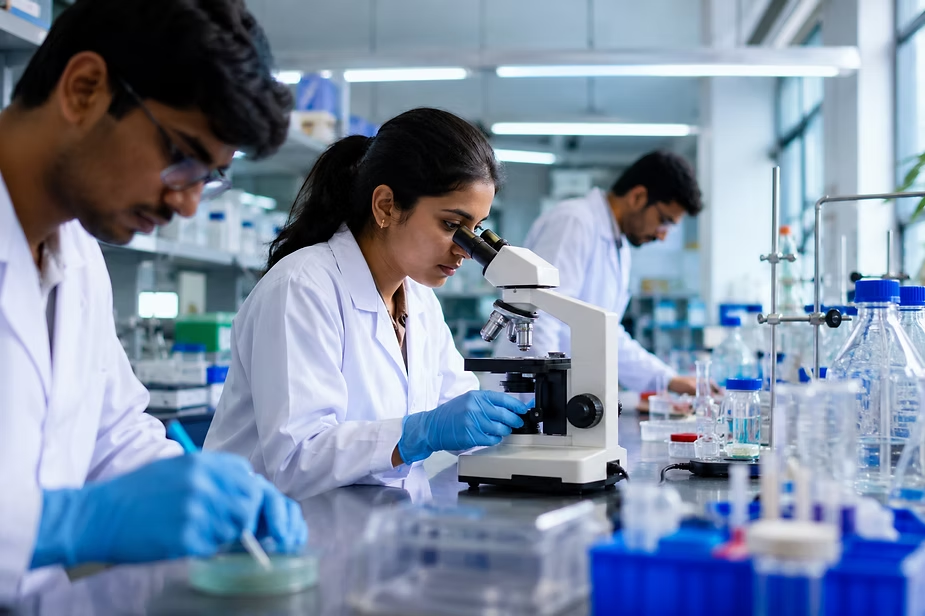
For decades, Goa’s identity has revolved around tourism, hospitality and beaches. But a remarkable surge in doctoral research suggests the state’s next growth story could be unfolding inside universities, laboratories and innovation centres.
At a Glance
- Goa’s doctoral enrolment has increased fourfold in five years, according to AISHE 2023–24.
- National PhD enrolment has grown by 47 percent during the same period, making Goa’s rise significantly steeper.
- India now has a record 4.5 crore students enrolled in higher education.
- Goa’s research ecosystem is anchored by institutions including Goa University, BITS Pilani K. K. Birla Goa Campus, IIT Goa, NIT Goa, CSIR-National Institute of Oceanography, and the National Centre for Polar and Ocean Research.
- Experts believe stronger research capacity can drive innovation, startups, skilled employment and knowledge-based industries.
Beyond Tourism: The Numbers That Reveal Goa’s Quiet Academic Transformation
The latest AISHE report has revealed one of the most significant education stories emerging from Goa in recent years.
While much public discussion often revolves around infrastructure, tourism or investment projects, the state’s higher education sector has been undergoing its own transformation.
Doctoral education, once considered a niche academic pursuit in Goa, is witnessing unprecedented growth.
The AISHE report shows that the number of students pursuing PhDs in Goa has multiplied four times within just five years. Nationally, PhD enrolment has risen by 47 percent over the same period. Goa’s growth therefore stands well above the national trend.
This surge reflects more than increasing student numbers.
It points towards expanding research opportunities, improved institutional capacity, greater awareness of academic careers and stronger confidence among students to pursue advanced research.
The growth also coincides with sustained expansion of institutions that have strengthened Goa’s academic landscape.
Goa University has expanded research across science, humanities, management and interdisciplinary studies. IIT Goa has rapidly developed advanced engineering and technology programmes since its establishment. BITS Pilani’s Goa campus continues to attract students from across India for cutting-edge research in engineering and applied sciences. NIT Goa is steadily strengthening technical education and research output, while globally recognised institutions like the CSIR-National Institute of Oceanography and the National Centre for Polar and Ocean Research continue to place Goa at the centre of marine and climate research.
Collectively, these institutions are creating an ecosystem where research is becoming increasingly visible and aspirational.
Why This Matters More Than It Appears
At first glance, an increase in PhD enrolment may seem like an academic statistic with little relevance to everyday life.
In reality, it could become one of the strongest indicators of where Goa’s economy is heading.
Modern economies increasingly compete through knowledge, innovation and intellectual capital rather than traditional industries alone.
Research universities create skilled professionals.
Skilled professionals generate innovation.
Innovation attracts investment.
Investment creates high-value employment.
Countries that dominate sectors such as biotechnology, artificial intelligence, pharmaceuticals, clean energy and advanced manufacturing all share one common feature. They invest heavily in research.
For Goa, this matters enormously.
The state’s economy has long depended on tourism and services. While these sectors remain vital, they are also vulnerable to seasonal fluctuations, global disruptions and changing travel trends.
A stronger research ecosystem opens entirely new possibilities.
It can encourage technology startups, attract research grants, support collaborations between universities and industry, strengthen environmental conservation efforts and improve public policy through evidence-based decision-making.
The benefits extend beyond campuses.
Medical research can improve healthcare.
Engineering research can develop smarter infrastructure.
Marine science can help protect Goa’s coastline.
Environmental research can strengthen climate resilience.
Policy research can improve governance.
Each doctoral student represents not just an individual academic journey but also a future contributor to solving complex problems facing society.
For a small state like Goa, this shift could prove transformational.
How Goa Built the Foundations for a Research Ecosystem
Goa’s growing research story did not emerge overnight.
Over several decades, the state steadily built institutions capable of supporting advanced education and scientific inquiry.
Goa University, established in 1985, laid the foundation by expanding postgraduate education and doctoral programmes across multiple disciplines.
The arrival of BITS Pilani’s K. K. Birla Goa Campus in 2004 introduced world-class engineering education with a strong emphasis on innovation and industry collaboration.
IIT Goa, established in 2016, added another significant pillar by focusing on advanced engineering research and technology development.
NIT Goa has strengthened technical education while expanding research opportunities for engineering students.
Beyond universities, Goa is home to nationally significant scientific institutions.
The CSIR-National Institute of Oceanography, headquartered in Dona Paula, has played a pioneering role in ocean sciences for decades.
The National Centre for Polar and Ocean Research in Vasco conducts globally recognised work on Antarctica, Arctic studies and climate science.
Together, these institutions have gradually transformed Goa into a state where high-quality research infrastructure already exists.
The latest AISHE figures suggest students are increasingly choosing to take advantage of it.
From Classrooms to Careers: Why Every Goan Has a Stake in This Growth
It is easy to assume that doctoral education benefits only professors and researchers.
The reality is far more significant.
Every major innovation that changes everyday life begins somewhere inside a research laboratory, university department or scientific institution.
The medicines people rely on, renewable energy technologies, artificial intelligence, precision agriculture, disaster prediction systems and environmental conservation strategies all originate through years of research.
For Goa, the implications are particularly important.
A stronger research ecosystem can help the state diversify its economy beyond tourism and hospitality, sectors that remain vulnerable to global economic slowdowns, climate events and changing travel patterns.
Research-driven industries tend to create high-paying, knowledge-intensive jobs that encourage talented young professionals to build careers within the state rather than migrating elsewhere.
The impact extends across multiple sectors.
Environmental researchers can help preserve Goa’s fragile coastline and biodiversity.
Marine scientists can improve fisheries management and coastal resilience.
Engineers can develop solutions for smart mobility, clean energy and digital infrastructure.
Healthcare researchers can strengthen disease surveillance, medical innovation and public health planning.
Social scientists can contribute evidence-based solutions for governance, urban planning and education reforms.
For students, the expanding research ecosystem also opens new career pathways.
Instead of viewing a PhD solely as preparation for teaching, many researchers today work in technology companies, pharmaceutical firms, consulting organisations, think tanks, international institutions and startup ecosystems.
In many advanced economies, research has become one of the strongest engines of economic growth.
Goa now has an opportunity to move in the same direction.
A National Push for Research Is Creating New Opportunities
The growth recorded in Goa aligns with a broader national effort to strengthen India’s higher education and research landscape.
Over the past decade, the Union Government has introduced multiple initiatives aimed at expanding research capacity, improving institutional quality and encouraging innovation.
The National Education Policy (NEP) 2020 places significant emphasis on multidisciplinary education, research excellence and stronger collaboration between academia and industry.
The government has also proposed the establishment of the Anusandhan National Research Foundation (ANRF), designed to expand research funding, improve collaboration between universities and industry, and strengthen India’s overall scientific ecosystem.
Schemes supporting innovation through incubation centres, startup programmes and technology transfer have further encouraged universities to move beyond traditional classroom teaching.
Institutions in Goa have increasingly participated in these national initiatives through research collaborations, innovation cells, startup incubation programmes and interdisciplinary projects.
While AISHE does not directly attribute Goa’s rise to any single policy, the state’s progress reflects an environment where research has received growing institutional attention.
Places such as Singapore, Finland and Israel demonstrate how sustained investment in research and innovation can generate global influence despite limited geography.
Goa already possesses several ingredients needed to pursue a similar path.
It has internationally recognised research institutions.
It attracts students from across India.
It hosts globally respected marine science organisations.
Its relatively compact geography encourages collaboration between universities, government agencies and industry.
Education analysts believe this combination creates opportunities that extend well beyond academia.
A stronger research ecosystem can attract international collaborations, increase publication output, generate patents, strengthen startup ecosystems and encourage private investment in emerging technologies.
Research institutions also contribute significantly to local economies by creating demand for housing, professional services, scientific equipment, conferences and specialised employment.
For Goa, this represents an opportunity to build a second growth engine alongside tourism rather than replacing it.
Instead of choosing between visitors and innovation, the state could successfully develop both.
The Numbers Behind Goa’s Academic Rise
The latest higher education data places Goa within a much larger national story of expanding education and research.
Key Data
- Doctoral enrolment in Goa has increased fourfold over the past five years, according to the All India Survey on Higher Education (AISHE) 2023–24.
- India recorded a 47 percent increase in PhD enrolment during the same period, highlighting the country’s growing focus on advanced research.
- Higher education enrolment in India has reached a record 4.5 crore students, the highest ever recorded under AISHE.
- Female participation in higher education has continued to rise nationally, reflecting improving access across multiple disciplines.
- Goa’s research ecosystem is supported by institutions including:
- Goa University
- IIT Goa
- BITS Pilani K. K. Birla Goa Campus
- NIT Goa
- CSIR–National Institute of Oceanography
- National Centre for Polar and Ocean Research
Beyond universities, these institutions contribute research in engineering, artificial intelligence, marine sciences, climate studies, environmental conservation, biotechnology, public policy and advanced technology.
Together, they provide the scientific foundation needed to support Goa’s transition towards a stronger knowledge economy.
The AISHE figures suggest that more students are now choosing to build careers within this ecosystem, signalling a shift that could influence the state’s economic direction for years to come.
Goa’s Research Story Is Part of a Much Bigger Transformation
The rise in doctoral enrolment does not exist in isolation.
It is part of a broader shift taking place across the state.
Goa has been expanding digital infrastructure, strengthening startup support, improving higher education facilities and attracting investments in technology-driven sectors.
Research complements each of these developments.
A stronger innovation ecosystem can help improve healthcare, environmental conservation, sustainable tourism, coastal management, clean energy and advanced manufacturing.
It can also support evidence-based policymaking, helping governments make better decisions through data and scientific analysis.
For a state with limited land and natural resources, knowledge may become its most valuable asset.
The Future of Goa May Be Built in Its Laboratories
For decades, Goa’s story has been told through its beaches, hospitality and tourism industry.
Those strengths will continue to define the state.
But another story is quietly unfolding.
Inside university classrooms.
Inside research laboratories.
Inside innovation centres where students are working on problems that could shape the future of healthcare, engineering, climate science, artificial intelligence and public policy.
The latest AISHE figures are more than an education statistic.
They are an early signal that Goa is beginning to build a stronger knowledge economy.
Every research scholar represents curiosity transformed into expertise.
Every laboratory represents an investment in solving tomorrow’s challenges.
Every university that strengthens its research capacity creates opportunities that extend far beyond its campus.
Tourism may always remain Goa’s most recognised identity.
But if the current momentum continues, the state’s next chapter could be written not on its coastline, but inside its classrooms, laboratories and research institutions.
Goa has long welcomed millions of visitors.
Now, it has an opportunity to become a place where ideas, innovation and scientific discovery flourish alongside them.
That may prove to be one of the state’s most important transformations yet.