


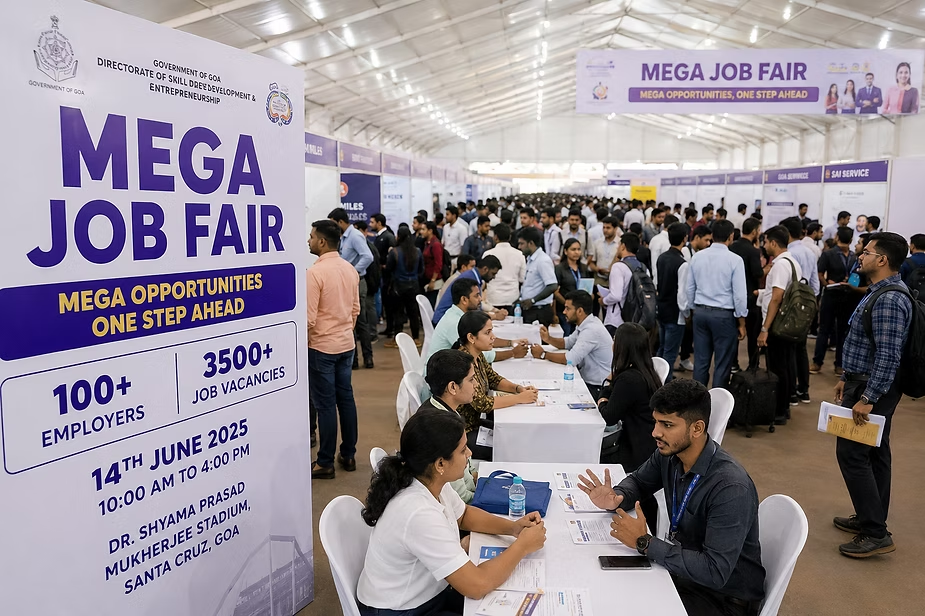
Every job begins long before an appointment letter is signed. It begins with uncertainty, preparation, and hope. On the morning of Goa’s Mega Job Fair at Santa Cruz, thousands of young men and women walked into the venue carrying neatly arranged resumes, folders filled with certificates, and expectations that could potentially alter the course of their lives. Some arrived with confidence, having researched companies and rehearsed interview questions. Others entered quietly, uncertain whether they would leave with an opportunity or simply another lesson in persistence. Yet what united everyone under one roof was the belief that a single conversation could change everything.
For years, employment has remained one of the most significant aspirations for Goan youth. While the state’s economy enjoys one of the highest per capita incomes in the country and continues to benefit from tourism, mining recovery, pharmaceuticals, manufacturing, logistics, and an expanding services sector, the challenge has increasingly shifted from the availability of jobs to the accessibility of opportunities. Employers seek skilled candidates while job seekers often struggle to identify where those opportunities exist. Events like the Mega Job Fair attempt to bridge precisely that gap by bringing both sides of the employment equation together in a single ecosystem.
This year’s Mega Job Fair was notable not merely because of the scale of participation but because of what it represented. According to official information released ahead of the event, more than one hundred employers participated, collectively offering over 3,500 vacancies across multiple sectors. Rather than limiting recruitment to a single industry, the event showcased the diversity of Goa’s economic landscape, bringing together pharmaceuticals, aviation, hospitality, retail, diagnostics, healthcare, mobility, food services, casinos, logistics, and several other industries that continue to shape the state’s growth trajectory.
The participating organisations reflected this diversity. Pharmaceutical giants such as Cipla, Lupin, Marksans Pharma, Micro Labs, Molbio Diagnostics and other healthcare companies represented a sector that has steadily become one of Goa’s strongest industrial pillars. Aviation opportunities came through FLY91, a regional airline that has rapidly expanded connectivity from Goa to several destinations. Hospitality and tourism, the traditional backbone of Goa’s economy, were represented by leading hotel chains and resorts including Radisson Blu and Fortune Hotels, while mobility and automobile companies such as GoaMiles, Sai Service and Chowgule Industries highlighted opportunities beyond the state’s conventional tourism narrative. Food delivery platforms, retail chains, emergency healthcare services and entertainment businesses further demonstrated that Goa’s employment ecosystem is broader than often perceived.
The importance of this diversity cannot be overstated. For decades, discussions about Goa’s economy have been dominated by tourism. Beaches, hotels, restaurants and hospitality have understandably occupied centre stage because of their contribution to employment and revenue generation. However, the state’s economic evolution has quietly been moving towards diversification. Pharmaceutical manufacturing, diagnostics, logistics, aviation support services and technology-enabled businesses have created new categories of employment requiring different skills and educational backgrounds. The Mega Job Fair effectively became a physical representation of this transformation, allowing candidates to visualise career pathways that may not have been apparent otherwise.
From a policy perspective, employment fairs perform an important market function. Economists often describe labour markets as information markets where employers and workers require efficient mechanisms to discover one another. In many regions, vacancies exist but remain unfilled because information does not flow effectively between companies and potential employees. Similarly, capable candidates frequently remain unaware of available positions or recruitment processes. By reducing these information barriers, large recruitment events can lower search costs for both employers and job seekers while accelerating hiring decisions.
The significance of such initiatives becomes even greater when viewed against India’s demographic profile. The country possesses one of the world’s youngest populations, creating what economists describe as a demographic dividend. Yet a demographic dividend only translates into economic growth if education, skills and employment opportunities align successfully. States that create effective pathways from education to employment stand to benefit enormously from higher productivity, increased household incomes and stronger local economies. In this context, employment events become more than administrative exercises; they become instruments of economic development.
The atmosphere inside the venue reflected this intersection of aspiration and opportunity. Registration counters processed streams of candidates while recruiters interacted with applicants across multiple booths. Conversations ranged from technical qualifications and previous experience to communication skills and future ambitions. For many fresh graduates, it represented their first direct engagement with corporate recruiters. For experienced professionals, it offered the possibility of career progression without the need to navigate fragmented recruitment channels across different companies.
An equally important aspect of the event was the signal it sent to industry itself. When over one hundred employers gather under one roof to recruit simultaneously, it demonstrates confidence in the availability of talent within the state. Companies invest time and resources into recruitment drives only when expansion plans justify workforce additions. Their presence therefore reflects broader business optimism regarding future operations and economic activity. While individual hiring numbers will vary across organisations, the collective participation suggests that multiple sectors continue to identify Goa as a location with significant human resource potential.
Beyond employment statistics lies another dimension that deserves attention: social mobility. Stable employment influences nearly every indicator of community development. It supports household consumption, improves access to education and healthcare, strengthens financial inclusion and creates multiplier effects throughout the local economy. A newly employed individual does not merely improve personal income; that income circulates through local businesses, housing markets, transportation services and educational investments, generating broader economic activity. Consequently, each successful placement carries implications extending well beyond the individual candidate.
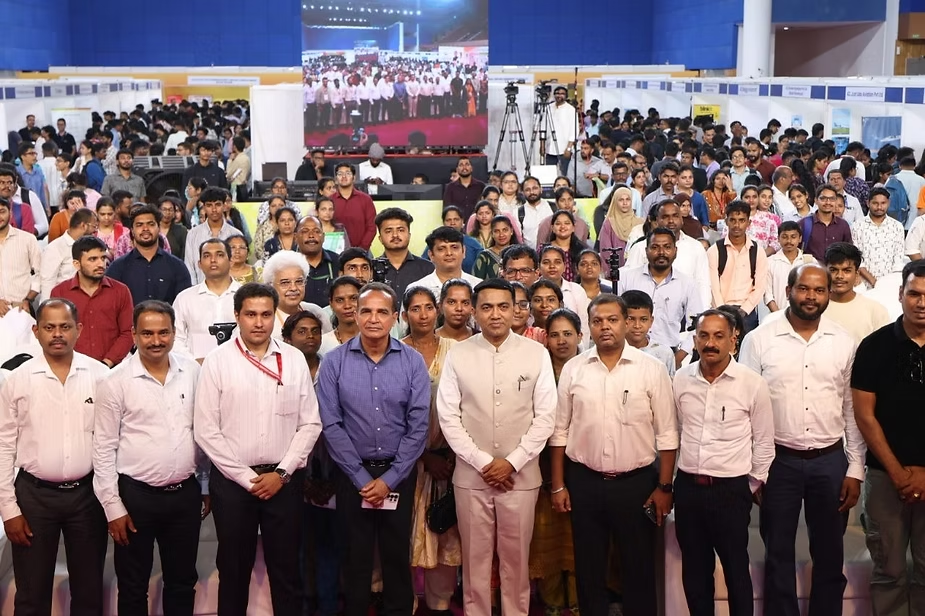
Perhaps the most compelling feature of the Mega Job Fair was that it replaced abstraction with immediacy. Employment often exists as an idea discussed through reports, policies and statistics. Here, it became visible. Young people stood face to face with decision-makers. Companies met potential employees rather than anonymous online applications. The economy, often described through percentages and growth rates, manifested itself in conversations across interview tables. That transformation—from economic theory to human interaction—is what gives such initiatives their enduring significance.
The Mega Job Fair also highlights a larger shift taking place in the way recruitment itself is evolving. A decade ago, a significant number of employment opportunities were discovered through personal networks, newspaper advertisements or scattered recruitment notices. Today, while digital platforms dominate hiring, they have also created a paradox. Candidates often apply to hundreds of positions online without ever interacting with a recruiter, while companies receive thousands of applications that are difficult to evaluate efficiently. The result is a process that can be impersonal and time-consuming for both sides. A large-scale job fair reverses this dynamic by restoring direct human interaction to the hiring process. Within minutes, a recruiter can assess communication skills, confidence and motivation—qualities that rarely emerge from a résumé alone.
For first-time job seekers, this interaction is particularly valuable. Many graduates possess academic qualifications but have limited exposure to professional interviews. Walking into a hall filled with industry leaders can be intimidating, yet it also becomes an educational experience. Every conversation teaches candidates how to present themselves, explain their skills and understand employer expectations. Even those who do not receive immediate offers leave with practical knowledge that improves their prospects in future recruitment processes. In this sense, the value of a Mega Job Fair extends beyond the vacancies advertised on that particular day; it contributes to building a more employment-ready workforce.
Goa’s changing industrial profile makes such platforms increasingly important. The state’s reputation has long been tied to tourism, but manufacturing and pharmaceuticals have quietly emerged as major contributors to its economy. Several globally recognised pharmaceutical companies operate manufacturing facilities in Goa, supplying products to national and international markets. These industries require technicians, engineers, quality analysts, laboratory professionals, logistics specialists and management personnel. The opportunities they create differ significantly from traditional hospitality jobs, demonstrating that the state’s economic future is becoming more diversified and resilient.
The aviation sector provides another example of this transformation. With improved connectivity and the expansion of regional aviation services, Goa is increasingly positioned not merely as a tourist destination but as a transportation hub linking multiple cities. Airlines require professionals across operations, customer service, engineering support, ground handling and administration. Every expansion in connectivity creates a chain reaction of employment opportunities that extends well beyond airports, benefiting tourism, commerce and ancillary services.
Hospitality, meanwhile, continues to reinvent itself. Modern hotels and resorts no longer recruit solely for front-office or housekeeping roles. They seek digital marketers, sustainability managers, culinary specialists, finance professionals, event planners and technology-enabled customer service teams. As visitor expectations evolve, the hospitality workforce must evolve alongside them. The presence of leading hospitality brands at the Mega Job Fair reflects the industry’s continued confidence in Goa’s position as one of Bharat’s premier tourism destinations while simultaneously acknowledging the need for a skilled and adaptable workforce.
Another notable aspect of the event was the participation of companies from mobility, logistics and technology-enabled services. The rise of app-based transportation, rapid commerce, organised delivery networks and integrated logistics has fundamentally changed employment patterns across the country. These sectors generate opportunities not only for drivers and delivery personnel but also for operations executives, customer support teams, technology specialists and managerial roles. Their inclusion at the Mega Job Fair demonstrates that Goa’s employment ecosystem is increasingly aligned with broader national economic trends.
The economic implications of employment generation extend beyond individual salaries. Every new job contributes to local consumption, increases purchasing power and stimulates demand for housing, transportation, retail and services. Economists often describe this as the multiplier effect, where income earned by one individual circulates through the wider economy, supporting additional businesses and employment. When thousands of vacancies are brought together under one platform, the potential impact reaches far beyond the recruitment venue itself. It represents an investment in the state’s future economic activity.
There is also a demographic dimension to this story. Goa has one of the highest literacy rates in the country and a relatively educated workforce. Yet education alone does not guarantee employment. The transition from classrooms to careers requires structured opportunities where talent can connect with industry. Job fairs function as bridges between these two worlds. They shorten the distance between aspiration and employment by allowing candidates to engage directly with recruiters instead of navigating fragmented recruitment channels.
For employers, the benefits are equally significant. Recruiting through isolated advertisements often results in lengthy hiring cycles and inconsistent candidate pools. A Mega Job Fair allows companies to evaluate large numbers of applicants within a compressed timeframe while also strengthening their employer brand among prospective employees. It enables businesses to understand prevailing skill levels, identify emerging talent and establish relationships with educational institutions and workforce development agencies. In competitive industries where attracting qualified professionals is increasingly challenging, these advantages become strategically important.
Perhaps the most powerful images from the event are not the company banners or registration desks but the expressions on the faces of participants. Behind every application is a personal story—a graduate seeking a first opportunity, an experienced employee hoping for career advancement, a family depending on a stable income or a young professional determined to build a future within Goa rather than seeking opportunities elsewhere. Employment statistics often reduce these stories to numbers, but events like this restore their human dimension.
The Mega Job Fair therefore deserves to be viewed not simply as a one-day recruitment exercise but as a reflection of Goa’s broader development journey. It illustrates a state economy that is expanding beyond conventional sectors, an industry ecosystem willing to invest in local talent and a workforce eager to participate in that growth. It demonstrates that economic development is not measured solely through infrastructure projects or investment announcements but also through the opportunities created for ordinary citizens.
As Goa continues to diversify its economy and attract new industries, initiatives that connect employers with job seekers will become increasingly important. The true success of the Mega Job Fair will ultimately be measured not by the number of visitors who enter the venue but by the careers that begin because of it, the confidence it instills in young professionals and the signal it sends that opportunity exists for those prepared to seize it. In a rapidly changing economy, bringing ambition and opportunity together under one roof may be one of the most meaningful investments a society can make in its own future.