


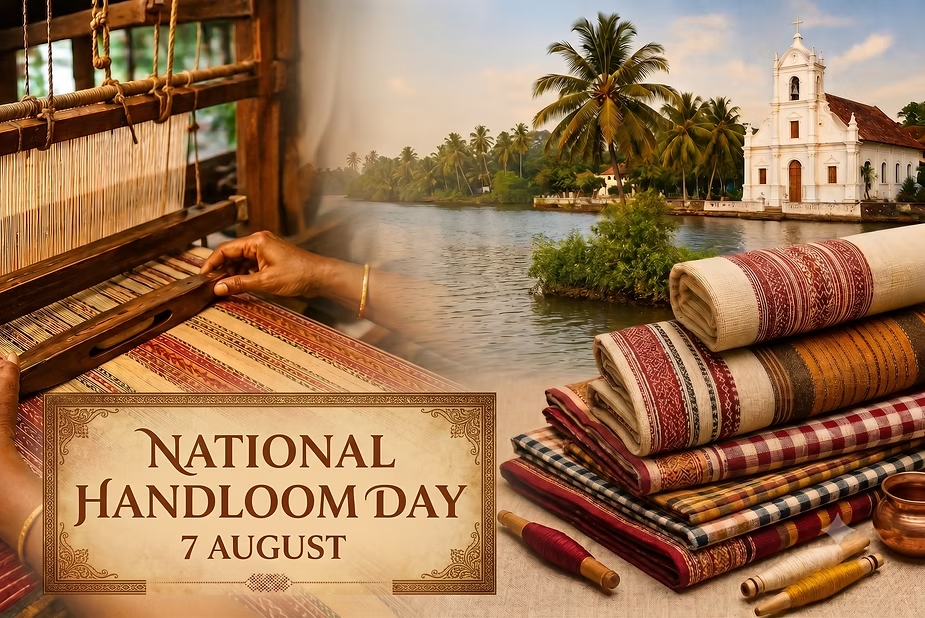
On National Handloom Day, Goa celebrates its Handloom legacy. The Kunbi handloom is far more than a piece of cotton cloth; it is the woven soul of Goa’s indigenous heritage.
For centuries, the Kunbi heavy fabric has been instantly recognisable due its bold red and white checks that served as the second skin of the land’s original inhabitants, the Kunbi and Gauda tribes.
To look at a Kunbi saree today is to see a map of Goan history.
It tells a story that begins in the ancient mud of the paddy fields, passes through a period of heartbreaking near-extinction, and arrives at a modern, high-profile revival led by state policy and cultural pride.
Read Also: Goa’s ST Reservation, Finally in Force!
Cultural Legacy and Pride for Goans
The roots of the Kunbi weave are as deep as the Goan soil itself.
Long before the Portuguese arrived in the 16th century, the Kunbi community of traditional farmers and nomadic cultivators had already mastered this craft.
The saree was never intended to be a fashion statement; it was born out of sheer necessity.
Read Also: CM Sawant Accelerates ST Reservation Push
Because tribal women worked knee-deep in the monsoon slush of the rice paddies, the saree was designed to be practical. It was worn short, stopping just below the knees, and draped without a blouse, secured by a distinctive knot at the shoulder known as the ‘dethali’.
Even the name “Kunbi” offers a window into this world, believed to be derived from kun (people) and bi (seeds). For these original settlers, the fabric was a symbol of labor, survival, and a spiritual connection to the earth.
To know what makes an authentic Kunbi saree unique is its total reliance on the Goan landscape. It is a masterpiece of pre-industrial sustainability.
Historically, the weavers used 100% coarse cotton yarn, making the garment breathable in the tropical humidity yet durable enough for the rigors of farm work.
Perhaps the most fascinating detail lies in the traditional dyeing process.
The signature deep red was not a chemical product but a local recipe: a mixture of iron ore, rice starch (kanji), and vinegar, all materials found in abundance in the Goan backyard. Woven on manual pit looms, even the checkered pattern carried weight.
The red signified energy and vitality, while the geometry of the checks represented the mandala, or the sacred symmetry of nature.
Read Also: Goa Is Building the Team Behind Every Champion With a Sports Science Network
The Silent Years: A Legacy on the Brink
By the mid-20th century, this vibrant tradition faced a ‘silent death’. The reasons were as much social as they were economic.
Colonial-era pressures often discouraged indigenous attire in favor of Western-influenced clothing. However, the most significant blow came in the 1970s with the rise of power looms.
Mass-produced, cheaper synthetic fabrics from neighbouring states flooded the market, and local weavers simply could not compete with the speed of machines.
As Goa modernised, a painful social stigma also took root. Younger generations began to view the Kunbi saree as a ‘caste-marker’, a symbol of social marginalisation they preferred to shed to achieve social mobility.
By the early 2000s, the looms had mostly gone silent, with only a few elderly weavers left in remote corners like Sanguem and Pernem.
Read Also: Goa’s ST Political Reservation Moves Closer
The Renaissance: From Fields to the Global Stage
A strategic revival and preservation was launched due to the recognition that the loss of the Kunbi weave would be an irreversible cultural tragedy.
CM Dr. Pramod Sawant’s government, alongside dedicated cultural activists, began a mission to ‘revitalise the loom’.
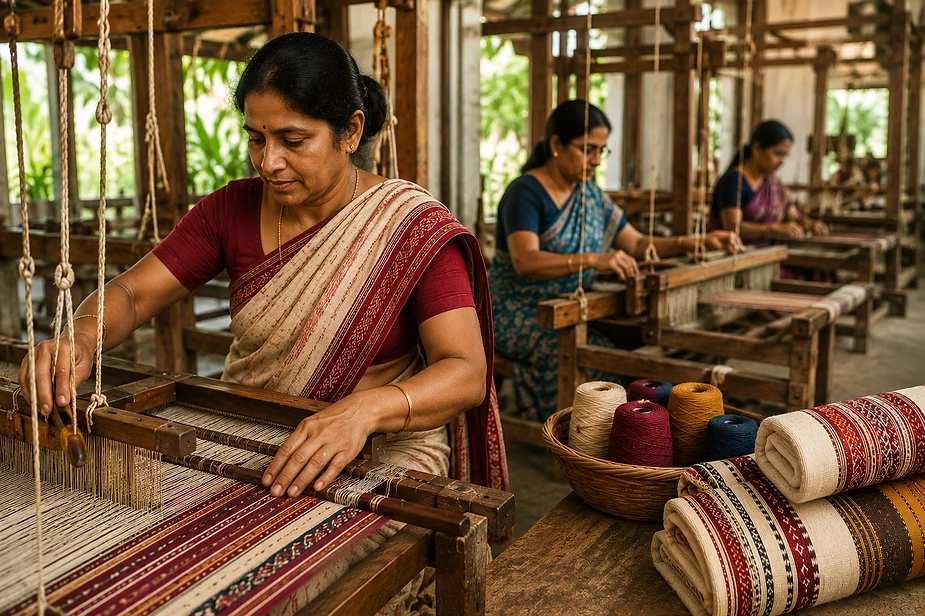
The centerpiece of this effort is the Kunbi Handloom Craft Village in Uguem, Sanguem. This ₹10-crore initiative, managed by the Department of Handicrafts, Textile & Coir, has created a sustainable ecosystem where artisans can live, weave, and sell their work directly to the world.
The development of the Kunbi Handloom Craft Village at Uguem, Sanguem, a project designed to provide permanent infrastructure, workshops, and sales platforms for local weavers.
To institutionalise production, the CM inaugurated the Off Farm Sector Producer Organisation (OFPO) in collaboration with NABARD, while simultaneously setting up dedicated training centres in clusters like Pernem and Keri to build a skilled workforce of first-generation weavers.
Beyond infrastructure, CM Sawant has personally championed the weave by mandating the use of Kunbi shawls at official government functions and gifting them to visiting dignitaries, significantly boosting the market value and visibility of the fabric. By integrating these efforts with the Swayampurna Goa initiative, he has transformed the Kunbi handloom from a fading tradition into a sustainable means of rural entrepreneurship and economic independenceIt isn’t just a production site; it is a living museum.
Through the Swayampurna Goa mission, the state has focused on skilling a new generation, ensuring the craft is passed down to those who might have otherwise abandoned it.
The formation of the Goa Handloom Weavers Cooperative Society has provided financial independence to rural women, turning a dying tradition into a viable modern career.
Simultaneously, legal efforts are underway to secure a Geographical Indication (GI) Tag, ensuring that the Kunbi name is protected from cheap, machine-made imitations.
The fashion world provided the final spark.
The late designer Wendell Rodricks famously brought the Kunbi weave to national ramps, proving that indigenous textiles belonged in the world of luxury.
Today, designers like Verma D’Mello have carried this torch even further, showcasing the fabric at international venues like the Cannes Film Festival.In short, the Kunbi saree is making a triumphant return!
It is no longer confined to the history books or the paddy fields; it is worn with pride at weddings, formal state receptions, and cultural festivals.
This resurgence is a powerful reminder that while a legacy may fade under the pressure of modernisation, it can be reclaimed through a combination of community pride and strategic action.