


For Goa, the sea is far more than a scenic backdrop. It is deeply tied to the state’s identity, economy, livelihoods, tourism industry, and everyday life. From fishing communities and coastal villages to tourism operators, water sports businesses, and maritime movement, Goa’s coastline remains one of its most important strategic and economic assets.
Stretching across nearly 105 kilometres, the Goan coastline supports thousands of livelihoods while also attracting millions of tourists every year. Beaches, rivers, ports, fishing zones, and marine tourism routes collectively create a highly active coastal ecosystem that requires continuous monitoring, rapid response systems, and modern maritime security infrastructure.
As coastal activity continues to expand, the importance of marine policing and coastal vigilance has become significantly greater than before.
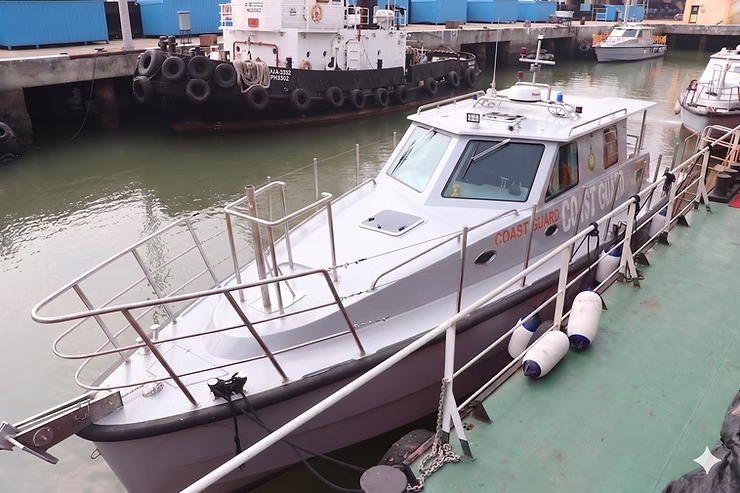
In this backdrop, Goa’s decision to procure a new high-speed Fast Patrol Boat for the Goa Police marks an important step towards strengthening coastal security and upgrading maritime response capabilities across the state.
The Goa government has sanctioned approximately ₹3.4 crore for the procurement of a new 15-metre Fast Patrol Boat aimed at enhancing surveillance, emergency response, marine policing, and coastal enforcement operations.
More importantly, the move reflects a broader effort towards modernising security infrastructure and improving preparedness along Goa’s coastline.
In recent years, maritime security has evolved into a far more complex responsibility than traditional coastal patrolling alone. Coastal police units today are expected to manage multiple functions simultaneously — surveillance, emergency response, rescue operations, suspicious activity monitoring, tourist safety, fisheries support, and rapid enforcement capability across water routes and shoreline zones.
This growing operational complexity has made modern marine infrastructure increasingly necessary.
The new patrol vessel is expected to significantly strengthen Goa Police’s ability to monitor and respond across coastal regions more efficiently. High-speed marine mobility is one of the most critical advantages in maritime policing because emergencies and suspicious movements on water often require immediate intervention.
Unlike land-based operations where access points are fixed, marine environments demand rapid navigation across wide and constantly changing operational zones. Faster patrol capability therefore directly improves response effectiveness.
The upcoming vessel is specifically designed for high-speed interception and shallow-water agility, making it suitable for Goa’s coastal geography and operational requirements. Shallow-water capability is especially important because several coastal areas, estuaries, and near-shore zones require vessels that can navigate efficiently without operational limitations.
The patrol boat is also expected to support round-the-clock coastal surveillance.
Continuous monitoring has become increasingly important due to growing tourism activity, fishing operations, recreational boating, marine transport movement, and expanding use of coastal waters. Maintaining visible marine vigilance across these areas improves both enforcement capability and preventive security presence.
Importantly, the vessel will operate alongside the existing patrol boat “Chandreshwar,” strengthening Goa Police’s marine fleet and effectively increasing overall patrol coverage and operational readiness.
This expansion of maritime infrastructure can significantly improve coastal monitoring across sensitive and high-activity zones.
The timing of the upgrade is particularly relevant because Goa’s coastline experiences growing pressure from multiple forms of activity simultaneously. Tourism seasons bring increased beach movement, water sports operations, private boating, and marine recreation. Fishing communities operate daily across coastal waters, while commercial maritime movement continues through ports and related infrastructure.
Managing this complex ecosystem requires specialised policing systems designed specifically for marine environments.
The investment in modern patrol infrastructure therefore reflects recognition that coastal security must evolve alongside economic and tourism growth.
One of the most important aspects of the upgraded marine capability is its role in emergency response and rescue operations.
Water emergencies can escalate rapidly. Whether involving tourists, fishermen, boating incidents, weather-related situations, missing persons, or stranded vessels, faster deployment capability significantly improves operational outcomes during emergencies.
Quick-response marine systems can reduce rescue delays and strengthen coordination during critical situations where time becomes a major factor.
For Goa’s fishing communities, stronger coastal policing and emergency response infrastructure can provide additional reassurance and operational support. Fishermen often face unpredictable marine conditions and may require rapid assistance during technical failures, rough weather, or distress situations at sea.
The improved marine infrastructure is expected to enhance the state’s ability to respond more effectively during such incidents.
The presence of trained marine police personnel further strengthens this operational capacity. Reports indicate that approximately ten trained marine personnel are expected to support operations associated with the upgraded patrol infrastructure.
This is important because maritime policing requires specialised skills, including navigation, marine coordination, surveillance procedures, rescue operations, and rapid-response handling under difficult conditions.
Modern coastal security therefore depends not only on equipment but also on trained personnel capable of operating effectively within maritime environments.
The development also reflects a broader national trend towards police modernisation and technology-driven security systems.
Across Bharat, policing agencies are increasingly upgrading mobility infrastructure, surveillance mechanisms, communication systems, and rapid-response capabilities to adapt to evolving operational demands. Coastal states, in particular, require specialised maritime policing systems because traditional land-based security frameworks alone are insufficient for marine environments.
Goa’s latest patrol boat acquisition aligns with this larger movement towards specialised and modernised policing infrastructure.
At the same time, stronger coastal vigilance has implications beyond law enforcement alone.
Goa’s economy is heavily dependent on coastal activity. Tourism, fisheries, marine recreation, hospitality, and waterfront businesses all rely directly or indirectly on perceptions of safety and stability. Stronger marine policing therefore contributes not only to public security but also to economic confidence.
For tourists visiting Goa, visible coastal security infrastructure provides reassurance regarding beach safety, water activity management, and emergency preparedness. Internationally, tourism destinations increasingly understand that public safety and visitor confidence are deeply connected.
The state’s coastline is one of Goa’s strongest global identities. Protecting that coastline requires continuous investment in both environmental management and security systems.
The new patrol vessel therefore symbolises more than just an equipment upgrade. It represents a proactive governance approach towards improving preparedness, operational speed, and marine enforcement capability in a rapidly evolving coastal environment.
The focus on faster surveillance, rapid interception, smarter enforcement, and emergency readiness reflects how modern policing itself is changing. Security systems today depend increasingly on mobility, speed, coordination, technology, and preventive vigilance rather than static enforcement models alone.
The investment also demonstrates recognition that maritime security is no longer a secondary component of governance for coastal states. As tourism expands, marine activity increases, and coastal economies become more complex, stronger marine policing infrastructure becomes essential for long-term resilience.
Goa’s geography naturally makes coastal vigilance a permanent priority.
Whether protecting fishermen, assisting tourists, monitoring suspicious movement, supporting rescue operations, or ensuring safer waters overall, marine police infrastructure plays an increasingly central role in maintaining coastal stability.
For ordinary residents, the most visible impact may simply be greater confidence.
Confidence that emergency response systems are becoming faster.
Confidence that surveillance capability is improving.
Confidence that coastal activity is being monitored more effectively.
And confidence that governance systems are adapting to modern realities instead of relying on outdated infrastructure.
Ultimately, the significance of the new Fast Patrol Boat lies not only in the vessel itself, but in what it represents — a broader effort to build a safer, smarter, and more prepared Goa.
A state where growing tourism and coastal activity are matched by stronger vigilance, faster response systems, and modern security infrastructure capable of protecting both people and livelihoods.
Because in Goa, protecting the coastline ultimately means protecting the state itself.