


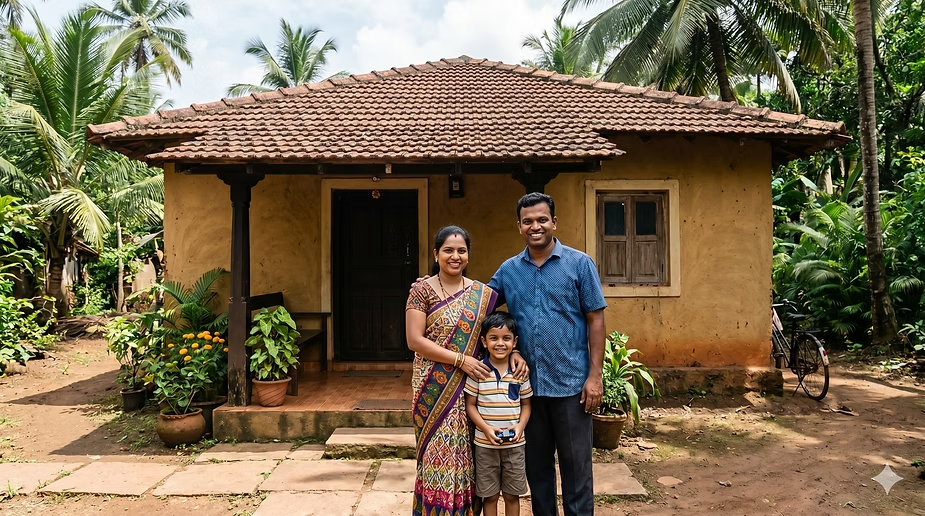
For decades, thousands of Goan families lived in homes they called their own but could never fully claim as theirs. Many had inherited houses from parents and grandparents, built on government land, comunidade land, or properties caught in legal and administrative complexities. While these homes provided shelter and community roots, the absence of formal ownership documents created a persistent sense of uncertainty. Families often found themselves unable to access bank loans, undertake legal property transactions, transfer assets smoothly to future generations, or make significant investments in improving their homes.
The Government of Goa’s Mhaje Ghar Scheme has emerged as one of the most significant housing regularisation initiatives in the state’s recent history. Designed to provide legal ownership rights to residents occupying eligible houses built on government and community lands, the scheme represents a major governance intervention aimed at resolving longstanding land and housing issues affecting thousands of citizens.
The latest announcement by Chief Minister Dr. Pramod Sawant marks a major milestone in the implementation of this programme. According to the Chief Minister, more than 5,000 applications under the Mhaje Ghar Scheme have already been approved, while approximately 3,000 ownership orders have either been prepared or are ready for distribution to beneficiaries. The government expects nearly 5,000 people to benefit from the initiative in the immediate phase, making it one of the largest housing regularisation exercises undertaken by the state in recent years.
Goa’s Export Gateway Expands: How the India–Oman CEPA Creates New Opportunities for Goan Businesses
The significance of this development extends beyond administrative approvals. For thousands of families, these ownership orders represent legal recognition, security, dignity, and certainty after years—sometimes decades—of ambiguity regarding their residential status. The scheme is effectively transforming informal occupation into legally recognised ownership, creating a foundation for stronger social and economic stability across Goa.
The origins of the Mhaje Ghar Scheme can be traced to the state’s recognition of a unique challenge. Over many decades, residential structures emerged on various categories of land where ownership documentation was either absent, incomplete, disputed, or administratively difficult to secure. While residents often occupied these homes peacefully for generations, legal ownership remained unresolved. This created barriers not only for individual families but also for broader planning and governance efforts.
The scheme was formally launched in October 2025 in the presence of Union Home Minister Amit Shah and Goa Chief Minister Dr. Pramod Sawant. The initiative was conceived as a comprehensive housing regularisation programme that would provide legal ownership rights to eligible residents while simultaneously bringing more properties into the formal land records system. By doing so, the government sought to address a historical issue through a structured policy framework rather than piecemeal administrative interventions.
One of the most important aspects of the scheme is its focus on housing security. Legal ownership is more than a document; it is a gateway to economic opportunity. Families possessing valid ownership rights can access institutional finance, secure housing loans, invest confidently in property improvements, and ensure smoother inheritance processes for future generations. In practical terms, ownership transforms a house from a shelter into a recognised economic asset.
From Occupants to Owners: How 350 Sada GRB Families Are Finally Securing Their Future
Recent developments indicate that the implementation of the scheme has accelerated significantly. The government has announced special programmes for the distribution of ownership orders, including large-scale beneficiary events in South Goa and North Goa. Dedicated assistance counters have also been established to help applicants complete documentation and resolve procedural issues. These measures demonstrate an emphasis on citizen-centric service delivery and administrative accessibility.
The scale of public interest in the programme has been substantial. Earlier government statements indicated that approximately 50,000 application forms had been distributed following the launch of the scheme. This level of response highlights the extent of unmet demand for housing regularisation and ownership security across the state. It also reflects the importance of land and housing issues in the everyday lives of Goan families.
The legislative framework supporting the scheme has also undergone important reforms. Amendments introduced by the government created provisions for the regularisation of dwelling houses constructed on eligible categories of comunidade land. Additional changes opened fresh opportunities for applicants who had missed previous deadlines or whose applications had been rejected under earlier frameworks. These legislative interventions were designed to expand access and reduce procedural barriers.
Another significant reform involved simplifying documentation requirements. Earlier procedures often required multiple permissions and approvals that slowed down applications. The revised framework has streamlined several processes, making it easier for eligible residents to navigate the system. This administrative simplification reflects a broader governance philosophy focused on improving service delivery and reducing bureaucratic obstacles.
The government’s approach has also emphasised inclusivity. Many beneficiaries belong to families that have occupied the same homes for generations but lacked the legal means to establish formal ownership. By addressing these historical anomalies, the scheme seeks to ensure that long-term residents are not disadvantaged simply because of legacy documentation issues or outdated administrative processes.
Beyond individual beneficiaries, the scheme carries wider economic implications. Formal property ownership contributes to greater economic participation. Properties with clear titles become eligible for financing, investment, and lawful transfer. This creates opportunities for wealth creation, asset utilisation, and financial inclusion. In the long run, such outcomes can strengthen local economies and improve household resilience.
The scheme also supports better governance outcomes. Bringing previously informal or irregular residential properties into the formal legal framework improves land records management and enhances administrative clarity. Accurate land and housing records support planning, infrastructure development, taxation systems, and service delivery. As more properties enter the formal system, the state’s ability to manage growth and development improves correspondingly.
Importantly, the government has sought to balance regularisation with future compliance. Officials have repeatedly emphasised that the scheme is intended to resolve historical issues rather than encourage new unauthorised construction. The administration has maintained that while genuine long-term residents deserve relief, future violations of planning and construction regulations will not be tolerated. This distinction is central to maintaining public confidence in the initiative.
Nine Lives Saved at Morjim: How Goa’s Beach Safety Network Prevented a Tragedy
Recognising that many eligible applicants required additional time to complete documentation and obtain necessary approvals, the Goa Cabinet approved an extension of the scheme. The deadline has been extended until March 2027, providing additional opportunities for eligible residents to submit applications and complete procedural requirements. This decision is expected to benefit many families whose applications were delayed due to administrative or documentary challenges.
The extension also demonstrates the government’s responsiveness to citizen concerns. During discussions in the Goa Legislative Assembly, legislators highlighted difficulties faced by some applicants in obtaining required approvals and documents. The government’s decision to extend the deadline reflected a willingness to adapt implementation strategies based on feedback from the ground.
The human impact of the scheme remains its most compelling dimension. Behind every approved application is a family that gains legal certainty over its home. For elderly residents, ownership recognition provides peace of mind. For younger generations, it creates opportunities for financial planning and asset creation. For entire communities, it strengthens stability and social confidence.
The distribution of approximately 3,000 ownership orders represents more than a bureaucratic exercise. Each order symbolises a transition from uncertainty to security. Families that once faced questions about the legal status of their homes can now look toward the future with greater confidence. This transformation underscores the role that effective governance can play in addressing longstanding social challenges.
The broader significance of the Mhaje Ghar Scheme lies in its ability to combine policy reform, legislative action, administrative execution, and citizen outreach into a single governance initiative. It illustrates how governments can address historical issues through structured interventions that produce measurable benefits for ordinary citizens.
As Goa continues its development journey, housing security will remain a critical component of inclusive growth. Stable housing contributes to stronger families, healthier communities, and greater economic participation. By providing legal ownership rights to thousands of residents, the Mhaje Ghar Scheme is helping create the foundations for a more secure and prosperous future.
The approval of more than 5,000 applications marks a significant milestone, but it is also part of a larger process. With ownership orders being distributed, applications continuing to be processed, and the deadline extended to accommodate more beneficiaries, the programme is likely to impact even more families in the coming months. The initiative demonstrates how targeted governance interventions can produce tangible improvements in people’s lives while strengthening institutional systems.
For thousands of Goan families, the message is clear: a home is no longer merely a place to live. Through the Mhaje Ghar Scheme, it is becoming a legally recognised asset, a source of security, and a symbol of dignity. The transition from uncertainty to ownership represents one of the most meaningful forms of social empowerment, and the continuing progress of the scheme suggests that many more families are set to experience that transformation in the years ahead.