


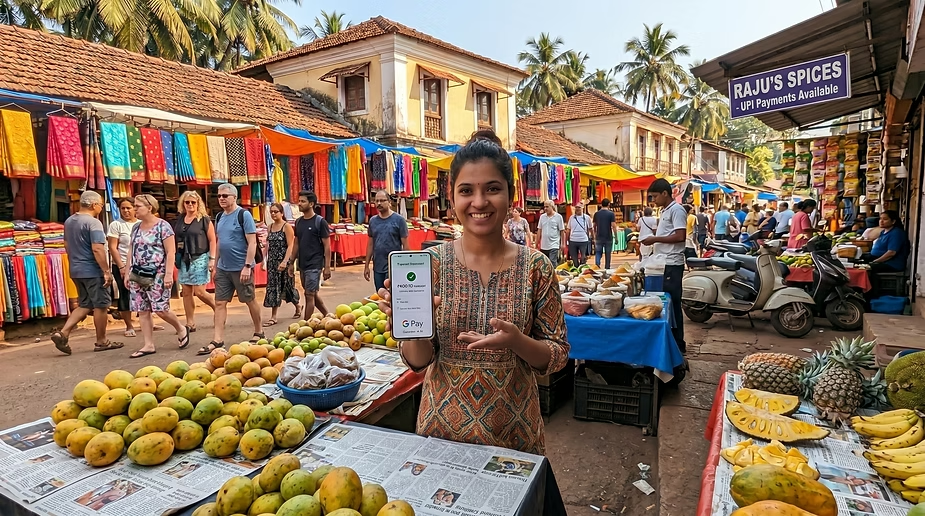
For generations, a familiar scene played out across Goa. A customer would buy a packet of biscuits, a cup of tea or a few vegetables, only to discover that neither they nor the shopkeeper had exact change. The solution was simple but imperfect—a toffee, a chocolate or some small item handed over in place of a few rupees. It was an accepted part of daily commerce, woven into the rhythm of local markets and neighbourhood shops.
Today, that scene is rapidly disappearing.
Instead, a customer pulls out a smartphone, scans a QR code and completes the payment in seconds. No search for coins. No arguments over change. No trips to the ATM. What was once an inconvenience accepted as normal has largely been solved through a technology that has quietly transformed the way Bharat conducts business: the Unified Payments Interface, better known as UPI.
As UPI completes a decade since its launch, Goa offers a compelling example of how digital public infrastructure can reshape everyday life. From bustling municipal markets and village grocery stores to beach shacks and taxi operators, digital payments have become an integral part of commerce across the State.
The story of UPI began on April 11, 2016, when it was launched by the National Payments Corporation of India (NPCI) under the oversight of the Reserve Bank of India. The objective was ambitious yet simple—to create a real-time payment system that would allow people to transfer money instantly between bank accounts using a mobile phone. Unlike traditional banking systems that often involved delays, complicated account details or multiple steps, UPI promised simplicity. A mobile number, QR code or virtual payment address could be enough to move money instantly.
Few could have predicted the scale of the transformation that would follow.
When UPI started operations, transaction volumes were tiny by today’s standards. In FY 2016-17, the platform processed roughly two crore transactions. A decade later, annual transaction volumes have crossed 24,000 crore transactions, while transaction values have surged to approximately ₹314 lakh crore. The increase represents one of the fastest adoptions of a financial technology platform anywhere in the world.
The growth has been so dramatic that UPI now accounts for around 81 percent of all retail digital payment transactions in Bharat, making it the world’s largest real-time payment ecosystem.
National figures tell only part of the story. The real significance of UPI can be seen in places like Goa, where digital payments have become deeply embedded in daily life.
Across Panaji Market, Mapusa Market and municipal markets throughout the State, QR codes are now as common as weighing scales and cash boxes. Flower vendors, fish sellers, fruit traders and roadside food stalls routinely accept payments through digital platforms. What initially seemed like an urban convenience has evolved into a mainstream payment mechanism used across economic and social groups.
One of the strongest indicators of Goa’s digital transition is the sheer volume of transactions taking place every month. According to figures reported earlier this year, Goa recorded more than four crore digital transactions worth over ₹6,000 crore in a single month. Such numbers are remarkable for a State with a relatively small population and reflect both high digital adoption and a vibrant local economy.
Several factors have contributed to this transformation. The rapid spread of smartphones, affordable internet access, expansion of mobile banking services and wider availability of high-speed mobile networks have created conditions where digital payments are often easier than cash transactions. The tourism-driven nature of Goa’s economy has further accelerated adoption. Visitors increasingly expect digital payment options wherever they travel, encouraging businesses of every size to embrace QR-based transactions.
Research examining state-wise UPI trends identifies Goa as an outlier that ranks high in both transaction volume and value, a trend attributed partly to tourism and the widespread use of digital payments by visitors.
The impact on small vendors has been particularly significant.
For many flower sellers and market vendors, UPI has reduced dependence on cash handling. Previously, a day of sales meant carrying cash, maintaining change and making frequent trips to deposit money in bank accounts. Today, earnings can move directly into a bank account as transactions occur. This has improved convenience, reduced the risk associated with carrying cash and simplified bookkeeping.
The benefits become even more visible during emergencies or after business hours. Instant bank-to-bank transfers allow individuals to send money quickly for medical expenses, family emergencies or urgent purchases without relying on physical cash. For many people, especially those operating small businesses, this capability has fundamentally changed the way they manage money.
The COVID-19 pandemic accelerated this behavioural shift.
During the pandemic, contactless transactions became a necessity rather than a convenience. Consumers sought ways to minimise physical contact, while businesses looked for safer methods of accepting payments. UPI emerged as a practical solution. The habits formed during those years have largely remained intact, helping digital payments become routine even after restrictions ended.
The numbers support this trend. UPI’s growth accelerated dramatically through the early 2020s and continues to set records. In May 2026 alone, the platform processed more than 23 billion transactions worth nearly ₹30 lakh crore, highlighting the extraordinary scale it has achieved.
Yet the story is not entirely one of uninterrupted success.
Speak to local shopkeepers and many will point to challenges that continue to affect day-to-day operations. Network connectivity remains one of the biggest concerns. Although mobile internet coverage has improved significantly, inconsistent signals can still disrupt transactions, particularly during peak hours or in areas where connectivity is weaker.
The issue becomes especially problematic when transaction notifications are delayed. A customer may complete a payment process on their phone, while the merchant’s confirmation arrives several minutes later—or not at all. In busy environments, this can create confusion and occasionally result in losses.
Many small business owners recount situations where customers claim payment has been made, only for merchants to later discover that the transaction failed. By that point, the customer has often left. Recovering the money can be difficult, particularly when dealing with tourists or unfamiliar customers.
These concerns highlight an important reality about digital infrastructure. The success of a payment platform depends not only on software but also on the reliability of supporting systems such as mobile networks, internet connectivity and banking infrastructure.
Critics argue that Bharat must continue investing in these foundational systems to ensure digital payments remain dependable even in high-volume environments. While UPI has solved many traditional problems associated with cash, it has introduced a new set of challenges centred around connectivity, authentication and transaction reliability.’
Despite these concerns, confidence in digital payments remains strong.
The reason is simple: for most users, the benefits far outweigh the drawbacks.
Consumers appreciate convenience. Merchants appreciate faster settlements. Banks appreciate lower cash-handling costs. Governments appreciate greater transparency and financial inclusion. The result is a payment ecosystem that serves multiple stakeholders simultaneously.
UPI’s success has also reinforced Bharat’s reputation as a global leader in digital public infrastructure. What began as a domestic payment solution is now attracting international attention. Several countries are exploring interoperability arrangements and studying Bharat’s digital payment model as they seek to modernise their own financial systems.
The platform continues to evolve as well. New services, expanded transaction capabilities, recurring payments and integration with additional financial products are steadily broadening UPI’s role beyond simple peer-to-peer transfers. Recent initiatives even aim to extend UPI-based functionality into areas such as provident fund withdrawals and other government-linked services, further embedding digital payments into everyday governance and public service delivery.
For Goa, the implications are substantial.
The State’s economy depends heavily on tourism, hospitality, retail trade and small enterprises. Digital payments help these sectors operate more efficiently by reducing friction in transactions. A tourist arriving from another part of Bharat no longer needs to carry large amounts of cash. A local entrepreneur can receive payments instantly. A market vendor can complete dozens of transactions without worrying about change.
This efficiency may seem minor at the level of an individual purchase, but across millions of transactions, it contributes meaningfully to economic activity.
There is also a social dimension to this transformation. Digital payments have helped bring many individuals into the formal financial system. Small vendors who previously operated almost entirely in cash now maintain active bank accounts and digital transaction histories. These records can support access to financial services, lending opportunities and business growth.
As Goa continues to modernise its infrastructure and expand digital connectivity, the role of UPI is likely to grow even further. Emerging technologies such as UPI Lite, offline payment solutions and enhanced fraud-prevention mechanisms may help address some of the current limitations while improving user experience.
Ten years after its launch, UPI is no longer merely a payment method. It has become part of the State’s economic fabric.
The transition from cash to digital payments did not happen overnight. It required technological innovation, public trust, widespread smartphone adoption and a willingness among ordinary people to change long-established habits. Yet that transformation has occurred, often quietly and without fanfare.
Today, a QR code sits beside cash boxes in markets across Goa. Fisherwomen accept payments through mobile phones. Flower vendors complete transactions with a scan. Small businesses settle accounts instantly. Tourists move through the State without searching for ATMs.
The toffee once handed out as change has become a relic of another era.
In its place stands a small black-and-white QR code—a symbol not only of technological progress but also of how governance, infrastructure and innovation can come together to simplify everyday life.
A decade after UPI’s arrival, paperless payments in Goa are no longer a glimpse of the future.
They are simply routine.