


There is a sentence heard inside countless homes across Goa every single day. “It’s nothing serious. I’ll go to the doctor later.” That “later” often stretches into months. Sometimes years. For generations, women have silently normalized pain, exhaustion, weakness, dizziness, and chronic health discomfort as an unavoidable part of life. A backache becomes routine. Constant fatigue becomes “normal.” High blood pressure remains unnoticed. Diabetes quietly develops in the background. The body sends warning signs, but responsibilities always come first.
Across households in Goa, women continue to hold entire families together. They wake up before everyone else. They prepare meals, manage homes, support elderly parents, care for children, contribute financially, and often handle agricultural or informal work alongside domestic responsibilities. They become the emotional and operational backbone of the household. Yet when it comes to their own health, they are almost always the last priority.
Sometimes it is because there is no time. Sometimes it is because of fear of hospital expenses. And many times, it is because women themselves believe the family’s needs matter more than their own physical well-being.
Today, Goa is attempting to change that reality.
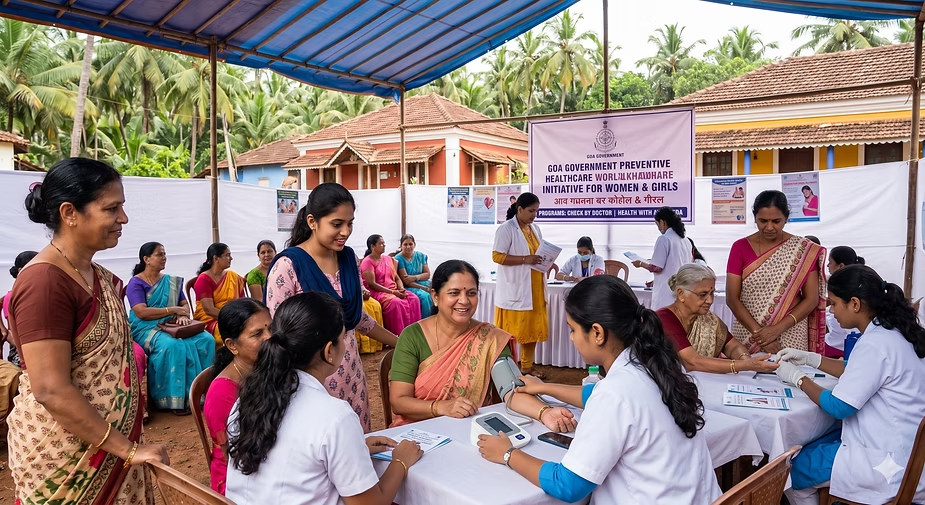
Through large-scale healthcare initiatives like “Check by Doctor” and “Health with Ayurveda,” the state government has launched an aggressive preventive healthcare drive aimed directly at women and girls across the state. Already, over 50,000 women have benefited through free medical screenings, medicines, and treatment assistance.
But beyond the numbers lies something far more important: a shift in public thinking. Goa’s healthcare outreach is beginning to send a powerful cultural message — women’s health cannot continue to wait until crisis arrives.
For years, preventive healthcare remained one of the weakest links in India’s broader public health system. Most people sought medical care only after conditions became severe enough to interfere with daily functioning. This pattern became even more visible among women, especially in semi-urban and rural communities where household responsibilities often overshadow personal health concerns.
The consequences of delayed healthcare can be devastating. Conditions like hypertension, diabetes, anemia, thyroid disorders, osteoporosis, and reproductive health complications frequently remain undiagnosed for years. By the time medical attention is finally sought, treatment often becomes more expensive, more invasive, and significantly more difficult.
Healthcare experts consistently emphasize that early detection is one of the strongest tools available in modern medicine. Identifying blood pressure issues early can prevent strokes and heart disease. Detecting elevated sugar levels early can help prevent long-term diabetic complications. Addressing nutritional deficiencies early improves immunity, productivity, and overall quality of life.
This is precisely why Goa’s current initiative matters so deeply. Instead of waiting for illnesses to escalate into emergencies, the state is actively taking healthcare directly into communities through free health camps and preventive screenings.
The scale of the outreach itself is significant. More than 50,000 women and girls have already participated in the programmes across Goa. These are not symbolic or isolated interventions. The initiative has expanded across multiple regions, reaching women who may otherwise never have voluntarily visited hospitals for routine check-ups.
The services being provided are practical, immediate, and highly accessible. Women attending the camps receive free screenings for diabetes and blood pressure, access to medicines, and healthcare support assistance reaching up to ₹20,000 in certain cases. Importantly, the initiative directly addresses the two biggest barriers that prevent women from seeking healthcare in the first place: affordability and accessibility.
For many families, healthcare delays are not caused by ignorance. They are caused by fear. Fear of expenses. Fear of medical tests. Fear of hospital bills. Fear of discovering something serious that the family cannot financially manage.
This economic anxiety forces many women to continuously postpone healthcare until situations become unavoidable. By removing immediate financial burdens through free screenings and assistance, Goa’s healthcare drive is significantly reducing that hesitation.
However, the challenge extends beyond economics. There is also a deep psychological barrier surrounding women’s healthcare in Indian society.
Many women have been socially conditioned to place themselves last. Their own needs are frequently treated as secondary to the needs of children, husbands, parents, or the household itself. A mother may spend immediately on her child’s treatment while ignoring her own worsening symptoms for months. A woman may continue daily labor despite severe physical discomfort simply because responsibilities cannot pause.
This emotional conditioning creates a dangerous culture where women normalize suffering.
That is why awareness campaigns surrounding the current healthcare drive are emotionally important. The messaging does not merely speak about medicine or treatment. It speaks directly to families. It encourages children, siblings, husbands, and relatives to actively bring the women and girls from their households for check-ups.
Take your mother. Take your sister. Take your wife. Take your grandmother – to the nearest health camp.
Because preventive healthcare often begins with someone else insisting that care cannot wait any longer.
Another major strength of Goa’s initiative lies in its decentralized approach. Accessibility remains one of the biggest healthcare challenges across India. Long travel distances, overcrowded hospitals, transportation costs, and work responsibilities often discourage routine medical visits.
Community-based health camps solve many of these issues by bringing healthcare directly into neighborhoods and localities.
This creates multiple benefits simultaneously. Elderly women can access screenings more easily. Transportation costs are minimized. Waiting times are reduced. Participation becomes socially normalized within communities. Most importantly, localized camps create a less intimidating environment than large hospital settings, especially for women who rarely seek formal healthcare.
Alongside modern screenings, the “Health with Ayurveda” initiative also introduces a preventive wellness component rooted in traditional Indian healthcare systems. Ayurveda has historically focused heavily on lifestyle management, nutrition, immunity strengthening, and long-term bodily balance. By integrating wellness-oriented approaches alongside medical screenings, the programme attempts to encourage a more preventive culture around healthcare rather than a purely reactive one.
For many women, especially from traditional households, Ayurveda-based outreach may also feel culturally familiar and approachable, helping increase participation and trust.
The impact of healthier women extends far beyond individual beneficiaries. Public health research globally has consistently shown that women’s health directly influences entire household ecosystems. Healthier women improve family nutrition, strengthen child development outcomes, stabilize household finances, and increase long-term educational opportunities for children.
When women remain healthy, entire families function more effectively.
This is why women-focused healthcare initiatives create social impact far beyond healthcare statistics themselves. Supporting women’s health means strengthening communities.
The scale of Goa’s outreach therefore carries significant long-term implications. More than 50,000 women benefiting from preventive healthcare means tens of thousands of families indirectly benefiting from improved health awareness and early medical intervention.
The initiative also reflects a broader shift in how governance itself is increasingly being understood. Modern governance is no longer evaluated solely through infrastructure projects or economic announcements. Citizens increasingly judge governance through accessibility, responsiveness, and quality-of-life improvements.
Healthcare remains one of the most emotionally personal dimensions of governance because it directly intersects with fear, survival, dignity, and family well-being.
When governments actively reduce barriers to healthcare access, public trust strengthens significantly. Citizens begin feeling that governance is reaching them not only during elections or emergencies, but in the everyday realities of life.
Economically, preventive healthcare also makes long-term sense for governments themselves. Treating advanced diseases places far greater strain on healthcare systems than preventing them early. Large-scale preventive screenings help reduce hospitalization burdens, lower emergency treatment costs, and improve workforce productivity by keeping populations healthier over time.
For a state like Goa, where tourism and service industries rely heavily on an active and productive population, preventive healthcare becomes both a social and economic investment.
Yet despite the infrastructure and outreach, the biggest challenge remains awareness and participation.
Many women will still continue saying, “I’ll go later.” “It’s probably nothing serious.” “There’s too much work today.” “We’ll spend money if it becomes necessary.”
This is why the current June 5 deadline for the camps is important. Deadlines create urgency. They encourage action before postponement returns. For many women, this may become the first proper health screening they have undergone in years.
And for some, early diagnosis through these camps may genuinely become life-saving.
Behind every statistic lies a deeply human story. A mother silently tolerating fatigue for years. A grandmother unknowingly living with hypertension. A woman delaying treatment because she feared medical expenses. A caregiver finally becoming the one receiving care.
These healthcare camps are not merely administrative exercises or public relations initiatives. They represent intervention at very human moments — moments where someone finally feels prioritized.
Ultimately, the true strength of a healthcare system is not measured only by hospitals or technology. It is measured by how early, how affordably, and how compassionately it reaches ordinary people.
Goa’s women-focused healthcare drive is attempting exactly that.
By combining preventive screenings, free medicines, financial assistance, and community outreach, the state is directly confronting the reasons women have historically delayed healthcare for so long.
With thousands of women in Goa receiving the benefits– the most important achievement is not numerical at all.
It is cultural.
The message slowly spreading across Goa’s households is finally beginning to change.
A woman’s health is not something that should wait until tomorrow.
It deserves attention today.