


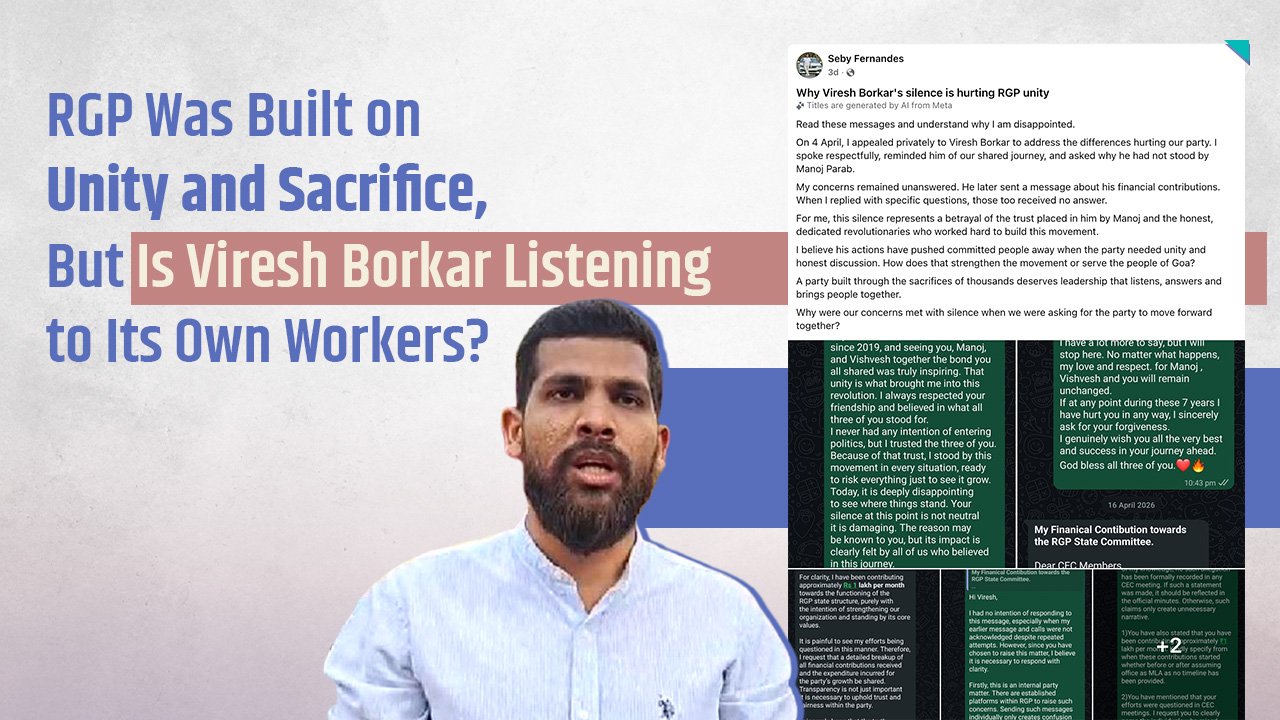
The Revolutionary Goans Party emerged from a grassroots movement that promised to protect Goa’s identity and give ordinary Goans a political voice. However, recent exchanges between a party supporter and MLA Viresh Borkar have raised questions about internal communication, accountability and the party’s commitment to unity. A movement built through the sacrifices of thousands cannot afford to ignore the concerns of its own workers.
A Movement That Promised Change
When the Revolutionary Goans movement began in 2017, it brought together young Goans who wanted to protect their state’s identity, land, culture and employment opportunities. Led by Manoj Parab, Viresh Borkar and Vishvesh Naik, the movement gradually developed into a political organisation. In November 2021, it became the Revolutionary Goans Party (RGP), offering Goans a regional political alternative.
Thousands of supporters invested their time, energy and personal resources in building this movement. They believed in its promise to give ordinary Goans a stronger voice and to challenge established political practices.
But a movement built on unity and collective sacrifice must also demonstrate those values within its own organisation. Recent exchanges involving RGP MLA Viresh Borkar have raised uncomfortable questions about whether the party continues to uphold the principles that brought its supporters together.
An Appeal for Unity That Received No Clear Answer
In a message dated April 4, a party supporter privately approached Borkar with concerns about the growing differences within RGP. The supporter recalled the friendship and shared journey between Borkar, Manoj Parab and Vishvesh Naik, explaining that their unity had inspired many people to join the movement.
The message raised a direct concern: why had Borkar not stood by Manoj Parab when internal differences emerged?
The supporter also questioned why an issue that could have been resolved through discussions among the leaders had escalated to the Central Executive Committee (CEC).
Rather than receiving the meaningful discussion the supporter sought, the exchange subsequently shifted towards Borkar’s financial contributions to the party.
Financial Contributions Cannot Replace Accountability
In a separate message addressed to CEC members, Borkar stated that he contributed approximately ₹1 lakh every month towards the functioning of RGP’s state structure. He expressed disappointment over allegations that his financial contribution had been zero and requested a detailed account of the party’s contributions and expenditure.
Financial transparency is undoubtedly important for every political organisation. However, the supporter responding to Borkar’s message raised several questions about the claim.
The response sought clarification on when these contributions began, who had allegedly questioned his financial support and whether such allegations appeared in official CEC meeting minutes. It also questioned the lack of specific details behind his claims.
These questions highlight an important distinction: financial contributions and political accountability are separate matters. Supporting a party financially does not automatically resolve concerns about leadership, communication or internal disagreements.
More importantly, the original appeal concerned unity and the relationship between Borkar and Manoj Parab. The financial discussion did not answer those fundamental concerns.
A Grassroots Movement Cannot Ignore Its Own People
What makes this episode particularly disappointing for committed RGP supporters is the larger question it raises about the movement’s future.
The people who helped build RGP did not join merely to support individual leaders. They joined because they believed in a collective vision for Goa. Many stood with the organisation through difficult periods, invested their resources and worked tirelessly to establish it as a political alternative.
They deserve leaders who listen to their concerns rather than leave important questions unanswered.
Borkar’s position as the party’s elected MLA carries responsibilities beyond representing St Andre in the Assembly. It also demands accountability towards the people and grassroots workers who helped create the political platform that brought him to power.
Differences within a political organisation are not unusual. However, leaders must address them through dialogue, mutual respect and transparent decision-making. Allowing disagreements to deepen only risks weakening the organisation from within.
Who Will Protect the Movement’s Original Ideals?
RGP was created to challenge conventional politics and give Goans a reason to believe in a different kind of leadership. Its strength came from ordinary people who placed their trust in a collective movement.
That trust should not become secondary to individual positions or internal rivalries.
The questions raised by the supporter deserve serious consideration. Why did an appeal for reconciliation fail to produce meaningful dialogue? Why did concerns about unity remain unresolved? And how can RGP expect grassroots workers to remain committed if they feel their voices no longer matter?
Ultimately, a political movement belongs to the people who believe in its ideals and work to advance them. Leaders may hold positions, but the movement’s strength comes from its workers and supporters.
RGP must remember that it was built through unity, not individual influence. If it wants to preserve its credibility and continue serving Goa, its leadership must listen to its own people before expecting the people of Goa to listen to it.
Rushed for Votes, Rejected by Reality: Viresh Borkar’s Bambolim Bridge Blunder