


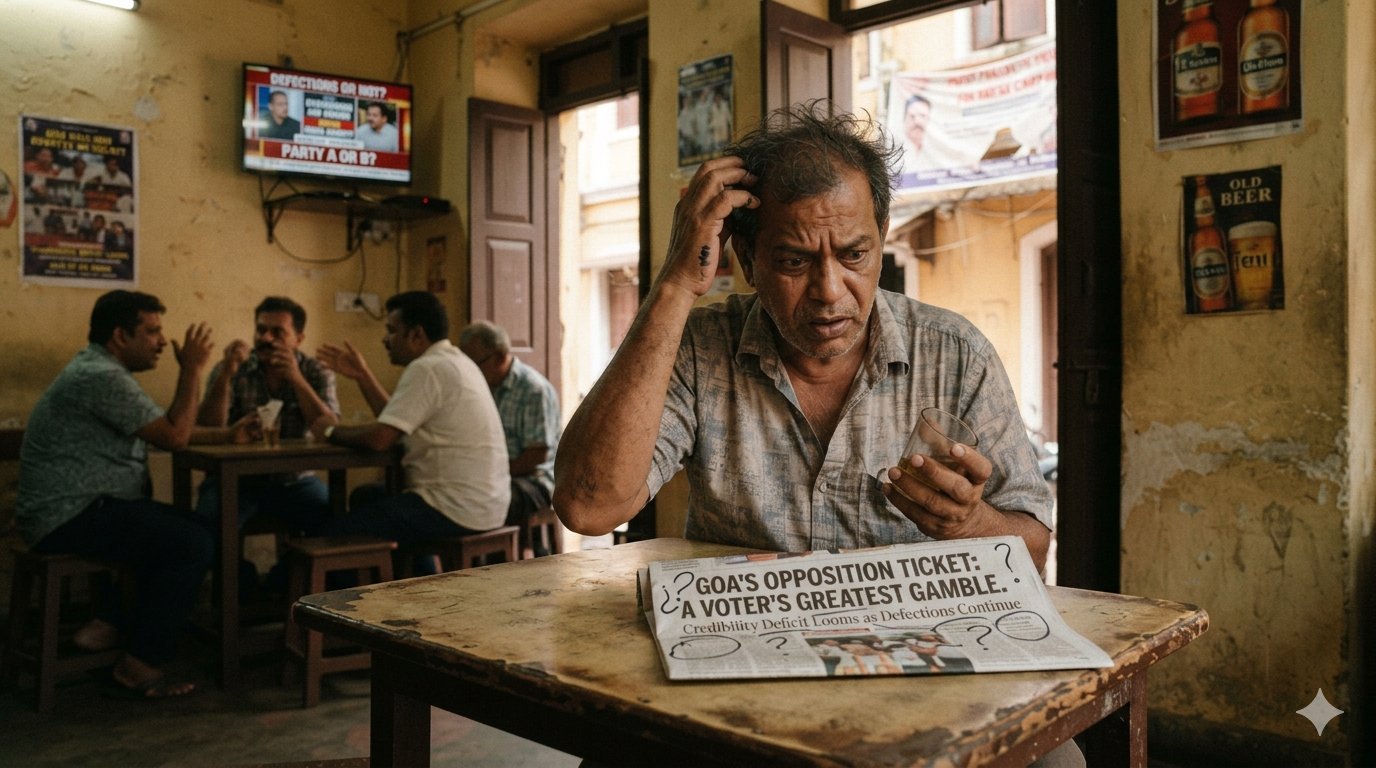
PANAJI: In Goa, the ink on a voter’s finger lasts significantly longer than an opposition MLA’s loyalty to their party. As opposition parties explore alliances and launch high-profile campaigns such as the Congress-led Goy Rakhonn Yatra, they face a problem that cannot be solved with rallies, slogans or press conferences: a deep and growing credibility deficit.
For many Goans, voting for an opposition candidate has increasingly come to feel less like choosing an alternative government and more like handing a politician a valuable bargaining chip. The fear is simple: elect an opposition MLA today, only to see that mandate become political currency tomorrow.
The sentiment is increasingly blunt. An opposition ticket, critics argue, can look less like a commitment to the voter and more like a temporary vehicle to enter the Assembly, before the destination changes.
Goa’s Defection Problem Has Become a Political Pattern
The distrust cannot be explained simply through allegations of corruption or political opportunism. Goa’s recurring defections have created a larger structural problem, voters have repeatedly watched election mandates change political ownership after the results are declared.
The Tenth Schedule of the Constitution, commonly known as the Anti-Defection Law, allows a merger to avoid disqualification when at least two-thirds of a legislative party’s members agree to it. In Goa’s 40-member Assembly, the arithmetic has repeatedly become central to political manoeuvring.
The 2019 Defection
In 2019, 10 Congress MLAs, led by Chandrakant “Babu” Kavlekar, joined the BJP in a move described as a merger of the Congress legislative wing.
The episode left voters confronting an uncomfortable question: what happens to the mandate given to a candidate under one party’s banner when that candidate subsequently joins another?
The 2022 Repeat
Three years later, the political memory had barely faded when history repeated itself.
In 2022, eight Congress MLAs, including former Chief Minister Digambar Kamat and Michael Lobo, joined the BJP.
The numbers mattered. In a 40-member Assembly, two-thirds of an 11-member legislative party is eight. The legal threshold may be mathematical, but its political consequence is anything but abstract.
For voters, the recurring pattern has helped create a perception that an opposition mandate can become negotiable once the election is over.
Goa’s Strongmen and the Politics of the Personal Vote
The problem goes beyond defections. Goa’s electoral politics has also developed a powerful culture of the local political strongman.
In constituencies where a few hundred votes can decide an election, candidates with deeply entrenched local networks can command political influence that extends beyond party ideology.
Leaders such as Michael Lobo in Calangute and Vijai Sardesai in Fatorda have built political identities closely associated with their individual influence. Their political journeys also illustrate how Goa’s smaller constituencies can produce leaders whose personal vote base can become as important as the party symbol itself.
That creates an uncomfortable equation for national and regional parties.
The party may provide the symbol, organisation and electoral platform. But once the election is over, a powerful local politician may possess enough independent political capital to negotiate from a position of strength.
This is where Goa’s “rent-a-symbol” politics becomes particularly relevant. Parties need strong local faces to win seats. Strong local faces, in turn, know that parties need them.
And the voter is left somewhere in between.
Opposition Unity Is Not Enough
The current opposition leadership, including Leader of the Opposition Yuri Alemao, has repeatedly raised issues inside the Assembly and taken on the government over matters of public concern.
But political opposition is not simply about attacking the government of the day. It is also about convincing voters that the mandate they give will remain intact after election night.
That is where the opposition faces its biggest credibility test.
Saying that the doors are closed to former defectors may sound politically reassuring. But keeping defectors out does not necessarily prevent elected representatives from walking out later.
Religious oaths have not solved the problem. Political promises have not solved it. And legal proceedings against defections can take years to reach their conclusion.
Can Goa’s Opposition Rebuild Voter Trust?
The real challenge before Goa’s opposition is therefore bigger than forming another alliance or organising another statewide campaign.
It must convince voters that an opposition vote will remain an opposition vote.
That requires more than speeches and election-time assurances. Political parties need credible internal safeguards, transparent commitments to voters and meaningful consequences for representatives who abandon the mandate under which they were elected.
Until that happens, every opposition candidate will face the same uncomfortable question at the doorstep:
If voters give you their mandate, will you still belong to them after the election?
For Goa’s opposition, that may be the most important question of the 2027 election, and one that no rally can simply shout away.