

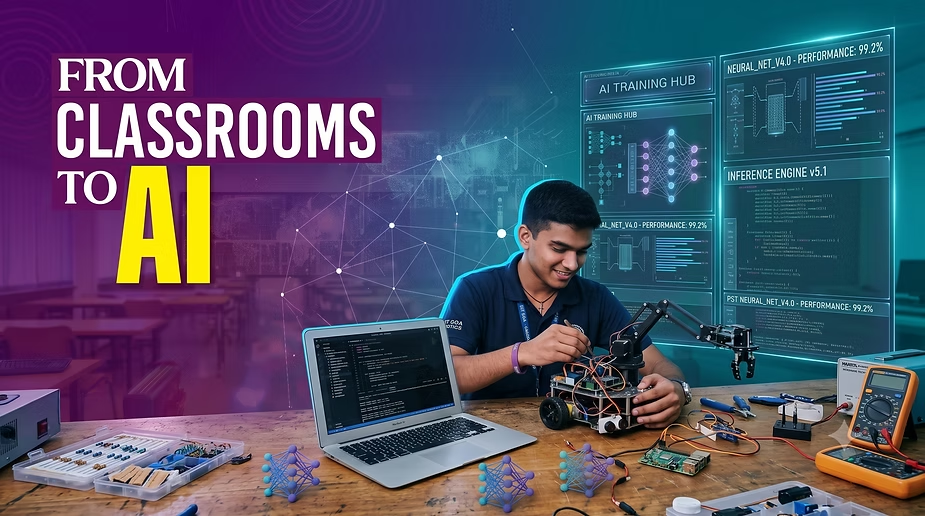
From AI-powered classrooms and robotics labs to 250 MBBS seats and India’s first unified school governance platform, Goa is rewriting what public education can look like.
At a Glance
- Over 2.89 lakh students are digitally connected through Goa’s education ecosystem.
- Goa became India’s first state to implement the SamarthX unified school governance platform covering over 1,500 schools.
- Vidya Samiksha Kendra now monitors learning outcomes through real-time analytics across the state’s school system.
- Coding, robotics and AI are becoming part of mainstream school education.
- Goa Medical College’s annual MBBS intake has expanded from 150 seats to 250 seats over the last few years.
- Nearly 79% of students have already received APAAR digital academic IDs.
- Goa now spends approximately 15% of its state budget on education, significantly above the national average cited by the state government.
The Revolution Most Goans Didn’t Notice Happening Inside Their Classrooms
Walk into a Goan classroom today and you’ll still see students in uniforms, teachers taking attendance and blackboards filled with equations.
At first glance, nothing seems very different.
But beneath that familiar setting, one of Goa’s biggest transformations has been quietly unfolding.
Attendance is now monitored digitally.
Learning performance is tracked in real time.
Artificial Intelligence is helping children practice lessons.
Students are learning robotics instead of simply reading about technology.
Medical education has expanded dramatically.
Vocational education is no longer treated as a second choice.
Five years ago, these developments sounded ambitious.
Today, they are increasingly becoming part of Goa’s education ecosystem.
While debates often focus on roads, tourism or politics, the state’s education sector may have experienced one of its biggest structural upgrades in decades.
Beyond New Buildings: Goa Is Rebuilding the Entire Learning Ecosystem
The most significant shift has not been the construction of new schools.
It has been the digitisation of education itself.
Goa’s Vidya Samiksha Kendra (VSK) functions as a central command centre for education. It collects real-time information from schools, allowing administrators to monitor attendance, assessments, teacher performance and learning outcomes across the state. The system was launched in 2023 as part of Goa’s digital education push.
Building on that foundation, Goa introduced SamarthX, a unified education governance platform integrating data from more than 1,500 schools into one digital ecosystem, bringing students, teachers, parents and administrators onto a common platform.
Together, these systems represent a fundamental change in how education is administered.
Instead of waiting for annual reports, policymakers can increasingly rely on live data.
Why This Matters Far Beyond School Exams
Education reforms rarely become headline news.
But they shape every other sector.
A student learning coding today could become tomorrow’s entrepreneur.
A robotics lab today could produce tomorrow’s engineer.
Better vocational education means industries can recruit locally instead of looking outside Goa. (Read Also: Goa Is Training Tomorrow’s Firefighters Today. Why This Quiet ITI Reform Could Change Public Safety and Youth Employment Forever)
Digital governance also allows schools to identify struggling students earlier, reducing learning gaps before they become permanent.
In an economy increasingly driven by technology, education is no longer simply about passing examinations.
It is about preparing students for jobs that may not even exist today.
The Journey From Traditional Learning to Digital Classrooms
Goa has traditionally enjoyed one of India’s strongest literacy rates.
But literacy alone no longer defines educational success.
The National Education Policy 2020 accelerated a shift towards competency-based learning, digital governance and multidisciplinary education.
Goa appears to have embraced that transition aggressively.
Nearly four out of every five students now possess an APAAR ID, creating a lifelong digital academic identity linked with DigiLocker and future educational records.
Meanwhile, AI-powered initiatives such as the Parakh Weekly Practice Bot are delivering curriculum-based practice questions to tens of thousands of students in multiple languages.
Coding and Robotics Education under the CM CARES initiative is also exposing students to emerging technologies far earlier than previous generations.
What This Means for Every Goan Family
For parents, the reforms promise more transparency.
Student progress is becoming measurable.
Academic records are becoming portable.
Career opportunities are expanding beyond conventional professions.
The government has simultaneously invested heavily in vocational education.
Girls enrolling in Government ITIs now receive complete tuition fee waivers under the Mukhyamantri Sukanya Kaushalya Vikas Protsahan Yojana.
ITI graduates are also being granted SSC and HSC equivalency certificates, allowing easier access to higher education.
The state’s apprenticeship programmes have already provided practical work experience to more than 11,000 young Goans over the last few years.
For families, education is increasingly becoming linked directly with employability.
Government Says This Is About Building Future-Ready Citizens
Chief Minister Dr Pramod Sawant has repeatedly described technology-driven education as essential for preparing students for the future economy.
At the launch of Vidya Samiksha Kendra, he said the platform would enable real-time monitoring of student progress while strengthening accountability across schools. He also described technology as central to improving educational outcomes.
The government’s broader education strategy also includes AI laboratories, semiconductor training, aviation skill development, startup promotion and expansion of higher education infrastructure.
The Numbers Tell an Even Bigger Story
- 289,223 students connected through the digital education ecosystem.
- 16,148 teachers integrated into digital governance.
- 1,470+ schools monitored through VSK.
- 1,500+ schools covered under SamarthX.
- Nearly 79% of students issued APAAR IDs.
- 98,861 students using AI-supported Parakh practice tools.
- 11,468 apprentices trained through the Chief Minister’s Apprenticeship Policy.
- 16,421 students trained through Government ITIs since 2020.
- 735 DPIIT-recognised startups, including 47% women-led.
- Goa Medical College MBBS intake increased from 150 to 250 seats.
The Questions That Still Need Answers
Can AI improve learning outcomes across every school?
Will rural schools receive the same technological support as urban campuses?
Can teacher training keep pace with digital transformation?
Will students graduating from these new systems find employment within Goa itself?
Can Goa retain skilled youth instead of losing talent to larger cities?
These questions will determine whether today’s reforms become tomorrow’s success story.
What Happens Next Could Be Even Bigger
The next phase has already begun.
The state is moving ahead with an AI Academy, India AI Data Labs, semiconductor education programmes, a permanent IIT Goa campus proposal, new agriculture and veterinary colleges, expanded medical education and specialised institutions focused on cyber security, public policy and forensic sciences.
If these initiatives mature successfully, Goa’s education story may increasingly shift from producing graduates to producing innovators.