


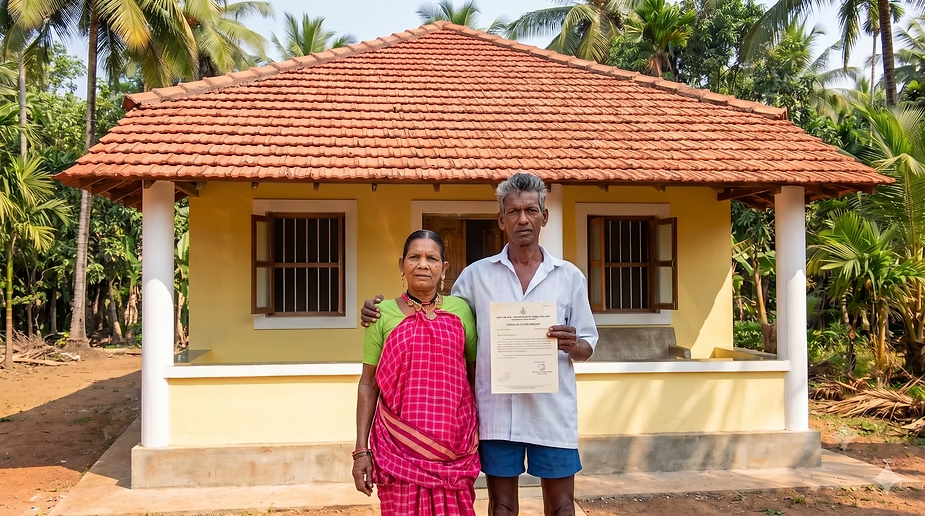
For thousands of Scheduled Tribe families across Goa, a house has long been a home without legal ownership. The Mukhyamantri Janajatiya Mhaje Ghar Yojana aims to change that by granting ownership rights to eligible families, opening the door to security, dignity and opportunities that come with having a legal title.
At a Glance
- Goa has introduced the Mukhyamantri Janajatiya Mhaje Ghar Yojana for eligible Scheduled Tribe families.
- The scheme seeks to grant legal ownership rights to homes built on government, comunidade and other eligible lands without formal title.
- Legal ownership can help families access loans, welfare benefits and secure inheritance rights.
- The initiative is intended to provide long-term housing security while resolving decades-old ownership issues affecting tribal communities.
When a Home Isn’t Truly Yours
For generations, many Scheduled Tribe families in Goa have lived in the same homes, celebrated festivals under the same roofs and raised children on the same land. Yet, despite living there for decades, many never possessed one document that officially proved those homes belonged to them.
Without a legal title, a house often remains just a place to live rather than an asset that can secure a family’s future.
It affects everything.
Access to bank loans becomes difficult. Property cannot always be transferred smoothly to the next generation. Government schemes linked to ownership remain out of reach. Even routine legal procedures become complicated.
Now, Goa is attempting to change that reality.
The Mukhyamantri Janajatiya Mhaje Ghar Yojana has been introduced with a clear objective: provide eligible Scheduled Tribe families with legal ownership rights over homes they already occupy, subject to the conditions laid down under the scheme.
For many, this is not about getting a new house.
It is about finally owning the one they have always called home.
A Long-Standing Housing Question Moves Towards a Solution
Unlike traditional housing schemes that construct new homes, the Mukhyamantri Janajatiya Mhaje Ghar Yojana focuses on recognising existing residential occupation.
The initiative is designed for eligible Scheduled Tribe families residing on government land, comunidade land and other categories of land covered under the scheme but where no formal ownership title currently exists.
If found eligible after verification, beneficiaries can receive legal ownership rights, bringing long-awaited certainty over properties that may have been occupied by families for several decades.
The scheme complements Goa’s wider efforts to address legacy land and housing issues through the broader Mhaje Ghar framework while recognising the unique circumstances faced by tribal communities.
Instead of relocating families or constructing fresh settlements, the policy seeks to regularise eligible homes already rooted within villages and communities.
That distinction makes the initiative particularly significant.
This Is About More Than Property Papers
At first glance, the scheme may appear to be another administrative exercise.
In reality, legal ownership changes the relationship between a family and its home.
Property ownership provides certainty.
Families become better positioned to access institutional finance because banks generally require documented ownership before sanctioning housing-related loans.
Ownership also strengthens inheritance rights, reducing uncertainty when property passes from one generation to another.
Many welfare programmes, infrastructure improvements and housing upgrades also become easier when ownership records are clear.
Beyond economics lies something equally important.
Dignity.
Owning a home provides psychological security that informal occupation cannot.
For tribal communities that have historically faced challenges in securing land rights across India, legal recognition represents far more than paperwork. It is an acknowledgement that long-standing residents deserve legal certainty over the homes around which their lives have been built.
For Goa, where land remains one of the state’s most valuable and emotionally significant assets, ownership carries enormous social value.
Why Tribal Land Rights Have Been a Sensitive Issue
Across India, land ownership has remained one of the most complex challenges affecting Scheduled Tribe communities.
Many families settled generations ago under traditional systems that rarely produced modern ownership documents.
Over time, changing land laws, revenue records and administrative procedures created situations where genuine occupants continued living in homes without possessing formal legal titles.
Goa has its own unique history.
The presence of comunidade lands, historical Portuguese-era land records and multiple categories of government land has often complicated ownership questions.
Successive governments have introduced different initiatives to address various land regularisation issues.
The Mukhyamantri Janajatiya Mhaje Ghar Yojana represents a targeted attempt to resolve one specific part of that larger challenge by focusing on eligible Scheduled Tribe households.
If implemented efficiently, it could provide permanent relief to families that have waited years for ownership certainty.
For Families, Ownership Could Unlock New Opportunities
The immediate impact of legal ownership extends well beyond having a certificate.
A legally recognised property often becomes a family’s largest financial asset.
It creates opportunities to seek bank finance for education, home improvements or small businesses where permissible.
Children inherit documented property rather than uncertain occupation.
Future disputes become easier to resolve because ownership records exist.
Families also gain confidence to invest in improving their homes, knowing the property enjoys legal recognition.
For younger generations, legal ownership can become the foundation upon which future financial security is built.
Perhaps most importantly, it offers peace of mind.
The fear that accompanies uncertain ownership gradually gives way to confidence that a family’s home has legal protection.
That emotional security is difficult to measure but impossible to ignore.
Government Says the Focus Is Security, Not Just Regularisation
The Goa Government has positioned the Mukhyamantri Janajatiya Mhaje Ghar Yojana as a welfare initiative that seeks to provide housing security to eligible Scheduled Tribe families rather than simply regularise land occupation.
According to the framework announced by the government, the scheme is intended to grant legal ownership rights to eligible beneficiaries residing on government, comunidade and other eligible categories of land without formal title. Authorities have also organised outreach and verification drives under the broader Mhaje Ghar programme to help applicants understand eligibility requirements and complete documentation.
Officials maintain that the objective is to resolve long-pending ownership issues while ensuring that the process remains transparent and compliant with existing laws.
The government has emphasised that eligibility will be determined only after scrutiny of each application and that not every occupied property will automatically qualify under the scheme.
Political Consensus Exists, But Execution Will Be Closely Watched
Unlike many infrastructure or taxation policies, securing housing rights for tribal communities has generally attracted broad public support.
At the same time, political observers note that implementation will inevitably come under scrutiny.
Questions are likely to focus on whether the verification process is completed efficiently, whether deserving beneficiaries receive titles without unnecessary delays and whether eligible families across all regions receive equal treatment.
If the rollout is smooth, the initiative could become one of the state’s more significant tribal welfare interventions. If delays emerge, expectations among applicants could quickly turn into frustration.
Ultimately, the success of the scheme will depend less on announcements and more on how many families receive legally recognised ownership.
Experts Say Secure Property Rights Can Transform Communities
Housing experts and development economists have long argued that secure property rights contribute to social and economic stability.
A documented property title can increase a family’s confidence to invest in home improvements, improve access to formal credit and reduce the likelihood of prolonged ownership disputes.
Legal ownership also creates clearer inheritance pathways, helping prevent conflicts within families over future succession.
For tribal communities, recognition of long-term occupation can carry an additional social significance. It strengthens inclusion by formally acknowledging communities that may have lived on the same land for generations without documentary ownership.
Experts caution, however, that the effectiveness of any regularisation programme depends on efficient implementation, accurate land records and clear communication with beneficiaries.
The Numbers Behind Goa’s Tribal Population
Understanding the importance of the scheme requires looking at Goa’s demographic profile.
According to the 2011 Census, Scheduled Tribes account for about 10.2% of Goa’s population, following their inclusion in the Scheduled Tribe list in 2003. Communities such as the Gawda, Kunbi and Velip form a significant part of the state’s tribal population.
While the government has not yet published a final estimate of the number of families that may ultimately benefit from the Mukhyamantri Janajatiya Mhaje Ghar Yojana, the scheme addresses an issue that has affected tribal households across multiple villages for decades.
The final impact will depend on the number of eligible applications approved after verification.
The Real Test Begins After Applications Are Filed
Policy announcements often receive headlines.
Implementation changes lives.
The next phase of the Mukhyamantri Janajatiya Mhaje Ghar Yojana will involve document verification, eligibility assessments and issuance of legal ownership rights to qualifying families.
If completed efficiently, the programme could become one of Goa’s most consequential tribal welfare initiatives in recent years, transforming homes that have stood for generations into legally recognised family assets.
For thousands of families, the outcome is about much more than paperwork.
It is about certainty.
It is about dignity.
And perhaps, for the first time, it is about knowing that the place they have always called home is finally theirs in the eyes of the law.