


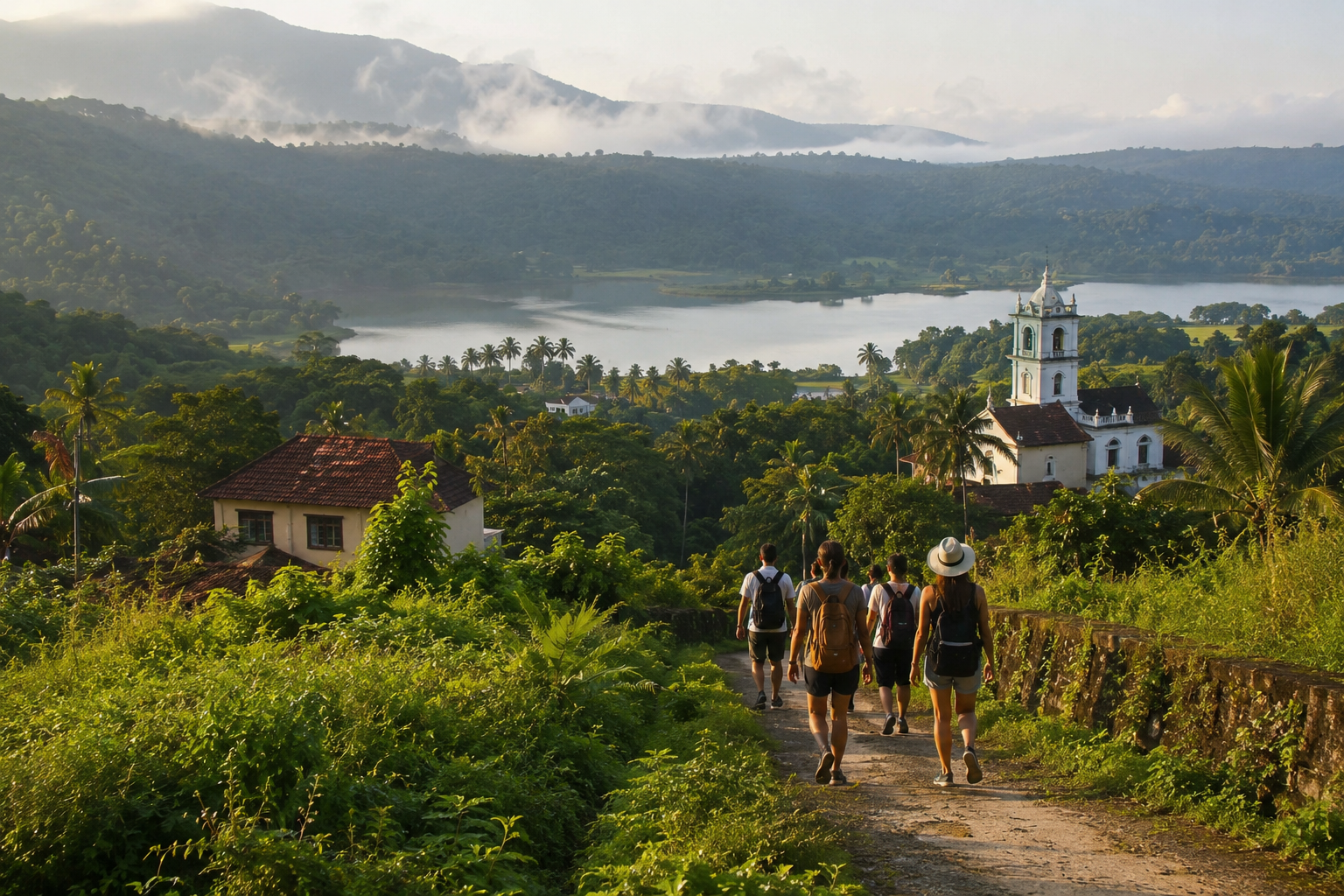
Goa’s coastline carried the weight of the state’s tourism economy. Now, the government is betting that the next wave of jobs, businesses and visitor experiences will come from somewhere very different: its villages.
AT A GLANCE
- Goa has taken another step towards expanding tourism beyond its coastline.
- Five rural tourism ventures received seed funding after a competitive Rural Accelerator Programme.
- The initiative focuses on homestays, eco-tourism, local experiences and sustainable rural enterprises.
- The long-term vision is to help more Goans earn from tourism by strengthening the state’s hinterland economy.
- The programme builds on Goa’s broader homestay and hinterland tourism policies introduced over the last few years.
Goa Has Been Selling Its Beaches for Decades. Now It’s Selling Something Bigger.
Close your eyes and think of Goa.
The first image that comes to mind is probably the same one millions of tourists see every year.
Golden beaches.
Beach shacks.
Nightlife.
Sunsets.
For decades, that image has powered one of India’s strongest tourism economies.
But here’s the question Goa has quietly started asking itself.
What if the state’s biggest tourism opportunity isn’t on the coast anymore?
What if the next chapter of Goa’s tourism story begins in Aldona instead of Anjuna?
In Sattari instead of Sinquerim?
In a family-run homestay instead of another beach resort?
That question is no longer theoretical.
Last week, it took another step towards becoming government policy.
At the Rural Accelerator Programme felicitation ceremony held on July 4, five promising rural tourism ventures were selected to receive seed grant support after a competitive evaluation process. The selected entrepreneurs will now receive assistance to pilot and scale businesses built around rural tourism, community experiences, sustainability and local livelihoods.
On the surface, it looked like another government event.
In reality, it signals something much bigger.
Goa isn’t trying to attract more tourists.
It is trying to change where tourism happens.
This Isn’t About Five Entrepreneurs. It’s About Rewriting Goa’s Tourism Map.
Every tourism destination eventually reaches a difficult question.
How do you grow without overcrowding the places that already attract everyone?
Goa knows that challenge better than most.
Its beaches remain its biggest tourism draw, but they also carry the greatest pressure from traffic, infrastructure demand and seasonal crowding.
Instead of concentrating future tourism in the same locations, the state’s strategy is increasingly looking inland.
The Rural Accelerator Programme reflects that thinking.
Rather than funding hotels or large hospitality projects, the programme identifies local entrepreneurs capable of building experiences rooted in village life.
Some ideas focus on homestays.
Others explore eco-tourism.
Some are built around local culture, food and community experiences.
Others combine tourism with sustainability initiatives such as waste management.
The common thread is simple.
Create reasons for visitors to spend time and money in parts of Goa they would otherwise drive past.
That shift matters because tourism doesn’t create value only when someone checks into a hotel.
It creates value when visitors buy breakfast from a local café.
Hire a village guide.
Rent bicycles.
Purchase handicrafts.
Eat at family-run restaurants.
Book kayaking experiences.
Attend local festivals.
Stay in heritage homes.
Every additional stop spreads tourism income across more communities instead of concentrating it within a handful of destinations.
That is exactly the model Goa has been gradually building over the last few years.
This latest programme is another piece of that larger puzzle.
Why This Could Become One of Goa’s Most Important Economic Experiments
Goa has spent decades becoming one of India’s most recognisable tourism brands.
Now it faces a different challenge.
How do you make tourism work for more Goans, not just more tourists?
The answer appears to be taking shape through rural entrepreneurship.
The state has already introduced a dedicated Homestay and Bed & Breakfast Policy that identifies hinterland tourism as a priority. The policy aims to create livelihood opportunities, preserve heritage homes, promote local cuisine, generate self-employment and encourage responsible tourism across rural talukas. It also offers financial and non-financial incentives for eligible homestays, including reimbursements, marketing support and promotion through official tourism channels.
The Rural Accelerator Programme complements that vision.
Instead of waiting for outside investors to transform villages into destinations, it encourages local residents to become entrepreneurs themselves.
That changes the conversation.
The question is no longer:
“How do we bring more hotels to villages?”
It becomes:
“How do we help villages build tourism on their own terms?”
If that approach succeeds, Goa won’t simply have more places for tourists to visit.
It could build a tourism economy that reaches far beyond the coastline while preserving the culture, architecture and way of life that make rural Goa unique.
For a state where tourism supports thousands of livelihoods, that may prove to be one of the most significant policy shifts in years.
If the Rural Accelerator Programme feels like a sudden announcement, it isn’t.
It is the latest milestone in a strategy that Goa has been quietly building over the past few years.
For decades, tourism investment naturally flowed towards the coastline. Hotels, restaurants, nightlife and entertainment created an economic engine that transformed Goa into one of India’s most recognisable travel destinations.
But success also created new challenges.
Popular beach destinations began facing seasonal congestion, pressure on infrastructure and increasing competition for land and resources. At the same time, many villages rich in culture, biodiversity and heritage remained largely outside the mainstream tourism economy.
Recognising this imbalance, the Goa government gradually began promoting hinterland tourism through policy reforms, heritage conservation, homestay incentives and partnerships focused on community-based tourism.
A major step came with the state’s Homestay and Bed & Breakfast Policy, which encourages residents to convert traditional homes into licensed tourist accommodation while preserving Goa’s architectural and cultural identity. The policy offers incentives, marketing support and technical assistance, particularly for properties located in hinterland talukas. Official tourism policy identifies areas such as Sattari, Dharbandora, Sanguem, Bicholim, Ponda, Quepem and Canacona as priority regions for expanding rural tourism. (goatourism.gov.in)
The Rural Accelerator Programme builds on that foundation.
Rather than simply promoting destinations, it focuses on building entrepreneurs who can create experiences worth travelling for.
That is an important distinction.
Destinations attract visitors.
Entrepreneurs create local economies.
If Villages Become Destinations, More Goans Stand to Benefit
The biggest opportunity isn’t necessarily attracting more tourists.
It’s ensuring that tourism income reaches more people.
Imagine a family converting part of their ancestral home into a homestay.
A local youth becomes a certified nature guide.
A women’s self-help group starts offering traditional Goan cooking experiences.
An artisan begins selling handcrafted products directly to visitors.
A farmer adds spice plantation tours to supplement seasonal income.
Individually, these may seem like small businesses.
Collectively, they create a tourism ecosystem where economic benefits are distributed across villages instead of remaining concentrated in a few established destinations.
For young Goans, this also opens up an alternative career path.
Instead of viewing tourism only through the lens of hotel jobs or restaurants, entrepreneurship becomes a viable option.
The Rural Accelerator Programme reflects that thinking by identifying local innovators and helping them transform ideas into commercially viable ventures.
If these businesses succeed, they won’t just create income for their founders. They can generate demand for local suppliers, transport providers, guides, artisans, farmers and service professionals.
That is how rural tourism becomes an economic multiplier.
Strategy Focused on Opportunity, Not Just Visitor Numbers
At the July 4 felicitation ceremony, Chief Minister Dr. Pramod Sawant congratulated the selected entrepreneurs and reiterated the government’s commitment to promoting sustainable, community-led tourism across Goa.
The programme aligns with the state’s broader objective of diversifying tourism while ensuring that its economic benefits reach beyond the traditional coastal belt. Rather than measuring success only by tourist arrivals, the emphasis is increasingly shifting towards creating local enterprises and generating livelihoods within rural communities.
That philosophy represents an evolution in tourism planning.
Instead of asking, “How do we attract more visitors?”, the bigger question becomes, “How do more Goans benefit from every visitor who already comes?”
If implemented effectively, that shift could prove just as important as any marketing campaign.
World’s Fastest-Growing Tourism Experiences Are Often the Most Local
Across the world, travellers are increasingly looking beyond conventional sightseeing.
They want to stay in heritage homes.
Learn traditional recipes.
Explore forests with local guides.
Cycle through villages.
Experience culture through the people who live there.
This global shift has strengthened demand for authentic, community-led tourism.
For Goa, that presents an opportunity.
The state already has the ingredients.
Centuries-old villages.
Portuguese-era architecture.
Sacred groves.
Spice plantations.
Traditional cuisine.
Rich biodiversity.
Living cultural traditions.
The challenge has never been whether these assets exist.
The challenge has been converting them into sustainable livelihoods without losing their authenticity.
That is where programmes supporting local entrepreneurs can play a meaningful role.
The Real Test Starts Now
Announcements are easy.
Building a new tourism economy is not.
The Rural Accelerator Programme has identified entrepreneurs with promising ideas. The next challenge is ensuring those ideas become sustainable businesses that continue creating value long after the applause fades.
Will these ventures attract paying customers?
Will more villages join the movement?
Will local communities embrace tourism while protecting their identity?
Will rural tourism become a year-round economic opportunity instead of a seasonal experiment?
These are the questions that will determine whether this programme becomes a milestone or simply another initiative.
Success will not be measured by the number of certificates distributed.
It will be measured by the number of thriving businesses five years from now.
What Happens Next Could Decide the Future of Goa’s Hinterland
The five selected ventures will now receive mentorship, ecosystem support and seed funding to begin implementing their ideas.
If these ventures demonstrate commercial success, they could become blueprints for similar enterprises across Goa.
That has the potential to encourage more families to open homestays, more young entrepreneurs to build experience-based tourism businesses and more villages to participate in Goa’s tourism economy.
For the government, this is also an opportunity to understand what works, what doesn’t and how future programmes can be refined.
Scaling community-led tourism requires more than funding.
It demands continuous training, strong marketing, infrastructure support, digital visibility and sustained community participation.
The real success story will be written over the next few years, not over the next few weeks.
Goa’s Tourism Story Is Already Changing
This initiative does not exist in isolation.
It joins a series of governance measures aimed at strengthening Goa’s tourism sector beyond conventional beach tourism.
Recent efforts include expanding the Homestay and Bed & Breakfast Policy, promoting regenerative and eco-tourism, supporting entrepreneurship through training programmes and encouraging visitors to explore the state’s hinterland.
Viewed together, they point towards a clear policy direction.
The beaches will always remain Goa’s biggest attraction.
But the next phase of growth may come from places that rarely appeared on travel brochures.
Quiet villages.
Family homes.
Local entrepreneurs.
Traditional cuisine.
Nature trails.
Cultural experiences.
These are no longer just hidden gems.
They are becoming part of Goa’s long-term tourism strategy.
A Bigger Question Every Goan Should Be Asking
For years, Goa has asked a simple question.
“How do we bring more tourists?”
Today, another question is becoming equally important.
“How do more Goans benefit from tourism?”
That shift in thinking may prove to be one of the most important changes in Goa’s tourism policy.
The Rural Accelerator Programme alone will not transform the state’s economy.
But it represents another deliberate step towards a future where tourism creates opportunities not only along the coastline, but across Goa.
If that vision succeeds, the next tourism success story won’t just be measured by how many people visit Goa.
It will be measured by how many Goans build their future because of it.