


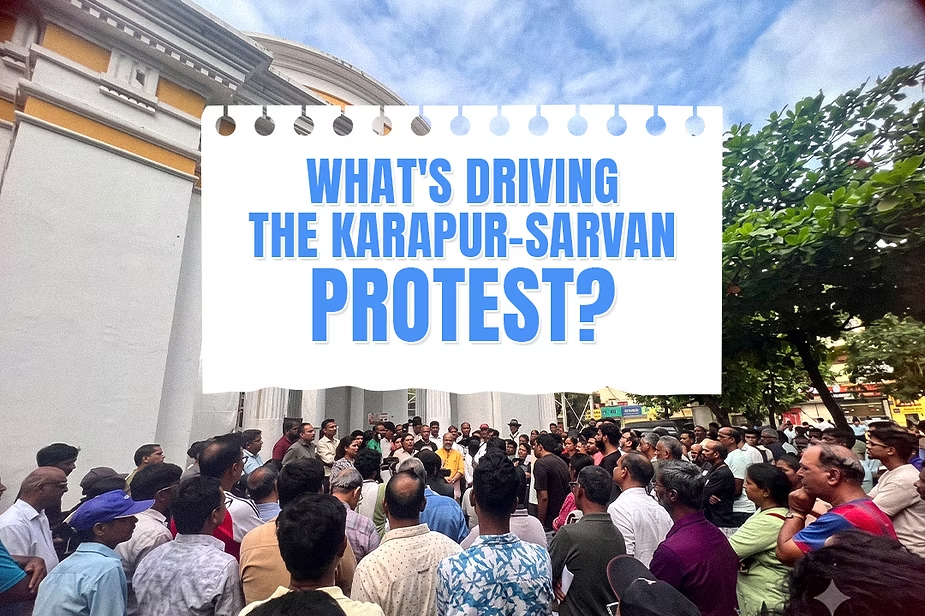
The Karapur-Sarvan agitation has now crossed roughly 150 days, keeping the proposed ‘One Goa’ project at the centre of a sustained political and public confrontation. What began as opposition to the development project has increasingly become a larger debate over land, local interests, development and the government’s role in resolving the concerns of residents.
But the arrest of two protest-linked figures, Siddhesh Jana Tari and Pritesh Salgaonkar, in an alleged extortion case has introduced an entirely new and troubling dimension to the controversy.
The question is no longer only about whether the project should proceed.
It is also about who is driving the agitation, what interests are operating behind it, and whether every person claiming to speak for the public is actually acting in the public interest.
Read Also: SHOCKING TURN IN KARAPUR-SARVAN PROTEST: Two Protest Leaders Arrested
150 Days of Agitation: What Is the Backstory?
For almost five months, the Karapur-Sarvan agitation has remained active over the proposed ‘One Goa’ housing project.
Residents and protesters have raised concerns over the project and demanded that their grievances be addressed. The government, on the other hand, has maintained that it is willing to listen to and address genuine concerns.
Goa BJP president Damodar Naik, while commenting on the agitation, said that the Pramod Sawant-led government was doing everything possible to mitigate the grievances of the villagers.
That position is important in understanding the political debate.
If the government says it is willing to address the grievances, while the protesters maintain that their concerns remain unresolved, the obvious question is: what is preventing the issue from concluding after nearly 150 days?
A prolonged protest is certainly not proof that there is a hidden agenda. Citizens have every democratic right to continue protesting when they believe their concerns have not been addressed.
But politically, the duration of the agitation inevitably raises another question:
Who benefits from keeping the confrontation alive?
Who Are the People Keeping the Issue Alive?
This is where the arrest of Siddhesh Jana Tari and Pritesh Salgaonkar becomes politically significant.
Both names have emerged in the extortion FIR filed by a representative associated with the ‘One Goa’ project. The complaint alleges that the accused, along with others, threatened disruption of project work and demanded large sums of money.
The FIR alleges a demand of ₹3 crore each, while also claiming that ₹41 lakh was subsequently paid to the two individuals.
The complaint further alleges a fresh demand of ₹10 lakh in August.
These are serious allegations – and they remain allegations until established through investigation and the courts.
But politically, the timing and circumstances inevitably raise questions.
If individuals associated with a protest movement are accused of demanding money from the very project they are opposing, does the agitation remain purely a people’s movement, or was someone allegedly attempting to use the protest as leverage?
That is a question investigators must answer.
Read Also: From Promise to Action: Goa Begins Recruitment Drive After Sawant’s Jobs Commitment
Is There More Behind the Protest?
This is perhaps the biggest political question emerging from the latest development.
Is the Karapur-Sarvan agitation entirely organic, driven by genuine concerns of residents? Or are there other interests attempting to keep the dispute alive?
At this stage, there is no established evidence that the protest is sponsored by any political party, organisation or outside interest. Therefore, calling it a “sponsored protest” as a fact would be premature.
But the possibility of outside influence is precisely the kind of question that a serious investigation should examine if evidence points in that direction.
Who is funding the mobilisation?
Who is coordinating the protests?
Who benefits politically or financially from prolonging the confrontation?
Are all those speaking on behalf of residents actually representing residents?
And most importantly – are legitimate public concerns being overshadowed by the actions of a few individuals?
These questions cannot be dismissed simply because they are politically uncomfortable.
The Political Picture Is Becoming Clearer
From a political analyst’s perspective, the arrests have changed the narrative.
For 150 days, the dominant question was:
“Why is the government not resolving the Karapur-Sarvan issue?”
After the extortion case, another question has entered the political conversation:
“Who is interested in keeping the issue unresolved – and why?”
That does not mean the concerns of every protester are illegitimate. Nor does the arrest of two individuals prove that the entire movement is compromised.
But it does mean the movement’s leadership and methods will now face greater public scrutiny.
The coming investigation could reveal whether this was simply a case involving individuals operating independently, or whether there was a wider network behind the alleged demands.
And if evidence of organised or sponsored activity emerges, the political implications could be much bigger.
For now, the truth remains with the investigation. But one thing is certain: after 150 days of protest, the Karapur-Sarvan story is no longer only about a project. It is increasingly about the interests, money and people behind the agitation.
The Questions That Remain
For now, the answers remain unclear.
Whether the agitation is being driven purely by genuine local concerns, whether vested interests are keeping the issue alive, or whether there is a larger network operating behind the scenes, we may get to know in the future.
The investigation into the alleged extortion case could provide important answers.
Until then, the questions remain open, and so does the bigger political question:
Who really benefits from keeping the Karapur-Sarvan issue alive?
Read Also: From Waste to Jobs: Goa Opens Advanced Recycling Facility with 87% Employment for Goans