


Tourism contributes significantly to Goa’s economy, supporting thousands of livelihoods across hospitality, transport, food services and recreation. Yet as the state’s tourism sector matures, policymakers are increasingly confronting a critical question: how can the benefits of tourism be distributed more evenly across Goa rather than remaining concentrated along a narrow coastal belt?
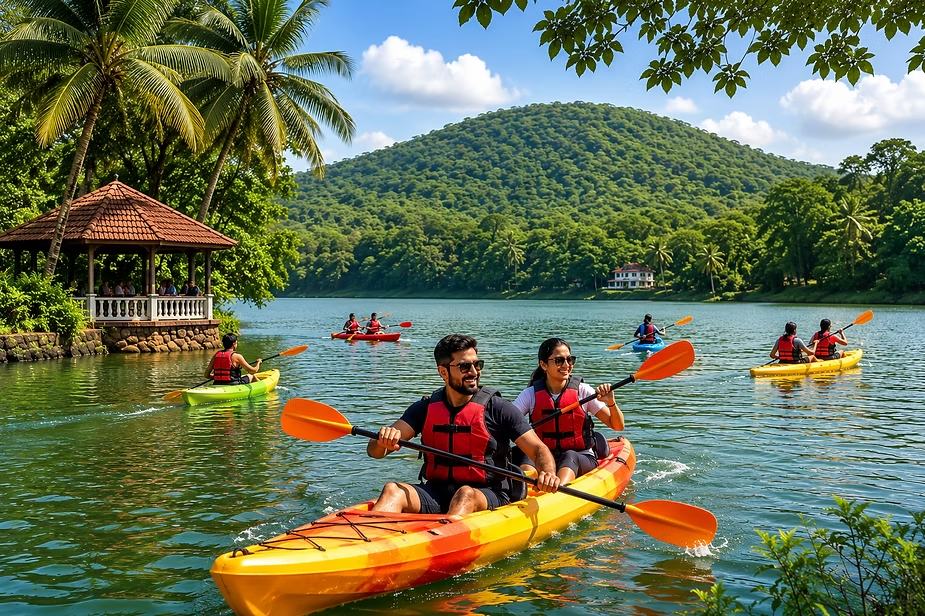
The recent introduction of kayaking at Mayem Lake may appear, at first glance, to be a relatively small tourism initiative. Compared to major infrastructure projects, airport expansions or highway developments, a kayaking facility is modest in scale. Yet viewed through the lens of tourism planning and economic development, the initiative represents something much larger. It reflects a growing effort to diversify tourism experiences, activate existing public assets and encourage visitors to explore parts of Goa that have historically remained outside mainstream tourism circuits.
Located in North Goa’s Bicholim taluka, Mayem Lake has long been considered one of the state’s most picturesque inland destinations. Surrounded by rolling hills and dense greenery, the lake offers a distinctly different experience from Goa’s coastal landscape. For generations, it has served as a recreational space for residents and domestic visitors seeking a quieter side of the state. Despite its natural appeal, however, Mayem has often struggled to compete with the magnetic pull of Goa’s beaches, which continue to attract the overwhelming majority of tourist traffic.
This imbalance is not unique to Goa. Around the world, tourism destinations face the challenge of concentration, where visitor activity becomes heavily clustered in a few locations while other regions remain underutilised. Such concentration creates pressure on infrastructure, increases environmental stress and limits the distribution of economic benefits. In response, tourism planners increasingly advocate for destination diversification — a strategy that encourages visitors to explore a wider range of attractions and experiences.
Goa’s tourism authorities have gradually embraced this approach. Over the last several years, the state has promoted hinterland tourism, spiritual tourism, heritage tourism, eco-tourism and nature-based experiences as part of a broader effort to redefine Goa’s tourism identity. The objective is not to replace beach tourism but to complement it with new experiences that increase visitor engagement and spread economic opportunities across a wider geographical area.
Within this context, the launch of kayaking at Mayem Lake assumes greater significance. Adventure and experiential tourism have emerged as some of the fastest-growing segments within the global tourism industry. Modern travellers increasingly seek activities that allow them to engage with local landscapes rather than simply observe them. Kayaking offers precisely this type of experience. It transforms the lake from a scenic backdrop into an interactive destination where visitors can actively participate in recreation while appreciating the natural environment.
The initiative also builds upon previous investments made at Mayem Lake. Over the years, the area has undergone several improvements aimed at enhancing visitor amenities and increasing tourism potential. Infrastructure upgrades, landscaping initiatives, boating facilities and tourism-focused developments have sought to position the destination as a stronger recreational hub within North Goa. The addition of kayaking represents another layer in this ongoing effort to enhance visitor experiences without fundamentally altering the natural character of the site.
One of the most important aspects of tourism development is that its impact extends far beyond the attraction itself. Every tourism activity creates an economic ecosystem around it. A visitor arriving at Mayem Lake may pay for kayaking, but they are also likely to purchase refreshments, use local transport services, visit nearby attractions or engage with local businesses. Economists often refer to this as the tourism multiplier effect, where spending in one sector generates economic activity across multiple sectors.
For local communities, this multiplier effect can be particularly valuable. Unlike large-scale industrial investments that often require specialised infrastructure or highly skilled labour, tourism-related opportunities can emerge across a broad range of economic activities. Food vendors, taxi operators, guides, photographers, homestay owners and small retailers all stand to benefit when visitor numbers increase. Even modest increases in tourist footfall can generate meaningful income opportunities for local residents.
This is especially relevant in inland regions where economic opportunities linked directly to tourism have historically been more limited than in coastal areas. By creating reasons for visitors to travel beyond traditional tourism zones, destinations like Mayem can become part of a broader economic network that supports local livelihoods while reducing dependence on a small number of tourism hotspots.
The environmental dimension is equally important. Contemporary tourism planning increasingly emphasises sustainable growth rather than unrestricted expansion. Building entirely new tourism infrastructure often requires significant land use, environmental clearances and financial investment. In contrast, enhancing existing destinations can offer a more sustainable pathway to growth. By leveraging natural assets that already exist, governments can increase tourism capacity while minimising ecological disruption.
Mayem Lake is particularly well-suited to this model. The destination already possesses natural beauty, accessibility and recreational value. The challenge has never been the absence of potential; rather, it has been the creation of compelling experiences that encourage visitors to spend more time there. Kayaking helps address this challenge by adding an activity that appeals to families, young travellers, adventure enthusiasts and domestic tourists alike.
The timing of such initiatives is also significant. Tourism patterns globally are undergoing notable changes. Post-pandemic travel trends have shown increasing demand for outdoor activities, wellness-oriented travel and nature-based experiences. Visitors are often looking for destinations that provide space, authenticity and opportunities for active participation. Inland attractions are uniquely positioned to benefit from these changing preferences.
Goa’s tourism sector has already begun adapting to this shift. From hinterland trails and heritage walks to birdwatching experiences and eco-tourism circuits, there is growing recognition that the state’s tourism appeal extends well beyond its beaches. The success of these initiatives depends not only on marketing but also on the availability of quality experiences that justify visitor travel and spending. Kayaking at Mayem contributes to this evolving ecosystem.
There is also a strategic branding dimension. For years, Goa’s global image has been closely associated with coastal tourism. While that image remains valuable, diversification helps build resilience. Tourism destinations that rely too heavily on a single product category often face greater vulnerability to changing market conditions, environmental challenges or shifting traveller preferences. By expanding its portfolio of experiences, Goa strengthens its ability to attract a broader range of visitors throughout the year.
The importance of this approach becomes clearer when viewed through a long-term development lens. Tourism is not merely about visitor arrivals; it is about creating sustainable economic value. The most successful tourism destinations are those that continuously evolve while ensuring that growth benefits multiple stakeholders. Infrastructure, experiences and community participation must work together to create lasting impact.
This is why seemingly small projects can carry substantial strategic importance. A kayaking facility may not generate headlines in the same way as a major highway or airport project. Yet its value lies in how it contributes to a larger vision. It demonstrates how existing assets can be activated, how tourism can be diversified and how economic opportunities can be extended to new communities.
For Goa, this represents an increasingly important development philosophy. As available land becomes scarcer and environmental considerations become more pressing, the future of growth may depend less on creating entirely new destinations and more on enhancing those that already exist. The state’s natural lakes, forests, heritage sites and rural landscapes possess significant untapped potential. Unlocking that potential requires thoughtful planning, targeted investment and experiences that resonate with contemporary travellers.
The story of Mayem Lake’s new kayaking experience is therefore not really about kayaking. It is about a broader shift in how tourism development is being approached. It is about recognising that economic opportunity can emerge from better utilisation of existing resources. It is about creating reasons for visitors to explore more of Goa. And it is about ensuring that the benefits of tourism reach communities that have traditionally remained on the margins of the state’s tourism economy.
As visitors paddle across the calm waters of Mayem Lake, they are participating in something larger than a recreational activity. They are becoming part of a tourism model that seeks to spread growth more evenly, strengthen local economies and showcase the diversity of Goa’s landscapes. In that sense, the launch of kayaking at Mayem Lake offers a glimpse into the future of tourism development in Goa — one that looks beyond the coastline while remaining firmly rooted in the state’s unique natural and cultural assets.