


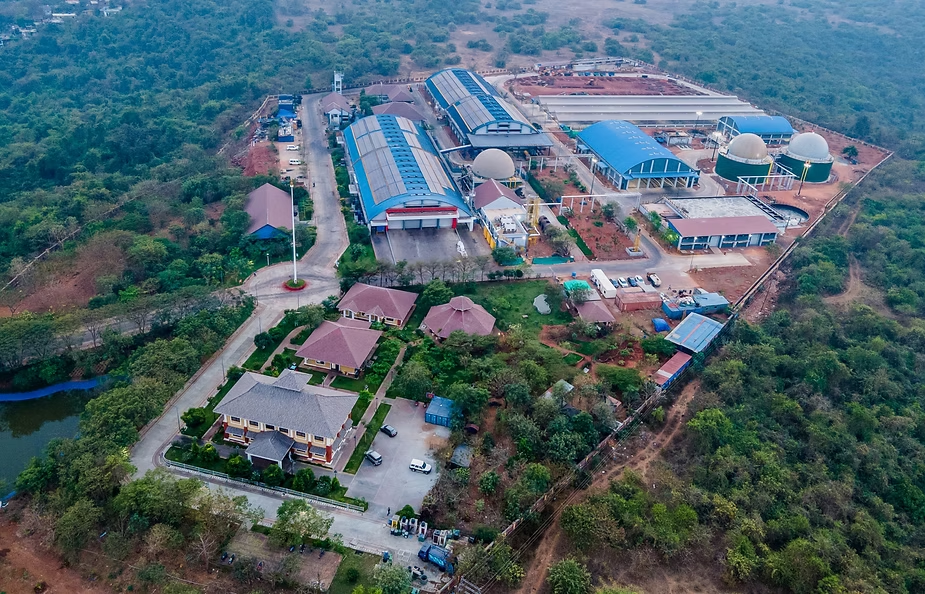
There was a time when discussions around waste management in India rarely inspired optimism. Overflowing dumpsites, unsegregated garbage and mounting environmental concerns had become familiar images across rapidly urbanizing cities and tourist destinations alike. Against this backdrop, Goa—India’s smallest state by area—has quietly been attempting something ambitious: to transform waste from a civic burden into a governance opportunity. Today, that effort is increasingly attracting national attention, with the state’s model being discussed as an example of how policy, technology and institutional planning can converge to address one of the country’s most persistent urban challenges.
For Goa, this transformation carries significance far beyond sanitation. The state’s economy is deeply intertwined with its natural beauty. Its beaches, forests, rivers, heritage settlements and villages are not merely environmental assets but economic engines that support tourism, hospitality, fisheries, small businesses and thousands of livelihoods. Every piece of unmanaged waste ultimately threatens this ecosystem. Consequently, waste management in Goa is not simply about cleanliness—it is about protecting economic growth, public health and the state’s global reputation.
Goa’s Green Advantage: How 61% Forest Cover is Shaping a More Resilient Goa
Unlike many regions where waste management remains largely a municipal responsibility, Goa has gradually developed an institutional framework that treats the issue as a strategic governance priority. The establishment of the Goa Waste Management Corporation marked a significant shift in approach by creating a dedicated agency responsible for planning, coordinating and implementing scientific waste management systems across the state. This institutional mechanism has enabled long-term planning rather than fragmented short-term responses, providing continuity that many urban systems struggle to achieve.
One of the most visible symbols of this transformation is the Integrated Solid Waste Management Facility at Saligao. The location itself tells an important story. What was once associated with waste accumulation has been redeveloped into a modern processing facility designed to scientifically handle municipal solid waste generated from multiple urban local bodies. Rather than relying solely on dumping, the facility incorporates segregation, processing, resource recovery and energy generation into a unified system. This represents a philosophical shift—from viewing waste as something to discard to recognizing it as material that can be recovered, recycled or converted into useful products.
The importance of this transition becomes clearer when one considers the pressures unique to Goa. The state hosts millions of visitors every year, and seasonal tourism can dramatically increase the volume of waste generated. Managing this surge requires infrastructure that is resilient enough to handle fluctuating demand while maintaining environmental standards. Traditional landfill-dependent models often struggle under such conditions, leading to overflowing sites, odour, groundwater contamination and public opposition. Scientific processing facilities, by contrast, seek to reduce landfill dependency through segregation, composting, recycling and waste-to-energy technologies.
Goa’s experience also reflects a broader change occurring in environmental governance across India. For decades, municipal solid waste was often perceived as the final responsibility of sanitation workers or local authorities. Modern policy thinking recognizes that effective waste management requires participation from every stakeholder—government departments, urban local bodies, businesses, households, educational institutions and tourists. Segregation at source, scientific transportation, processing and recycling form interconnected links in a chain where the failure of one component affects the performance of the entire system. Goa’s model increasingly emphasizes this integrated approach.
From Uncertainty to Ownership: How the Mhaje Ghar Scheme Is Transforming Housing Security for Thousands of Goan Families
Equally significant is the idea of decentralization. Across several parts of the state, local bodies and communities have experimented with segregation practices, composting initiatives and localized processing mechanisms. While challenges remain, decentralization reduces transportation costs, improves accountability and encourages citizens to become participants rather than passive beneficiaries. In governance terms, this represents a shift from centralized disposal to distributed environmental management.
The economic dimension of waste management is often overlooked in public discourse. A clean destination strengthens tourism competitiveness, enhances investor confidence and improves the quality of urban life. Hospitality establishments, restaurants, transport operators and local markets all benefit when public spaces remain clean and environmentally sustainable. Conversely, unmanaged waste imposes hidden costs through pollution, healthcare burdens, declining visitor experience and environmental degradation. Therefore, investments in scientific waste management should be viewed not merely as expenditure but as long-term economic infrastructure.
Another important aspect of Goa’s evolving model is its movement toward resource recovery. Modern waste management is increasingly based on the principles of the circular economy, where materials are retained within productive use for as long as possible. Organic waste can be processed into compost or biogas, recyclable materials can re-enter manufacturing chains, and certain non-recyclable fractions can be converted into refuse-derived fuel. Each of these pathways reduces dependence on landfills while extracting value from what would otherwise become environmental liability. In effect, the objective shifts from simply collecting garbage to managing resources intelligently.
This transformation is particularly relevant at a time when environmental sustainability has become a key indicator of governance quality. Citizens increasingly evaluate governments not only by roads and buildings but also by the cleanliness of public spaces, environmental protection and the efficiency of essential civic services. Waste management therefore becomes a visible measure of administrative capacity. Every scientifically processed tonne of waste reflects planning, logistics, infrastructure and institutional coordination working together.
The story of Goa’s waste management journey is still evolving, and no system is without challenges. Sustaining segregation habits, expanding infrastructure, improving recycling markets and adapting to rising waste volumes will require continued investment and public participation. Yet the direction of travel is significant. Instead of accepting waste as an unavoidable consequence of development, Goa is attempting to redefine it as a governance challenge that can be addressed through planning, technology and collective responsibility.
In many ways, this is why the state’s model is drawing attention beyond its borders. The lessons emerging from Goa are not solely about machines or facilities. They are about creating institutions that endure, policies that integrate multiple sectors and citizens who understand that environmental stewardship is a shared responsibility. For a state whose identity is inseparable from its natural beauty, building a scientific waste management ecosystem is not only an environmental necessity but a strategic investment in its future prosperity. The significance of Goa’s waste management journey becomes even clearer when viewed against the national backdrop.
India generates millions of tonnes of municipal solid waste every year, and rapid urbanization, rising incomes and changing consumption patterns continue to increase the volume of waste produced by households and businesses. For many cities, the challenge is no longer simply collecting garbage but scientifically processing it before it becomes an environmental hazard. Mountains of legacy waste, fires at dumping grounds and contaminated water bodies have demonstrated the long-term consequences of delaying action. Against this reality, Goa’s emphasis on scientific processing and institutional planning offers an alternative narrative—one that focuses on prevention rather than crisis management.
The state’s approach is particularly relevant because Goa experiences a unique demographic cycle. Its resident population is supplemented by a large influx of domestic and international tourists, especially during peak seasons. Hotels, restaurants, beach shacks, entertainment venues and transport hubs all contribute to a temporary but substantial increase in waste generation. A conventional waste collection system designed only for resident populations can quickly come under pressure during these periods. By investing in processing capacity and structured waste management systems, Goa has sought to build resilience into its urban infrastructure, ensuring that seasonal economic growth does not come at the expense of environmental sustainability.
An equally important feature of the model is the shift toward scientific segregation. The effectiveness of any waste management system depends on what happens at the point where waste is generated. When biodegradable, recyclable and hazardous materials are mixed together, their value is lost and processing becomes more expensive and less efficient. Segregation at source allows different waste streams to follow different treatment pathways. Organic waste can be converted into compost or biogas, recyclable materials can be recovered for industry, while residual waste can be processed using appropriate technologies. In governance terms, this means that the success of the system begins not inside a processing plant but inside homes, offices, hotels and commercial establishments.
Goa has also benefited from recognizing that waste management is an environmental issue with direct public health implications. Poorly managed waste creates breeding grounds for disease vectors, contributes to air pollution through open burning and contaminates soil and groundwater. In a state where tourism and quality of life are closely linked to environmental conditions, reducing these risks becomes an investment in public health as much as in sanitation. Cleaner surroundings translate into healthier communities, lower environmental stress and a better experience for visitors, creating benefits that extend across multiple sectors of the economy.
The conversation around waste is increasingly shifting from disposal to resource recovery, and this is where modern governance distinguishes itself from traditional approaches. Around the world, cities are adopting the principles of a circular economy, where materials are reused, recycled or converted into energy instead of being discarded. The objective is to minimize the extraction of new resources while reducing the burden on landfills. Goa’s efforts reflect this broader philosophy by emphasizing scientific treatment and the recovery of value from waste streams. Organic material that once contributed to methane emissions at dumpsites can instead generate biogas or compost, while recyclable materials can re-enter manufacturing supply chains, reducing the demand for virgin raw materials.
Another reason the model has attracted attention is that it demonstrates the importance of institutional continuity. Infrastructure projects alone cannot solve waste management challenges if they are not supported by dedicated governance mechanisms, technical expertise and sustained operational oversight. The creation of specialized institutions enables planning beyond electoral cycles, allowing policies and investments to mature over time. This continuity is often the difference between facilities that exist on paper and systems that function effectively on the ground.
The private sector also plays an important role in this ecosystem. Hotels, industries, commercial establishments and local businesses generate significant quantities of waste and increasingly recognize that sustainable practices are part of responsible operations. Waste segregation, recycling initiatives and environmentally conscious procurement can substantially reduce the pressure on municipal systems. When businesses and government institutions work toward common environmental objectives, waste management evolves from being a regulatory requirement into a shared development strategy that strengthens the state’s overall competitiveness.
Citizen participation remains the defining factor in determining long-term success. No amount of infrastructure can compensate for poor segregation practices or indiscriminate littering. Conversely, even modest infrastructure can deliver impressive outcomes when supported by responsible public behaviour. This is why awareness campaigns, school education, community engagement and local leadership are essential components of any successful waste management strategy. They create a culture where environmental responsibility becomes part of everyday life rather than an occasional civic campaign.
There is also a broader governance lesson embedded in Goa’s experience. Infrastructure often receives attention because it is visible—a road, a bridge or a public building can be easily photographed and celebrated. Waste management infrastructure, however, performs its greatest service when it is almost invisible to citizens. Efficient collection systems, scientific processing and clean public spaces create an environment where people rarely think about waste because the system works effectively. In this sense, successful waste management represents one of the highest forms of governance: a public service whose value is reflected in the absence of crisis rather than the visibility of intervention.
Looking ahead, the challenge for Goa will be to build upon its existing achievements while adapting to changing patterns of consumption and urban growth. Plastic packaging, electronic waste, construction debris and specialized waste streams require dedicated strategies and continuous technological innovation. Climate resilience and sustainability goals will further shape future policy choices. The next phase of progress will therefore depend not only on expanding infrastructure but also on strengthening recycling markets, encouraging innovation and deepening partnerships between government, industry and citizens.
Ultimately, the growing recognition of Goa’s waste management model is not simply a story about cleaner streets or improved facilities. It is a story about governance that seeks to anticipate future challenges rather than merely respond to existing problems. It illustrates how environmental protection, economic development and public health can reinforce one another when supported by thoughtful policy and institutional commitment. For a state whose natural landscapes define its identity, preserving that heritage through scientific waste management is both a civic responsibility and a strategic investment in the future.