


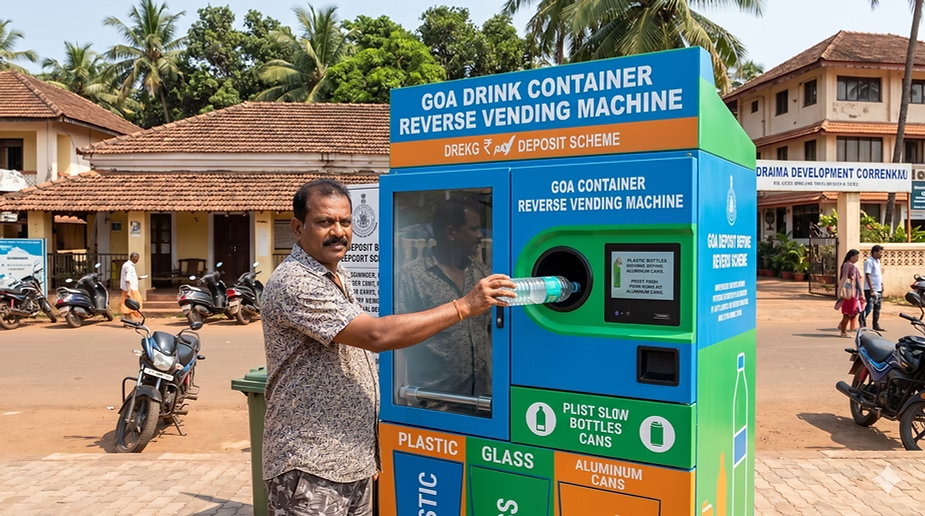
Waste management across Bharat has largely focused on collection and disposal. Municipal bodies collected garbage, segregation campaigns encouraged citizen participation, and recycling industries attempted to recover value from discarded materials. Yet one stubborn challenge remained constant: beverage containers. Plastic bottles, glass bottles, aluminium cans, multilayer packaging and other single-use containers continued to find their way into roadsides, beaches, rivers, forests and landfills.
Now, Goa is attempting something fundamentally different.
The state is moving towards a Deposit Refund System (DRS), supported by the creation of a dedicated authority and a digital ecosystem designed to make recycling economically rewarding for ordinary citizens. Instead of treating waste as something worthless, the new framework seeks to assign a monetary value to packaging itself. Every returned bottle becomes a recoverable resource. Every refund becomes an incentive for environmental responsibility.
The idea is remarkably simple. Consumers purchase a beverage and pay a small refundable deposit in addition to the product cost. Once the bottle, can or container is empty, it can be returned at an authorised collection point. The deposit is then refunded to the consumer. What appears to be a minor transaction has the potential to reshape an entire waste-management ecosystem.
Goa’s proposed model is among the most ambitious recycling reforms attempted in Bharat. Reports indicate that deposits may range from ₹2 to ₹10 depending on the packaging category, with plastic, glass and metal containers being covered under the system. The state government has indicated plans for implementation through a structured network of collection centres, digital tracking systems and stakeholder participation across manufacturers, retailers, distributors and recyclers.
The significance of this initiative extends far beyond recycling. It represents a transition from a linear economy—where products are manufactured, consumed and discarded—to a circular economy, where materials continuously re-enter the production cycle.
The challenge Goa faces is substantial. Despite being one of Bharat’s smallest states geographically, it experiences massive seasonal pressure from tourism. Millions of visitors generate large volumes of packaged waste every year. Plastic bottles and beverage containers frequently become visible pollutants on roads, public spaces, riversides and coastal zones. Traditional waste management systems often struggle to recover these materials once they enter mixed waste streams.
A Deposit Refund System addresses this challenge at the source. Instead of relying entirely on municipal collection, it creates direct consumer participation. The bottle itself acquires value. Throwing it away becomes equivalent to throwing away money.
This principle has proven successful across numerous countries. Deposit systems operating across Europe regularly achieve container return rates exceeding 90 percent. International studies show that higher deposit values, convenient return points and strong administrative systems dramatically improve collection performance and recycling outcomes.
The logic behind such systems is behavioural as much as environmental. People may ignore awareness campaigns, but financial incentives influence everyday habits. A bottle carrying a refundable deposit immediately becomes an asset rather than waste. This creates motivation not only for consumers but also for informal collectors, waste workers and local communities.
Goa’s proposed DRS framework appears designed to leverage this behavioural shift. Government information indicates that the scheme will operate under the Department of Environment and Climate Change, supported by a dedicated DRS platform for stakeholder registration, policy management and implementation monitoring. The official Goa DRS portal already describes the initiative as a mechanism for responsible recycling through refund-based returns.
Technology is expected to play a major role. Emerging reports suggest that the system may utilise a hybrid model involving Reverse Vending Machines (RVMs) and manual collection centres. Reverse vending machines allow consumers to insert used bottles and immediately receive refunds or credits. Manual collection centres can supplement this network in areas where automated infrastructure is less practical. Such a hybrid model would be particularly relevant in Goa, where urban centres, villages, tourism hubs and remote regions all coexist within a relatively small geographic area.
The tourism sector may emerge as one of the biggest beneficiaries.
Goa’s economy depends significantly on tourism. Beaches, heritage zones, riversides and public spaces form the backbone of the state’s visitor experience. Littered beverage containers directly affect perceptions of cleanliness and environmental quality. Broken glass bottles create safety hazards, particularly on beaches and public roads. Industry stakeholders have already expressed optimism that a well-designed DRS framework could reduce such waste while improving overall destination management.
The hospitality industry also generates large volumes of beverage packaging. Hotels, resorts, bars, restaurants and event venues often handle thousands of bottles every week. A structured collection-and-refund mechanism could create dedicated recovery channels for these bulk generators, increasing recycling rates while reducing disposal costs. Reports suggest that specialised collection routes for large waste generators may form part of Goa’s broader DRS ecosystem.
The environmental implications are equally significant.
Plastic pollution remains one of the defining environmental challenges of the twenty-first century. While PET bottles often possess recycling value, many other packaging materials continue to escape collection systems. Studies examining Bharat’s plastic waste landscape have highlighted persistent challenges involving low-value plastics, informal disposal practices and insufficient recovery infrastructure. Deposit systems can help address these gaps by creating stronger collection incentives and improving material traceability.
The reform also aligns closely with Bharat’s evolving Extended Producer Responsibility (EPR) framework. EPR regulations require producers, importers and brand owners to assume responsibility for the collection and recycling of post-consumer packaging waste. The Central Pollution Control Board’s EPR portal was established to improve accountability, transparency and traceability within this system. A Deposit Refund System effectively complements EPR by ensuring that packaging returns to formal recycling channels rather than disappearing into mixed waste streams.
For manufacturers and beverage companies, the scheme could improve access to high-quality recyclable material. One of the biggest challenges in recycling is contamination. Bottles recovered through mixed municipal waste streams are often damaged or contaminated, reducing recycling efficiency. Containers returned directly through DRS networks are generally cleaner, better sorted and more suitable for closed-loop recycling.
The economic implications are equally noteworthy.
A successful DRS ecosystem creates opportunities across collection, logistics, processing, sorting, technology deployment and recycling infrastructure. Collection centres require operators. Reverse vending machines require installation and maintenance. Transportation networks require coordination. Recycling facilities require consistent material supply. Each stage creates employment and enterprise opportunities.
The scheme may also strengthen Goa’s emerging circular economy ecosystem. Rather than viewing waste as a disposal problem, the state can begin treating waste as a recoverable resource stream. Every recovered bottle represents material value retained within the economy rather than lost to landfills or the environment.
However, implementation challenges cannot be ignored.
Industry associations have raised concerns regarding compliance costs, operational readiness and consumer burden. Several stakeholders have argued that the additional deposit could temporarily increase purchase costs for consumers, even though the amount remains refundable upon return. Questions have also been raised regarding infrastructure preparedness, retailer participation and integration with existing waste-management systems.
These concerns are not unique to Goa. Nearly every jurisdiction introducing DRS has encountered similar debates during the planning stage. International experience suggests that public acceptance generally increases once refund networks become easily accessible and consumers begin recovering deposits regularly.
Another important consideration involves Goa’s existing informal waste sector. Thousands of workers across Bharat depend on waste collection and recycling activities for livelihoods. Experts increasingly argue that successful DRS systems must complement, rather than replace, these existing networks. Integrating waste pickers, aggregators and informal recyclers into formal recovery systems can improve both social and environmental outcomes.
The digital dimension of Goa’s proposal could prove especially important. Emerging DRS models increasingly rely on digital tracking, electronic refunds and real-time verification systems. Such tools improve transparency, reduce fraud and enable more accurate reporting. Digital refund systems can transfer deposits directly to consumer accounts while simultaneously generating valuable data on collection rates and material flows.
For citizens, the experience remains straightforward. Buy a bottle. Use it. Return it. Receive the deposit back.
Yet behind that simple process lies a sophisticated infrastructure involving policy design, producer responsibility, digital governance, logistics management, recycling economics and environmental accountability.
What makes Goa’s initiative particularly noteworthy is its potential role as a national model. If implemented successfully, the state could become one of the first large-scale examples in South Asia demonstrating how a modern Deposit Refund System can function within an Indian context. The lessons learned from Goa could influence future policy discussions across other states confronting similar waste-management challenges.
The broader significance extends beyond bottles.
This initiative reflects a changing philosophy of governance. Instead of treating environmental protection as a matter of enforcement alone, policymakers are increasingly designing systems that align environmental goals with economic incentives. Citizens are not merely instructed to recycle; they are rewarded for participating. Producers are not simply regulated; they are integrated into recovery systems. Waste is no longer viewed solely as a burden but as a resource capable of generating value.
For Goa, a state whose identity is deeply connected to its natural beauty, coastlines, rivers and ecological heritage, the stakes are especially high. Cleaner public spaces, reduced litter, improved recycling rates, stronger environmental accountability and greater citizen participation all contribute toward a more sustainable development model.
The creation of a DRS Authority and the rollout of a structured bottle return system therefore represent more than a recycling programme. They signal the beginning of a new relationship between consumption and responsibility.
The bottle purchased today does not have to become tomorrow’s waste.
Under Goa’s emerging Deposit Refund System, it can become tomorrow’s resource.