


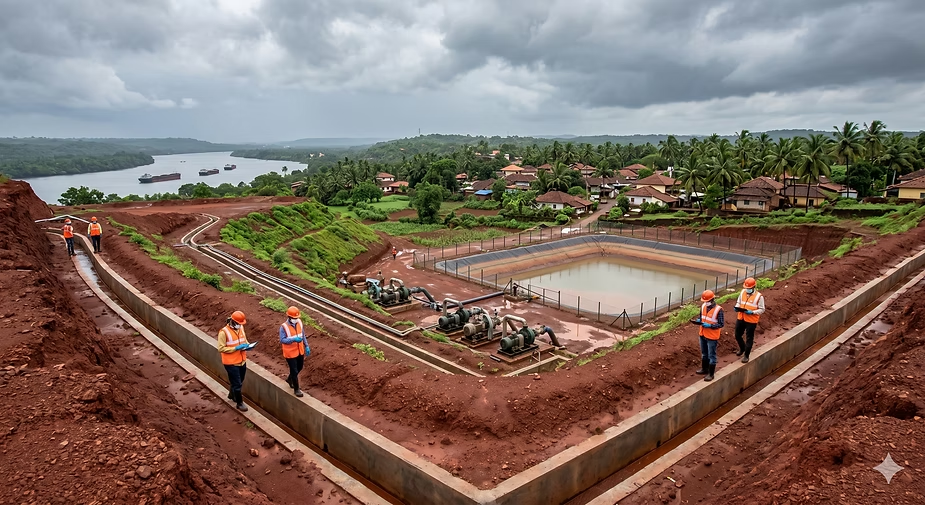
The arrival of the southwest monsoon in Goa brings a familiar sense of fear to the state’s mining corridors. The heavy, relentless rains that turn the coastal state into a lush, green paradise often had the opposite effect in the iron ore belts. Historically, the monsoon meant overflowing pits, compromised mine benches, agricultural fields choked with red runoff, and the looming threat of landslides. However, as Goa’s mining sector undergoes a historic revival, pivoting from a volume-driven extraction model to one anchored in sustainability, the upcoming rainy season is poised to be the ultimate litmus test for this new era of governance.
This year, the message from the authorities is unequivocal. This monsoon will not be business as usual. With five mines currently operational and the broader industry slowly springing back to life, the Directorate General of Mines Safety has drawn a hard line in the iron-rich soil. Through a sweeping set of precautionary directives aimed directly at mining companies, the government has mandated that safety, environmental preservation, and community welfare must supersede operational convenience. This proactive approach marks a radical departure from the reactive crisis management of the past, aiming to trigger a positive ripple effect across the environment, the local villages, and the workforce.
To understand the weight of these new directives, one must look at the historical context of Goa’s mining industry. In the years preceding the legal interventions that halted extraction, mining operations were heavily criticized for their ecological footprint. The monsoon amplified these concerns. Unmanaged ore dumps would erode, washing silt into rivers and drastically altering the aquatic ecosystem. Village roads would become treacherous, and the structural integrity of deep excavation pits was frequently pushed to the absolute limit.
The current revival of mining in Goa is built on a promise of accountability. The state is no longer just looking at the economic revival of truck owners, barge operators, and dock workers. It is demanding that this economic machinery operate within strict ecological boundaries. The recent intervention by the Directorate General of Mines Safety, grounded in the Metalliferous Mines Regulations of 1961, is the operationalization of this promise. By forcing companies to look ahead to the monsoon, the government is shifting the financial and logistical burden of environmental safety squarely onto the operators. It is a clear signal that the waste to value model and the broader economic revival cannot be used as excuses for seasonal negligence.
The mandates laid out by the authorities are comprehensive, highly specific, and data-driven. They target the exact vulnerabilities that have historically plagued open-cast iron ore mining during heavy rainfall. At the heart of the government’s mandate is the creation of specialized monitoring cells within each mining company. These are not merely administrative bodies. They are designed to be active, on-the-ground task forces. Their sole responsibility is to plan, monitor, and prevent untoward incidents before they occur. By decentralizing the oversight to these dedicated units, the government ensures that there are eyes on the ground around the clock, tracking weather patterns, soil stability, and water accumulation.
One of the most scientifically rigorous directives requires mining firms to calculate the potential rainwater accumulation in their mine areas based on the highest recorded rainfall on any single day over the past ten years. In an era where climate change is driving increasingly erratic and severe weather events, this historical baseline is crucial. It forces companies to prepare not just for an average monsoon, but for worst-case meteorological scenarios, ensuring that their drainage and pumping infrastructure is scaled to handle extreme deluge.
The physical mechanics of an open-cast mine make it highly susceptible to flooding. The authorities have mandated several non-negotiable infrastructure preparations. Companies must construct proper surface drains and intermittent bench drains, keeping them strictly free from obstruction. The goal is to safely divert all surface water to the pit bottom in a controlled manner, preventing the uncontrolled erosion of mine walls. Diverting water to the pit bottom is only half the battle. Getting it out is the other. The mandate requires adequate pumping arrangements, crucially including stand-by pumps, to ensure that mechanical failure does not lead to sudden inundation. Mines must also be equipped with natural overflow systems, such as adequately sized pipes, to safely manage excess water. The rise in water levels must be systematically monitored and meticulously recorded.
Perhaps the most visually apparent danger in a mining zone is the collapse of ore dumps or bench slopes. The government has ordered continuous monitoring of these structures. Furthermore, settling ponds, which hold water mixed with fine particulate matter to allow sediment to sink before water is released, must be strategically located. The mandate insists these ponds be situated away from public property to ensure that in the highly unlikely event of a breach, villages, roads, and agricultural lands remain untouched. While five mines are currently operational, Goa’s landscape is dotted with non-working, legacy mines. These abandoned pits often pose the highest risk during the monsoon, as they lack daily oversight. In a highly commendable move, a specific committee has been constituted to inspect these dormant sites and issue necessary directions, ensuring that the sins of past mining eras do not result in present-day disasters.
For the communities living in the shadow of the mining belts, from Bicholim to Sanguem, the monsoon has historically been a time of anxiety. The new safety directives serve as a vital shield for these villages, fundamentally altering their relationship with the industry next door. Agriculture in Goa is deeply interconnected with the local ecology. In the past, unchecked mining runoff during the rains resulted in laterite silt washing over fertile paddy fields, suffocating crops, and altering soil chemistry. By enforcing strict drainage protocols, monitoring ore stacks, and ensuring settling ponds are structurally sound and located far from public assets, the government is directly protecting the agricultural livelihoods of Goan villagers.
The mandate to securely fence waterlogged pits is a direct intervention in public safety. In past years, unfenced, rain-filled mining pits have been the sites of tragic drowning accidents, often involving local youth or livestock. Fencing these areas and preventing unauthorized entry is a basic but deeply impactful measure. Furthermore, by controlling runoff and preventing the breach of settling ponds, the local groundwater tables and village wells are safeguarded from sudden contamination by suspended mining solids. Ultimately, these mandates are helping to rebuild public trust. When villagers see continuous monitoring, fortified settling ponds, and secured perimeters, it visually reinforces the narrative that the current mining revival is distinctly different, and far more responsible, than the practices of the past.
While the environmental and community benefits are vast, the most immediate impact of these directives is felt by the thousands of workers employed within the mines. The men and women operating heavy machinery, managing logistics, and working the benches are the most vulnerable to monsoonal hazards. Open-cast mining relies on a series of terraced benches cut into the earth. Heavy rainfall can rapidly saturate the soil, increasing the pore water pressure and leading to catastrophic slope failures or landslides. The directive for continuous monitoring of the slopes of benches, dumps, and ore stacks is a literal lifesaver. By identifying micro-fissures or structural weaknesses before they result in a collapse, monitoring cells can halt operations and evacuate workers, prioritizing human life over extraction targets.
There is also a broader economic security at play for the workers. In previous eras, a lack of preparation often meant that a severe monsoon would completely wash out access roads, inundate primary pits, and force a total shutdown of operations for extended periods. This led to stalled wages for daily wage earners, truck drivers, and heavy machinery operators. By investing in heavy-duty pumping infrastructure, stand-by systems, and cleared drainage networks, mining companies can maintain the structural integrity of the site. While extraction naturally slows during the rains, preventing catastrophic flooding ensures that the mine can resume normal operations swiftly once the weather clears, providing much-needed financial stability for the workforce.
Goa occupies a highly unique geographical space where heavy industry, sensitive biodiversity hotspots, agriculture, and global tourism coexist within a remarkably small radius. The state’s rivers, primarily the Mandovi, Zuari, and their tributaries, are the lifeblood of the region, supporting estuarine ecosystems, fishing communities, and mangrove forests. The most severe ecological threat posed by monsoon mining is siltation. When rainwater mixes with loose iron ore dust and topsoil, it creates a thick, red slurry. If allowed to flow unchecked into natural streams and rivers, it blocks sunlight, depletes dissolved oxygen, and devastates aquatic flora and fauna. The government directives targeting runoff management are critical ecological interventions. By forcing water down to the pit bottom and utilizing adequately designed settling ponds, mining companies are required to strip the water of its heavy particulate matter before it ever reaches the natural environment.
These monsoon preparations are perfectly synchronized with the state’s broader narrative of a sustainable mining revival. The transition towards reusing old iron ore dumps through a waste to value model and a renewed focus on post-mining rehabilitation are only effective if the immediate environment is protected during the harsh monsoon months. You cannot successfully rehabilitate a landscape if the topsoil is allowed to wash away every July. By enforcing these seasonal safeguards, the government ensures that the long-term goals of ecological restoration remain viable.
The Directorate General of Mines Safety has laid down a flawless theoretical framework for the upcoming monsoon. The mandates are scientifically sound, socially responsible, and ecologically vital. However, as with any major policy shift, the true measure of success will not be found in the circulars issued from Panaji, but in the red dirt of the mining belts. The success of this new framework rests entirely on rigorous enforcement and unyielding compliance. Strong policies will falter if the designated monitoring cells become complacent, or if stand-by pumps are left unmaintained. The government must ensure that its regulatory oversight remains sharp, conducting surprise inspections and holding operators strictly accountable to the ten-year rainfall preparation standard.
Goa is currently writing a new chapter in its economic history. It is attempting an incredibly delicate balancing act, reigniting a massive industrial engine to feed the nation’s soaring demand for steel and infrastructure, while simultaneously preserving the pristine ecosystems and village communities that define the Goan identity. This monsoon is the crucible in which this new model will be tested. If the mining companies adhere strictly to the directives, preventing flooding, safeguarding slopes, and protecting the local water bodies, it will prove that economic growth and environmental stewardship do not have to be mutually exclusive. It will demonstrate to the nation that responsible mining is not just a buzzword, but a highly achievable reality. For the villagers, the workers, and the forests of Goa, the message is clear. The days of unchecked, hazardous extraction are over, and this monsoon, safety is the only acceptable yield.