


Goa’s Coastline Is Still Alive
Goa’s coastline is often measured by what it gives people. Tourism, nightlife, livelihoods, investment, leisure, culture, escape. Every year, its beaches absorb millions of footsteps, thousands of vehicles, endless construction, artificial lights, music, waste, and movement. Yet despite all of this, something remarkable still happens quietly along parts of the shore.
Sea turtles continue to return.
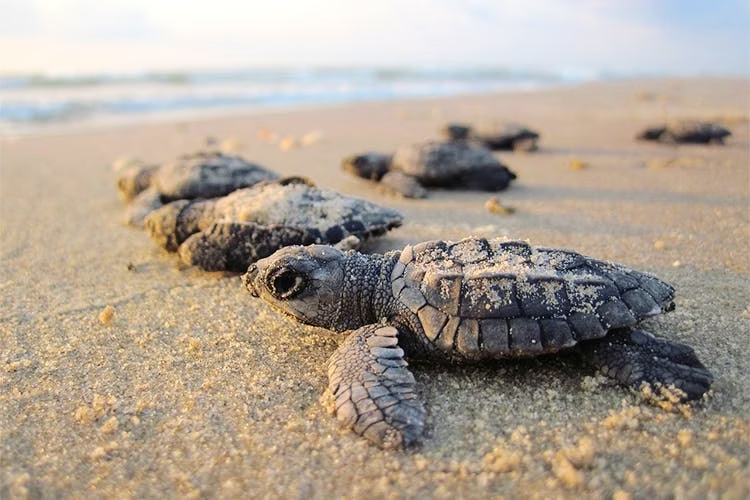
On beaches like Morjim, Mandrem, Agonda, and Galgibag, Olive Ridley turtles still emerge from the Arabian Sea during nesting season and crawl onto the sand under darkness, guided by instincts older than human settlement itself. They arrive on a coastline that looks dramatically different from the one their species once knew, brighter, louder, more crowded, and increasingly shaped by human activity.
And yet, they still come back.
That fact alone says something important about Goa.
Because the continued presence of nesting turtles is not just a wildlife story. It is proof that parts of Goa’s coastal ecosystem are still functioning despite immense developmental and tourism pressure. A turtle returning to nest is not an accident of nature. It is a biological response to environmental conditions that remain, at least partially, survivable.
In many ways, turtles have become silent indicators of the health of Goa’s coastline.
The Olive Ridley turtle is among the smallest marine turtles in the world, but its journey is extraordinary. These turtles spend most of their lives in the ocean, travelling across enormous marine distances before returning to coastal nesting grounds during breeding season. Female turtles instinctively search for dark, quiet stretches of beach where they can safely lay eggs beneath the sand before returning to the sea.
For centuries, this cycle repeated uninterrupted across coastlines around the world.
But modern coastlines changed rapidly.
Artificial lighting replaced darkness. Resorts replaced dunes. Traffic replaced silence. Human movement expanded into habitats that once belonged almost entirely to marine ecosystems. Across many parts of the world, turtle nesting populations declined sharply because beaches stopped functioning as natural environments.
Goa was not untouched by this transformation.
Over the decades, the state’s beaches evolved into some of Bharat’s most commercially active and globally recognised coastal spaces. Tourism became central to Goa’s economy, supporting livelihoods across hospitality, transport, retail, entertainment, food services, tourism operations, and local businesses. Infrastructure development expanded alongside visitor growth. Beach activity increased far beyond daytime tourism into late-night commercial ecosystems.
At the same time, environmental pressure along the coastline intensified.
For sea turtles, even small disturbances can become survival threats. Excessive beachfront lighting confuses hatchlings. Loud human presence can interrupt nesting. Construction near dunes affects nesting terrain. Waste and plastic pollution create marine hazards. Unregulated movement near nesting sites can destroy eggs buried beneath sand. Free-roaming animals threaten hatchlings before they ever reach the ocean.
Most people never see these risks directly.
They see a beach.
The turtle sees survival conditions.
This is what makes turtle conservation in Goa both difficult and deeply important. Conservation here is not happening in isolated wilderness. It is unfolding inside one of Bharat’s busiest tourism environments, where ecological protection and commercial activity exist side by side every single day.
And yet, Goa continues trying to maintain that balance.
Across turtle nesting zones, coordinated conservation efforts now play a critical role during nesting season. Goa’s Forest Department, researchers, lifeguards, volunteers, environmental groups, and local communities work together to monitor beaches, protect nests, regulate disturbances, and improve hatchling survival rates.
These efforts are often invisible to tourists.
A hatchery fence on the sand. A patrolling team late at night. Volunteers relocating vulnerable eggs away from unsafe areas. Temporary restrictions on lighting and sound. Quiet observation from a distance while a nesting turtle slowly moves across the beach.
None of this becomes part of mainstream tourism imagery.
But it may be among the most important work happening on Goa’s coastline.
Because conservation is ultimately about protecting processes, not just species.
A sea turtle nesting successfully represents an entire chain of environmental conditions functioning together, sand quality, manageable disturbance levels, survivable marine conditions, ecological continuity, and coordinated protection efforts. Remove enough of these conditions, and the cycle collapses.
That is the larger warning turtles represent globally.
Marine turtles have survived for millions of years, outliving climatic shifts, predators, and changing oceans. Yet in the modern era, human-driven coastal disruption has become one of the greatest threats to their survival. This is why nesting beaches across the world are increasingly monitored and protected.
Goa’s coastline is now part of that larger environmental responsibility.
What makes Goa unique, however, is that turtle conservation here exists alongside a dense tourism economy. This creates tension, but also opportunity. Goa has the chance to demonstrate that environmental protection and tourism growth do not always have to function as opposing forces.
But coexistence requires discipline.
For example, one of the most important requirements for nesting turtles is darkness. Hatchlings instinctively move toward the brightest visible horizon after emerging from nests. Historically, this meant moonlight reflecting over the sea. But artificial beachfront lighting can disorient hatchlings, causing them to move inland instead of toward the ocean.
Many die before reaching the water.
This is why restrictions on excessive lighting near sensitive nesting zones matter. They are not symbolic environmental gestures. They directly affect hatchling survival.
Similarly, noise reduction and controlled human movement during nesting periods help reduce stress on nesting females. Even repeated interruptions from crowds or flash photography can force turtles to abandon nesting attempts altogether.
These are realities many tourists simply do not know.
Awareness therefore becomes as important as enforcement.
Goa’s turtle conservation story is also increasingly becoming a story about public participation. Across several coastal areas, local communities have played an important role in supporting protection efforts. Fishermen report sightings. Volunteers assist monitoring teams. Residents help maintain awareness around nesting sites. Lifeguards support beach protection activity during sensitive periods.
Over time, this creates something extremely valuable, environmental ownership.
Conservation becomes sustainable only when local populations begin viewing ecological protection as part of community identity rather than external regulation. Goa’s coastline cannot be protected through administration alone. Public cooperation remains essential.
This is especially important as Goa continues facing broader environmental pressures linked to urbanisation, tourism expansion, and climate change.
Coastal ecosystems are naturally fragile. Erosion, rising sea levels, extreme weather events, changing marine temperatures, and habitat loss are already affecting shorelines globally. For species like sea turtles, whose survival depends on stable nesting environments, these changes create additional long-term risks.
Plastic pollution remains another major concern.
Marine turtles frequently mistake floating plastic for food, particularly jellyfish. Ingested plastic can become fatal. Fishing waste, discarded nets, and marine debris also create severe threats to marine species. Even small behavioural changes among visitors and coastal communities can significantly reduce these dangers.
This is why conversations about Goa’s future cannot remain limited only to infrastructure and tourism metrics.
Environmental sustainability is not separate from Goa’s economic future. It is directly connected to it.
The very landscapes that drive Goa’s tourism economy, beaches, rivers, forests, estuaries, biodiversity, and natural scenery, survive only through ecological protection. If these systems collapse under unmanaged pressure, the long-term consequences will affect tourism, livelihoods, fisheries, public health, and climate resilience alike.
Turtle conservation therefore represents something much larger than protecting one species.
It represents a broader decision about what kind of coastline Goa wants to preserve.
One entirely consumed by short-term commercial pressure.
Or one where development and ecological survival continue finding ways to coexist.
That choice is becoming increasingly important across the world’s coastal regions, where tourism economies are rapidly expanding into sensitive environmental zones. Goa now stands at the centre of that global conversation.
And perhaps this is why turtles hold such symbolic power.
A turtle crossing the sand at night changes how people see the beach itself. The coastline stops appearing empty. The darkness stops appearing meaningless. The shore becomes part of a living ecological system rather than merely a recreational backdrop.
Suddenly, every artificial light matters.
Every discarded plastic bottle matters.
Every vehicle driven carelessly on the sand matters.
Every protected nesting site matters.
Because somewhere beneath that sand, life may already be waiting to emerge.
This perspective fundamentally changes the relationship between people and the coastline. Instead of viewing beaches only through consumption, tourism, entertainment, photography, commerce, people begin understanding them as shared habitats supporting life systems that existed long before modern development.
That shift in thinking may ultimately become Goa’s greatest environmental strength.
Because policy alone cannot protect ecosystems indefinitely. Public culture must evolve alongside regulation. Citizens, tourists, businesses, local communities, and institutions all become stakeholders in environmental survival.
Goa’s turtle conservation efforts show what that cooperation can look like when it functions effectively.
Forest officials protecting nests through the night.
Volunteers monitoring hatchlings before sunrise.
Researchers documenting nesting activity.
Local communities helping secure vulnerable areas.
Lifeguards supporting conservation teams.
These are not isolated environmental actions. Together, they form a larger model of coexistence between human activity and ecological responsibility.
And importantly, they remind people that Goa’s identity is larger than tourism alone.
Goa is also biodiversity.
Goa is also home to marine life.
Goa is also an ecological heritage.
The continued return of Olive Ridley turtles proves that despite mounting pressure, parts of that heritage still survive.
But survival is not guaranteed.
Every nesting season now depends on sustained vigilance, awareness, cooperation, and protection. Conservation cannot become performative. It must remain active, scientific, and community-driven. The coastline’s future will ultimately depend on whether environmental protection continues being treated as central to Goa’s development rather than secondary to it.
Because once ecological systems disappear, rebuilding them becomes infinitely harder than protecting them in the first place.
And perhaps that is the most powerful lesson a turtle offers Goa.
Nature does not ask for attention.
It only asks for enough space to survive.
Even today, late at night, when most of Goa’s beaches finally grow quiet, Olive Ridley turtles still emerge from the sea and move slowly across the sand searching for a place to nest.
Ancient life continues on a modern coastline.
A fragile reminder that Goa’s beaches are not just beautiful.
They are alive.