


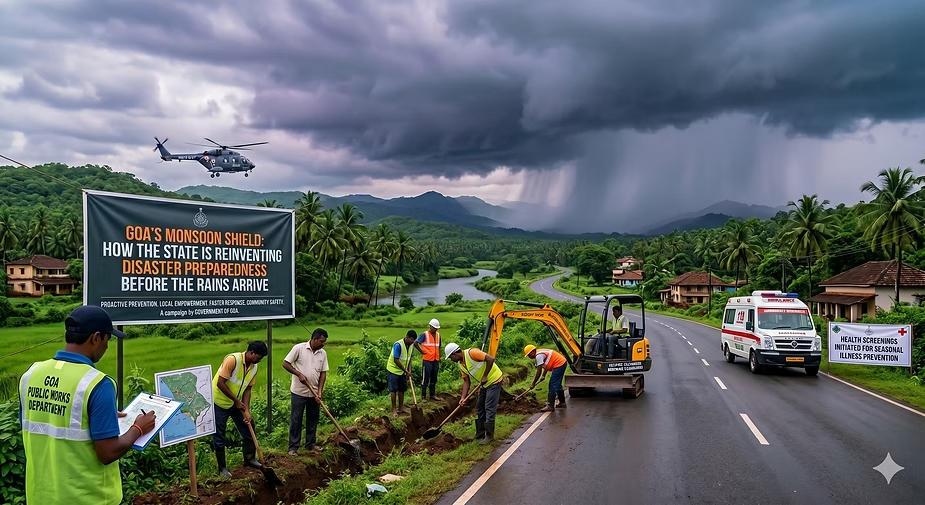
Every Goan knows the emotional duality of the rainy season. The first rains bring relief, nostalgia, and beauty. The smell of wet soil returns. Rivers swell back to life. Hills turn emerald green again. Families gather around hot chai and bhajis while the rhythmic sound of rainfall becomes the background music of daily life But alongside this beauty comes anxiety Flooded roads. Waterlogged homes. Fallen trees. Delayed emergency responses. Landslides. Open trenches dug during infrastructure works. Traffic collapses. Disease outbreaks. Every monsoon season, families across Goa quietly worry about whether this year will bring disruption, danger, or disaster. This year, however, the state government is attempting something fundamentally different.
Instead of waiting for heavy rains to expose weaknesses in the system, Goa has launched one of its most aggressive pre-monsoon preparedness strategies in recent years. Across departments, agencies, village panchayats, emergency services, and public infrastructure systems, the focus has shifted from reactive disaster response to proactive prevention.
The message: preparedness before rainfall is more important than repairs after flooding begins.
One of the most significant changes this year is the strict statewide crackdown on road excavation and trench digging during the monsoon period. For years, one of the biggest public frustrations during the rainy season involved roads being dug up just before heavy rainfall arrived. Trenches left exposed often became dangerous for commuters, caused water accumulation, weakened roads, and increased accident risks.
This year, the government has moved to prevent that situation entirely.
Departments and contractors have been instructed to avoid unnecessary road cutting during the peak monsoon window. The logic behind this decision is straightforward but critical. Goa’s road infrastructure becomes significantly more vulnerable during continuous rainfall. Open trenches quickly deteriorate into hazardous zones, particularly at night or during periods of poor visibility. By restricting excavation activity, the administration aims to minimize avoidable risks for commuters and reduce sudden road collapses or drainage blockages.
For ordinary citizens, this may appear like a small administrative decision. In reality, it represents a major shift in governance thinking. Instead of treating infrastructure management and disaster management as separate systems, the state is now integrating them into a single preventive framework.
Another major challenge during Goa’s monsoon season has historically been delayed local response mechanisms. In many villages, drain blockages and localized flooding escalate rapidly because local authorities often wait for approvals, clearances, or funding allocations before immediate work can begin.
This year, the state is decentralizing that response system.
Village panchayats are now being provided direct access to emergency funds for immediate drain cleaning and flood mitigation work. This dramatically reduces bureaucratic delays during emergencies. Instead of waiting for files to move through multiple departments while roads remain submerged, local authorities can now respond instantly.
This may become one of the most important structural changes in Goa’s monsoon preparedness model.
Flooding often intensifies not because of rainfall alone, but because response systems arrive too late. Waterlogged roads can become impassable within minutes during intense downpours. A blocked drain left unattended for even a few hours can trigger localized flooding across entire neighborhoods.
By empowering local governance structures financially and operationally, the state is effectively creating faster first-response systems directly within communities themselves.
Emergency response speed has also become a major focus area this monsoon season.
According to the updated preparedness strategy, emergency response teams are now targeting response times of under six minutes in critical situations. Additional ambulances have been deployed, emergency teams have been strengthened, and specialized support systems including Navy divers have been placed on standby for high-risk rescue situations.
This matters enormously in a state where geography itself creates logistical challenges.
Goa’s rivers, coastal belts, low-lying villages, and winding interior roads can quickly become dangerous during extreme rainfall events. Delayed rescue operations during flooding or water-related emergencies can dramatically increase risks to life.
Reducing response times therefore directly improves survival outcomes during emergencies.
The inclusion of Navy divers as part of standby rescue operations is particularly important. Water-related emergencies during the monsoon are unpredictable. Vehicles can get trapped. People can become stranded during flash flooding. River currents can intensify suddenly. Specialized aquatic rescue teams significantly improve operational readiness for worst-case scenarios.
Alongside physical infrastructure preparedness, the government has also introduced a strong public health protection component into this year’s monsoon strategy.
Monsoon seasons frequently increase the risk of vector-borne diseases such as malaria, dengue, and other infections. Goa’s large migrant workforce and increased movement of seasonal laborers create additional public health management challenges during this period.
To address this, incoming workers have reportedly undergone health screenings aimed at reducing outbreak risks and improving early disease detection.
This reflects another important evolution in governance thinking. Disaster preparedness is no longer being viewed solely through the lens of roads, floods, or rescue operations. Public health vulnerabilities are now being integrated directly into disaster management planning itself.
The COVID-19 pandemic fundamentally changed how governments approach crisis preparedness. Health systems, emergency management, mobility, sanitation, and local governance are now increasingly interconnected.
Goa’s updated monsoon preparedness framework appears to reflect this broader understanding.
The activation of dedicated emergency helplines and centralized monitoring systems also plays a major role in this year’s preparedness strategy.
The State War Room has become a central operational command system for coordinating emergency response across departments. Citizens have been encouraged to save key helpline numbers including 112 for emergencies and 0832-2419550 for direct State War Room access.
This centralized coordination becomes critical during periods of heavy rainfall when multiple incidents can occur simultaneously across districts.
Communication failures often worsen disaster situations. Delayed information flow between departments can slow rescue operations, prolong road closures, or create confusion among the public. Centralized command systems improve coordination, speed up decision-making, and create more efficient resource deployment during emergencies.
Importantly, the state’s current strategy also reflects lessons learned from previous monsoon experiences.
Every year, public criticism during the monsoon tends to focus on recurring issues: roads collapsing immediately after repairs, poor drainage maintenance, delayed tree removal, or emergency services arriving too slowly.
This year’s preparedness measures appear designed specifically around addressing those recurring public pain points before the rains intensify.
The emphasis on prevention rather than post-crisis repair is a notable governance shift.
This proactive approach also carries economic significance.
Goa’s economy remains heavily dependent on mobility, tourism, hospitality, local commerce, and transport connectivity. Severe monsoon disruptions impact not only households but also businesses, logistics, tourism movement, and service industries.
Flooded roads delay supply chains. Infrastructure failures disrupt economic activity. Public safety concerns reduce mobility. Disease outbreaks strain healthcare systems and workforce productivity.
Preventive preparedness therefore becomes not just a safety strategy, but an economic stability strategy as well.
The broader climate context also cannot be ignored.
Extreme rainfall episodes across India have become increasingly unpredictable in recent years. Climate variability has intensified the frequency of sudden heavy downpours, flash flooding, and infrastructure stress events across multiple states.
For coastal states like Goa, climate resilience is no longer optional.
Urban drainage systems, emergency response frameworks, public health preparedness, and infrastructure planning must now adapt to increasingly volatile weather patterns. The monsoon can no longer be treated as a routine seasonal cycle alone. It must be approached as a potential climate-risk management challenge.
Goa’s current monsoon prep measures therefore represent part of a larger long-term adaptation process.
However, even the best government preparedness systems still depend heavily on public cooperation.
Blocked drains caused by improper garbage disposal continue to worsen flooding in many areas. Unsafe driving during heavy rainfall contributes to accidents. Ignoring weather advisories increases public risk exposure.
Preparedness is therefore a shared responsibility.
The government can deploy emergency systems, improve infrastructure coordination, and strengthen response teams. But communities must also participate actively through responsible behavior, awareness, and cooperation.
This is why public awareness messaging remains central to the current monsoon campaign.
Saving emergency numbers. Reporting blocked drains early. Avoiding unnecessary travel during severe weather alerts. Staying cautious near waterlogged zones. Monitoring local advisories.
These small individual actions collectively strengthen overall public safety outcomes during extreme weather conditions.
At a deeper level, Goa’s evolving monsoon strategy reflects an important shift in what citizens increasingly expect from governance itself.
People no longer evaluate governance only through announcements or infrastructure projects. Increasingly, governance is judged through preparedness, responsiveness, and the ability to reduce anxiety during everyday crises.
The real test of administrative systems often arrives not during celebrations or inaugurations, but during storms.
When roads stay operational during heavy rains, citizens notice. When ambulances arrive faster, people notice. When drains are cleared before flooding escalates, families notice. When public health systems actively prevent outbreaks instead of merely reacting to them later, trust strengthens.
That trust becomes one of the most important outcomes of effective governance.
Ultimately, Goa’s monsoon preparedness strategy is about more than just managing rainfall.
It is about reducing fear.
Fear of flooded roads. Fear of delayed help. Fear of avoidable accidents. Fear of being stranded during emergencies.
By tightening infrastructure rules, decentralizing emergency funding, accelerating response systems, strengthening rescue preparedness, and integrating public health protections, the state is attempting to create a more resilient monsoon framework before disaster strikes.
The rains will still arrive. Rivers will still swell. Storm clouds will still gather over the Western Ghats.
But this year, Goa wants its people to know something important: The state is not waiting helplessly for the monsoon anymore.
It is preparing for it before the first storm even begins.