


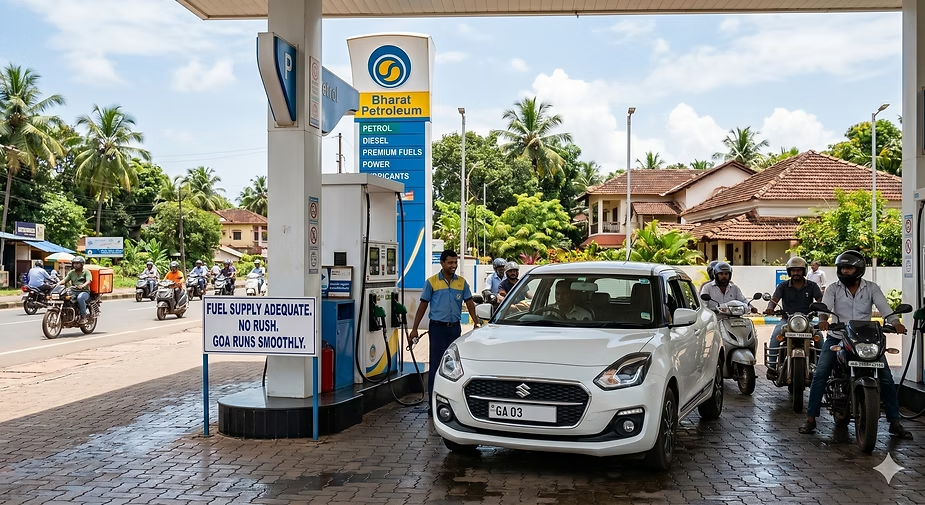
If you drive into any petrol pump across Goa today, you will notice something completely ordinary: there are no long queues, no chaotic traffic jams on the main roads, and no stressed-out drivers trying to hoard fuel in plastic bottles. You can pull up to the dispenser, fill up your tank as much as you need for your daily commute, and drive away in a matter of minutes. Everything is operating exactly as it should. Yet, just a short while ago, a sudden wave of anxiety spread across local WhatsApp groups and social media channels, making many people worry that the state was about to run out of petrol and diesel.
What could have easily turned into a massive headache for local families, office commuters, and taxi operators was stopped in its tracks. Within less than twenty-four hours, the Goa government, major oil marketing companies, and local petrol pump owners stepped up together to clear the confusion and keep the fuel moving. It was a textbook example of how quick communication and a perfectly adequate, well-managed supply system can protect everyday Goan life from being disrupted by baseless online rumors.
How a Simple Misunderstanding Triggered a Sudden Rush
To understand how Goa managed to stay calm and control the situation so quickly, we have to look at how the rumor started in the first place. It all began with a completely normal government notice. With global fuel prices shifting and a national focus on being smart with resources, the Goa government’s administration department issued an internal circular. This note simply asked all government offices, directors, and public servants to practice basic energy conservation. It suggested things like using video calls for official meetings instead of driving long distances, carpooling with colleagues, and avoiding unnecessary official trips to save taxpayer money on fuel bills.
Unfortunately, someone took a photo of this internal government memo and shared it online without any context. Within hours, the message was twisted out of shape as it was forwarded from one chat group to another. By the time it reached the average citizen’s phone, the rumor claimed that Goa was facing an immediate fuel shortage and that petrol pumps were about to shut down. Naturally, worried about how they would get to work, drop their children off at school, or run their businesses, hundreds of Goans rushed to the nearest fuel stations in Panaji, Margao, Mapusa, Vasco, and Ponda to top up their tanks all at the same time.
Quick Action: Replacing Rumors with Honest Facts
Instead of staying silent or letting the panic grow, the state authorities acted immediately. They recognized that the best way to calm a worried public is to give them straight, honest facts right away. The Civil Supplies Department, along with the top heads of the country’s main public-sector oil companies—Indian Oil Corporation Limited (IOCL), Bharat Petroleum Corporation Limited (BPCL), and Hindustan Petroleum Corporation Limited (HPCL)—held urgent meetings to map out the ground reality and talk directly to the public through local news channels and radio stations.
Madhurendra K. Pandey, who looks after the oil marketing companies in Goa as the divisional head for Indian Oil, came forward with a clear and reassuring message for every citizen. He publicly stated that there was an adequate supply of fuel anywhere in the state. The oil companies confirmed that their main storage facilities held completely adequate stocks and that supply trucks were arriving at petrol pumps on their regular daily schedules. By putting out these clear statements and explaining that the long lines were caused entirely by everyone trying to buy fuel at the exact same moment, the government helped people take a deep breath, realize they were safe, and stop panic buying.
There is absolutely no shortage of petrol or diesel in the state of Goa. Our supply lines are functional, our depots maintain adequate reserves, and replenishment tankers are arriving on schedule.
— Official Statement from Oil Marketing Companies
The Secret to Goa’s Fuel Security: Our Sea Routes and Port
Many people do not realize that Goa has a major geographical advantage when it comes to keeping its energy supplies secure. Unlike landlocked states that have to rely entirely on long-distance tanker trucks coming across state borders—which can easily get stuck in traffic, delayed by bad weather, or stopped by interstate transport strikes—Goa gets a major portion of its fuel directly by sea.
The backbone of Goa’s fuel security is the Mormugao Port. Every single month, large marine tanker vessels sail directly into the port to offload steady shipments of petrol, diesel, and aviation fuel. These shipments go straight into high-capacity, centralized storage depots located right here in the state. Under normal everyday conditions, these local depots always maintain a rolling, adequate buffer stock of about fifteen days. This means that even if a transport delay happens outside Goa, the state internally holds an adequate fuel reserve to keep cars, buses, and bikes moving for over two weeks without a single ship or outside truck arriving. Because these port operations were running completely on time during the rumor scare, the actual supply of fuel was always secure.
Teamwork at the Pumps: Oil Companies and Local Dealers
Having an adequate amount of fuel stored at the main depots is one thing, but getting it into the tanks of thousands of cars during a sudden rush requires incredible teamwork on the ground. Goa has a well-distributed network of 146 active petrol pumps scattered across every single taluka, ensuring that no village or town is left isolated. Out of these, 56 are managed by Bharat Petroleum, 50 by Indian Oil, and 40 by HP Limited.
The moment the artificial rush began, the oil companies put their logistics teams into high gear. They deployed their fleet of delivery tankers to work round-the-clock, moving back and forth between the main storage depots and local petrol pumps. If a popular pump in an urban center started running low because of the sudden crowd, a delivery truck was already on its way through the night to refill the underground tanks, maintaining an adequate balance before they could dry up.
At the same time, the Goa Petrol Pump Dealers Association, led by its president Narhar Thakur, worked closely with local police and civil supplies inspectors. Petrol pump owners and attendants did a fantastic job of managing traffic on the forecourts, keeping lines moving orderly, and politely reassuring anxious drivers that there was adequate fuel for everyone’s routine needs. Furthermore, because all 146 pumps in Goa use fully automated digital systems, there was zero chance of anyone altering prices or hoarding fuel dishonestly. Knowing that the prices were completely stable and seeing delivery trucks actively refilling the stations gave motorists immediate peace of mind. Within hours, the extra crowds thinned out, and the pumps returned to their quiet, normal routines.
Domestic Gas and Government Responsibility
While ensuring that vehicles could move was a top priority, the administration also made sure that everyday household life was completely protected. The government gave strict orders to prioritize the supply chains for domestic cooking gas (LPG). Local bottling plants worked at normal efficiency to ensure that an adequate number of gas cylinders were distributed across Goan homes every single day without a single hitch. To make things even easier for temporary residents, migrant workers, and students who might not have permanent local address proofs, the companies kept an adequate supply of smaller 5 kg cylinders available through a hassle-free process. This complete focus on both vehicular fuel and home cooking gas ensured that no family faced any true hardship.
The way the government handled its internal energy conservation circular also showed real leadership. Instead of forcing restrictions on ordinary citizens, the state government chose to lead by example. The administrative directive issued by Under Secretary Shweta Harmalkar was aimed strictly at reducing the government’s own fuel footprint. By asking government officers to carpool, cut down on non-essential travel, and use digital platforms for official meetings, the administration showed it was serious about managing public resources responsibly. It helped the common Goan understand that long-term resource planning is a sign of good governance, not a sign of an immediate crisis.
Trust and Common Sense Win the Day
The quick resolution of the brief fuel scare is a wonderful reminder of what makes Goa so resilient. In today’s digital world, it is very easy for a single misunderstood photo or message to cause unnecessary worry. However, Goa has proven that when a responsible government reacts with instant honesty, when oil companies work steadily, and when local pump owners look after their customers, rumors do not stand a chance.
For our local businesses, taxi drivers, and the vital tourism sector that so many families rely on for their livelihoods, this seamless handling of the situation was a massive win. It showed everyone—including the visitors enjoying our state—that Goa’s infrastructure is stable, adequate, and well-managed. By choosing facts over fear and relying on official updates instead of forwarded chat messages, the people of Goa and their local administration worked together to keep our roads open, our supplies adequate, and our daily life moving forward smoothly.