


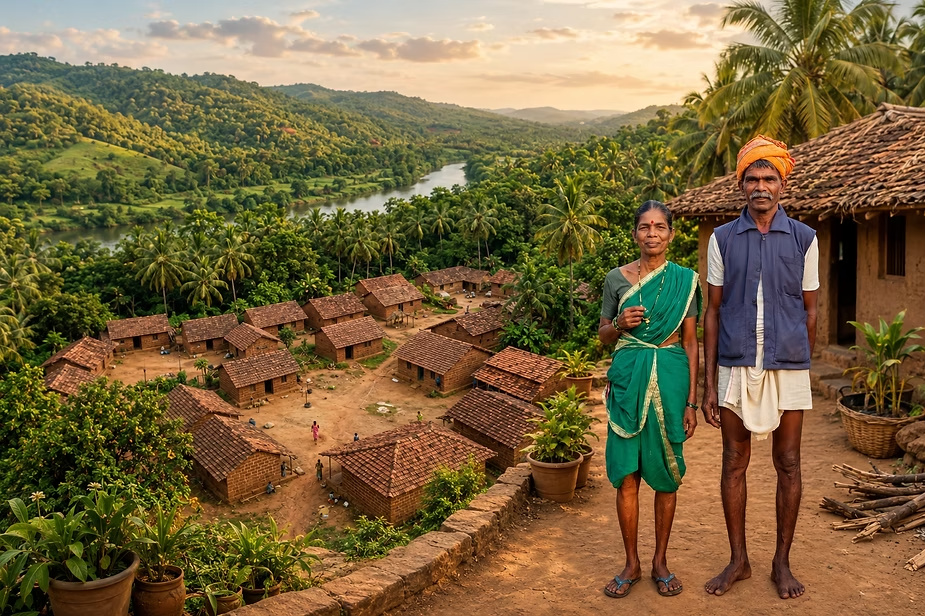
Some transformations are easy to miss unless you know where to look. Not in the cities. Not on the coastline. But deeper inside Goa’s villages, where a leaking roof replaced with concrete before the monsoon can change an entire family’s future. Where a first business loan can turn a daily wage worker into a shop owner. Where financial help arrives on time can stop a medical emergency from becoming lifelong debt.
Across Goa’s tribal communities, these quieter changes have steadily unfolded over the last five years.
For generations, the Gawda, Kunbi, and Velip communities have carried Goa’s oldest traditions, ecological knowledge, and cultural identity. Yet many tribal families remained excluded from the rapid economic growth seen across the state. Fragile housing, limited access to institutional credit, unstable livelihoods, and low financial security continued to affect thousands living in the hinterlands.
Over the last five years, however, Goa’s tribal welfare framework has expanded significantly through targeted interventions in housing, entrepreneurship, education, healthcare, and employment generation. The focus has gradually shifted from short-term welfare assistance toward long-term community empowerment.
Data from the Goa State Scheduled Tribes Finance and Development Corporation Ltd reflects the scale of this transition.
Building Stability From the Ground Up
A secure home is often the first step toward social and economic stability. For many tribal families, however, repairing or rebuilding homes remained financially impossible for years.
To address this, the state strengthened implementation of the Ashraya Adhar Scheme, which provides loans of up to ₹5 lakh at just 2% interest for repair, renovation, and reconstruction of houses belonging to Scheduled Tribe families.
The impact over the last five years has been substantial.
Between 2021 and 2026, the scheme supported 1,512 beneficiaries through first-installment disbursements alone, while second-installment support reached 1,143 additional beneficiaries. The total amount disbursed under the scheme crossed ₹69.02 Crore.
The yearly growth tells its own story:
- ₹6.88 Crore disbursed in 2021-22
- ₹14.62 Crore in 2022-23
- ₹16.81 Crore in 2023-24
- ₹13.24 Crore in 2024-25
- ₹17.47 Crore in 2025-26
These numbers represent more than financial transactions. They represent families moving from vulnerable structures into safer, weather-resistant homes with reinforced roofs, stronger walls, and improved sanitation facilities.
For communities living through Goa’s intense monsoon cycles every year, secure housing is not merely infrastructure—it is dignity, safety, and peace of mind.
A Shift Toward Self-Reliance
While housing creates stability, livelihood generation creates independence.
One of the most significant changes in recent years has been the growing focus on entrepreneurship and employment generation within tribal communities. Instead of limiting support to welfare assistance alone, the state has increasingly emphasized economic participation and self-reliance.
A major driver of this effort has been the Goa Tribal’s Employment Generation Programme (GTEGP), launched in 2020 with the Goa State Scheduled Tribes Finance and Development Corporation Ltd as one of its implementing agencies.
The scheme provides financial assistance for MSMEs, service enterprises, and trading activities, with loans reaching up to ₹25 lakh and subsidies covering 40% of the total project cost. Loans are offered at 2% interest with repayment periods extending up to 10 years.
Over the last five years, the results have steadily accelerated.
The number of beneficiaries under GTEGP grew from 13 in 2021-22 to 40 in 2025-26. In total, 133 tribal entrepreneurs received support under the scheme, while overall disbursement crossed ₹12.40 Crore.
Year-wise growth reflects increasing participation:
- ₹1.36 Crore disbursed in 2021-22
- ₹1.85 Crore in 2022-23
- ₹2.18 Crore in 2023-24
- ₹3.50 Crore in 2024-25
- ₹3.51 Crore in 2025-26
These enterprises include small shops, service businesses, workshops, trading units, and local ventures rooted in community economies.
The larger impact is visible beyond individual businesses. Local entrepreneurship creates jobs within villages, increases household income stability, and keeps economic activity circulating inside tribal communities themselves.
Perhaps most importantly, it changes aspiration.
A younger generation that once depended heavily on seasonal labour or informal work is increasingly entering business ownership and structured enterprise ecosystems.
Financial Support During Critical Moments
Economic vulnerability often reveals itself during emergencies.
Educational expenses, medical crises, or urgent business requirements can quickly destabilize low-income households. Recognizing this reality, the state also expanded access to short-term financial assistance through low-interest support schemes.
Under the Short Term Loan Scheme, tribal families can access loans of up to ₹1 lakh at 2% interest for educational, medical, and business purposes.
Between 2021 and 2026, the scheme supported 98 beneficiaries with disbursements totaling ₹0.87 lakh.
While the financial scale may appear smaller compared to housing or entrepreneurship schemes, the importance of such interventions lies in timing and accessibility.
A quick educational loan can prevent a student from dropping out. Emergency medical support can stop a family from entering long-term debt. Small business assistance can help sustain local livelihoods during financial stress.
These support systems act as critical safety nets that protect developmental gains from being reversed by sudden crises.
Preserving Identity While Advancing Opportunity
Goa’s tribal communities are not only economically significant—they are culturally foundational to the state itself.
The traditions, agricultural knowledge systems, folk practices, dances, and indigenous lifestyles of the Gawda, Kunbi, and Velip communities continue to shape Goa’s deeper cultural identity beyond tourism narratives.
What makes recent welfare efforts particularly significant is that modernization has not been positioned against cultural continuity.
Housing support has largely strengthened village-based living rather than displacing communities. Entrepreneurship support has enabled traditional skills and local knowledge to enter modern economic frameworks. Educational and employment opportunities are expanding without requiring communities to abandon their cultural roots.
This balance matters.
Development becomes sustainable only when communities are empowered without being culturally erased in the process.
A More Inclusive Goa Taking Shape
The progress achieved over the last five years reflects a broader shift in how development is being approached at the grassroots level.
More than ₹69 Crore invested in housing support. Over ₹12 Crore directed toward entrepreneurship and employment generation. Expanding access to educational, medical, and business assistance. Hundreds of families supported through long-term welfare interventions.
These are not isolated welfare measures. Together, they form the foundations of a more inclusive development model.
The road ahead will still require stronger investments in skill development, digital literacy, higher education access, and integration into emerging economic sectors. But the trajectory is becoming increasingly visible.
Across tribal villages in Goa, progress is unfolding in practical, everyday ways:a repaired home before monsoon season,a new business signboard outside a workshop,a student continuing higher education,a family avoiding financial collapse during a medical emergency.
This is not the Goa that usually dominates headlines. But it may ultimately define the state’s most meaningful transformation.
Over the last five years, Goa’s tribal welfare initiatives have steadily moved beyond symbolic support toward structural empowerment.
The combination of housing security, entrepreneurship funding, accessible credit, and employment generation is gradually reshaping the socio-economic realities of tribal communities across the state.
The transformation may not always appear dramatic from the outside. But on the ground, for thousands of families, the changes are deeply tangible.
And perhaps that is the clearest measure of real progress.