


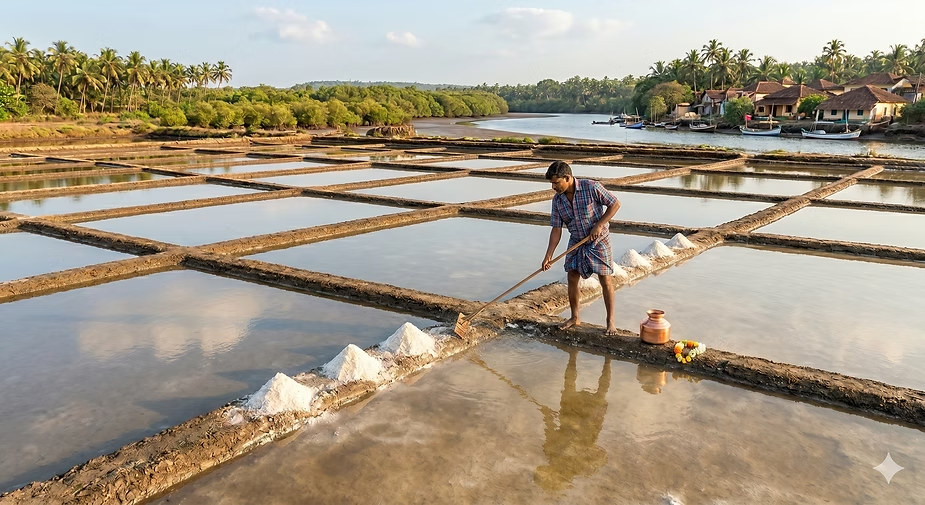
Goa’s identity has always been intricately shaped by its coastline. Long before modern tourism transformed the state into an international destination, a robust, ancient economic and cultural system existed. Rivers, estuaries, wetlands, fishing communities, agriculture, and traditional salt pans (Mithagors) worked together, creating a sustainable foundation for Goan life. While beaches and resorts now dominate the public image, many of Goa’s oldest traditional industries survive quietly, carrying generations of specialized knowledge, labor, and local heritage.
Among them, Goa’s traditional salt pans are on the cusp of a significant, state-backed revival.
A Struggle for Survival: The Pressures of Modernity
Spread across coastal belts and estuarine regions, these salt pans were once crucial to the local economy. For centuries, Mitkars (salt farmers) worked with tidal patterns, solar evaporation, and coastal ecology, relying on environmental understanding rather than industrial machinery to produce salt. These functional landscapes were also deeply woven into Goa’s visual identity and coastal culture.
Today, however, traditional salt farming faces intense pressure. Urbanization, changing land use patterns, declining labor participation, and alternative employment for younger generations threaten its viability. Traditional industries struggle to compete against large-scale, mechanized production. The intergenerational transmission of knowledge is at risk, as the skills required to manage these sensitive systems gradually disappear.
Strategic Revival: Direct Government Financial Support
This is why recent efforts to support and preserve Goa’s salt pans carry significance far beyond economics. Recognising that cultural heritage and environmental sustainability are interconnected, the state government has launched strategic interventions, directly funding the survival of this ancient trade.
Under the newly approved Salt Pan Conservation, Support and Revival Scheme, the Goa government has allocated a ₹95 lakh support package to revive these rapidly declining traditional systems. Crucially, this money is going directly into the hands of the cultivators.
The government has earmarked ₹75 lakh to be distributed as direct financial assistance, providing ₹1 lakh each to 75 traditional salt farmers. Recent updates from Chief Minister Pramod Sawant confirm that around 50 salt farmers have already received their ₹1 lakh disbursements. This direct government funding acknowledges that traditional livelihoods hold immense value within Goa’s economic future and require concrete institutional support to survive modern pressures. The remaining funds are being utilized for administration, field logistics, scientific monitoring, and the restoration of degraded salt pans—including bund strengthening and canal cleaning.
Living Heritage and Ecological Integration
In many ways, salt pans represent a form of living heritage. Unlike monuments, they are active landscapes shaped daily by labor, environment, and local knowledge systems. Their continued existence depends entirely on economic sustainability for the communities that maintain them. Once abandoned, these systems are extremely difficult to restore.
Furthermore, salt pans are not isolated industrial zones. They are vital ecological spaces integrated into coastal systems, interacting with wetlands, estuaries, mangroves, and biodiversity. Properly maintained, Mithagors support ecological balance by preserving open, wetland-like habitats that are critical for several species, including a variety of migratory birds. As urban pressure expands, preserving these landscapes also contributes indirectly to wider environmental protection.
The Broader Eco-Heritage Approach: Plantation Drives
Goa’s development model increasingly reflects this integrated thinking, where infrastructure growth must coexist with environmental and cultural considerations. Salt pan preservation fits directly within this broader vision. The conversation around Mithagors is moving beyond nostalgia; it is about understanding how traditional economic systems can contribute to sustainable development, local livelihoods, and ecological preservation simultaneously.
This broader Eco-Heritage Revival is evident in other government initiatives announced alongside the salt pan scheme, including strategic, large-scale bamboo plantation drives along highways. Beyond aesthetics, these government-funded plantation efforts are designed for environmental resilience, roadside ecological improvement, heat reduction, dust control, and the visual enhancement of critical infrastructure corridors. In rapidly urbanising regions, increasing green cover is vital for maintaining environmental balance and public comfort, reinforcing the principle that development must not come at the cost of ecological degradation.
Authentic Tourism and Global Lessons
These preservation efforts align perfectly with changing global trends in tourism. Travelers increasingly seek authentic experiences connected to local culture, traditional livelihoods, ecological systems, and community spaces, rather than only commercial recreation. Goa’s Mithagors, with their striking geometric patterns, manual harvesting processes, and surrounding estuarine landscapes, possess immense potential as educational and cultural assets. Responsible planning can transform these landscapes into examples of eco-cultural tourism, where environmental awareness, heritage education, and local economic participation thrive together.
Furthermore, Goa’s experience contributes to a wider global conversation. Around the world, environmental planners are revisiting traditional low-impact systems for lessons in sustainability, water management, and ecological integration. Salt farming, relying on solar evaporation and tidal management rather than energy-intensive industrial production, reflects these critical principles.
The Role of Community and the Danger of Loss
Ultimately, the long-term preservation of Goa’s eco-heritage depends on sustained community participation and awareness. While the government’s ₹1 lakh financial aid bridges immediate economic gaps, intergenerational continuity is essential. Public storytelling, cultural documentation, and educational awareness, especially for younger Goans, can help reconnect communities with these aspects of their identity. Heritage preservation succeeds most effectively when viewed as part of a collective identity rather than an external conservation project.
The potential danger is irreversible. Once heritage ecosystems disappear entirely, rebuilding them becomes impossible. Skills vanish, communities disperse, and landscapes transform permanently, leaving future generations with only photographs.
Goa’s strength has never come from economic activity alone. It comes from character, landscapes shaped by history, communities connected to place, and traditions adapted to nature. Goan strength lies in its ability to build roads while increasing green cover, support tourism while preserving ecosystems, and promote growth while protecting heritage through direct financial investments.
Goa’s salt pans may appear small within the larger scale of economic planning, but symbolically, they represent something much larger. They signify that heritage still matters, traditional livelihoods still matter, and environmental identity still matters. The strongest future is built by protecting what made a place unique in the first place, ensuring that progress includes preservation rather than replacing it.