


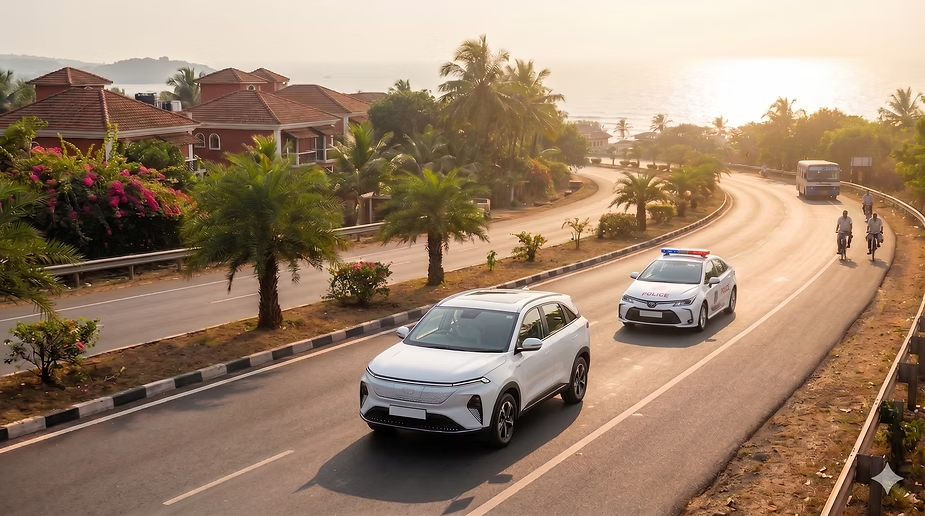
At a time when the global economy continues to face uncertainty, fuel prices remain volatile, and governments across the world are being pushed toward fiscal discipline, the true test of leadership lies not only in policy announcements but in visible public conduct. Citizens today are far more observant than before. They are no longer satisfied by speeches about responsibility and conservation alone—they expect governments to embody those values through action. In Goa, a quiet but significant shift is beginning to emerge from within the highest levels of governance.
Chief Minister Dr. Pramod Sawant and members of the state leadership have begun embracing a new culture centered around austerity, resource conservation, and sustainable administration. The recent decision to reduce the size of official convoys, combined with the growing adoption of Electric Vehicles (EVs) among ministers, is being viewed as more than just an administrative adjustment. It is increasingly being seen as a statement of governance philosophy. The message is straightforward but powerful: responsible governance must begin at the top.
Austerity in Governance: Why It Matters Now More Than Ever
Across Bharat, ordinary citizens are continuously adapting to rising operational costs in daily life. Transportation expenses, fuel bills, inflationary pressures, and economic uncertainty have altered the financial behavior of households and businesses alike. Families are cutting unnecessary expenditure, industries are optimizing logistics, and citizens are becoming increasingly conscious about fuel usage and financial efficiency. In such an environment, governments are expected to demonstrate similar restraint.
Historically, austerity has often been associated with economic crises or budgetary constraints. But modern austerity governance is not merely about spending less. It is about spending responsibly. It is about ensuring that public resources are utilized efficiently, visibly, and ethically. This is precisely where Goa’s recent measures become important. By consciously reducing the scale of official vehicle movement and encouraging the use of EVs for official purposes, the Goa government is signaling that resource conservation is not only a public expectation—it is a leadership responsibility.
The Convoy Reduction: A Symbol of Administrative Discipline
For decades, official convoys have remained a routine aspect of political movement across India. Large numbers of escort vehicles, security cars, pilot vehicles, and support staff often accompanied ministers and senior officials during travel. While security requirements remain essential, there has also been increasing public discussion around the financial and logistical burden of oversized government movement systems. Goa’s recent decision to reduce convoy size introduces a very different administrative approach.
The reduction directly impacts fuel consumption. Government convoys, especially those involving multiple SUVs and escort vehicles, consume substantial amounts of petrol and diesel daily. Over weeks and months, these numbers scale significantly. Reducing the number of vehicles immediately lowers operational expenditure in multiple ways, including reduced fuel consumption, lower maintenance costs, decreased manpower deployment, reduced idling time, and lower vehicle wear and tear.
But beyond economics, the decision carries symbolic weight. In governance, public perception matters enormously. Citizens notice whether governments practice the same restraint they advocate. When political leadership voluntarily adopts austerity measures, it changes the tone of governance itself. It sends a message that accountability is not only being expected from citizens—it is being practiced internally.
Fuel Conservation Is Now a National Imperative
India remains one of the world’s largest importers of crude oil. A substantial portion of the country’s fuel demand depends on international energy markets, making the economy vulnerable to geopolitical tensions, supply disruptions, and price volatility. Every spike in global crude oil prices eventually affects transportation, inflation, logistics, manufacturing, and household expenditure. This is why fuel conservation has evolved from being an environmental concern into a major economic priority.
Reducing fuel dependency directly strengthens national economic resilience. When governments themselves begin minimizing fuel-intensive administrative practices, they contribute meaningfully to this broader national objective. Goa’s austerity measures therefore fit into a much larger macroeconomic context. The reduction of unnecessary government fuel consumption may appear operationally small in isolation, but governance works heavily through behavioral signaling. If leadership visibly conserves resources, industries and citizens are more likely to adopt similar practices. The psychological impact of visible restraint often extends far beyond the immediate numerical savings.
The Shift Toward Electric Vehicles
Alongside austerity measures, Goa’s leadership has also begun accelerating the transition toward electric mobility. Several ministers have started adopting EVs for official movement, while Chief Minister Dr. Pramod Sawant has publicly indicated plans to shift toward electric transportation for official use. This transition reflects a larger understanding that the future of mobility in Bharat is gradually moving toward electrification.
The significance of government EV adoption extends beyond environmental optics. Public institutions play a crucial role as early adopters in any technological transition. When governments adopt EVs, public confidence increases, infrastructure deployment accelerates, manufacturers gain market confidence, awareness improves, and adoption barriers reduce. Many consumers still remain uncertain about electric mobility. Concerns around battery range, charging infrastructure, long-term maintenance, and operational reliability continue to slow wider adoption. When ministers and senior government officials begin using EVs consistently for official schedules, those concerns gradually weaken, and public trust in the technology strengthens.
Goa’s Environmental Responsibility
For Goa, the environmental dimension of this transition carries even greater importance. The state’s economy is inseparably tied to its natural ecology. Goa’s beaches, forests, rivers, biodiversity, and scenic landscapes form the foundation of its tourism industry. Vehicular pollution, traffic congestion, and unchecked fuel consumption directly threaten that ecological balance. As tourism continues to grow, sustainable mobility becomes increasingly critical.
Electric Vehicles offer several direct environmental advantages, such as zero tailpipe emissions, reduced urban air pollution, lower noise pollution, reduced fossil fuel dependency, and better compatibility with eco-tourism goals. Goa’s EV push therefore aligns perfectly with its broader developmental vision of becoming a cleaner, greener, and future-ready state. The transition also complements Goa’s increasing emphasis on sustainable tourism, innovation ecosystems, and smart infrastructure development.
Smaller Convoys, Larger Public Trust
One of the most underrated aspects of governance is public psychology. Citizens do not merely evaluate policies. They evaluate sincerity. People are far more likely to cooperate with public campaigns around conservation and austerity when they believe leadership is participating equally. This is why visible actions matter so much. A smaller convoy communicates restraint instantly and visually. It demonstrates that leadership is willing to voluntarily minimize excess rather than simply asking others to do so. That perception creates trust. Trust remains one of the most valuable forms of political capital any government can possess. And in today’s era of hyper-visibility, where every public action is instantly amplified across social media and news platforms, visible austerity carries enormous communicative power.
A New Definition of Leadership
Globally, governance models are evolving. The modern citizen increasingly expects leaders to embody efficiency, transparency, and sustainability. Excessive displays of privilege or administrative extravagance are no longer viewed positively in many parts of the world. Instead, modern leadership is increasingly associated with operational efficiency, environmental consciousness, fiscal discipline, accessibility, and public accountability. Goa’s recent measures reflect this transition. The focus is no longer on showcasing power through scale. The focus is shifting toward demonstrating responsibility through discipline. This represents a broader cultural change in how governance is visually understood.
EV Adoption as an Economic Opportunity
The shift toward EVs is not only environmentally beneficial—it also presents major economic opportunities. India’s EV ecosystem is expected to generate substantial investment, manufacturing growth, and employment opportunities over the coming decade. Battery technology, charging infrastructure, software systems, and mobility innovation are rapidly becoming strategic sectors globally. States that aggressively position themselves early in this transition stand to gain economically.
Goa’s proactive stance could help the state attract EV infrastructure investment, green mobility startups, sustainable tourism innovation, smart transportation technologies, and clean energy partnerships. By visibly integrating EVs into government operations, Goa strengthens its identity as a progressive, sustainability-oriented state.
The Ripple Effect on Society
One of the strongest effects of leadership behavior is normalization. When governments normalize sustainable practices, those behaviors gradually spread into society. A smaller convoy may encourage institutions to rethink unnecessary vehicle usage. EV adoption among ministers may encourage businesses to evaluate fleet electrification. Citizens may begin reconsidering their own transportation habits. This ripple effect is how long-term societal transitions begin. Policy alone rarely transforms culture. Repeated visible behavior does. And governance often works best when it demonstrates rather than dictates.
Challenges Ahead
Of course, transitions toward austerity and sustainability are never entirely seamless. Several structural challenges remain. First, Goa will require a larger and more reliable public charging network to support widespread EV adoption. Second, the long-term success of sustainable mobility will depend heavily on electrifying public transport systems alongside private vehicles. Third, convoy reduction must continue balancing operational security requirements with resource optimization. Finally, government efforts alone cannot achieve large-scale conservation goals; active public participation remains essential. However, the significance of Goa’s current approach lies precisely in the fact that leadership is beginning the process internally.
Building a Sustainable Governance Culture
Perhaps the most important takeaway from Goa’s recent measures is cultural rather than operational. The state is gradually cultivating a governance culture centered around efficiency, sustainability, and restraint. Such cultural transitions matter enormously because they influence how future administrative decisions are made. Once austerity and sustainability become normalized within governance systems, they begin shaping broader institutional behavior across departments and agencies. That transformation often proves more impactful than any single policy announcement.
Conclusion
Goa’s decision to reduce official convoy sizes and accelerate EV adoption is about far more than transportation. It reflects a broader rethinking of what responsible governance should look like in modern Bharat. At a time when citizens are being encouraged to conserve fuel, reduce waste, and adopt sustainable practices, Goa’s leadership is attempting to demonstrate those same values through visible administrative action. The significance of these measures lies not merely in liters of fuel saved or vehicles removed from convoys.
Their true importance lies in the message they send: Leadership must participate in the discipline it asks from society. Through smaller convoys, electric mobility, and visible austerity, Goa is quietly building a governance model rooted in accountability, sustainability, and public trust. And in an era increasingly defined by resource pressures and environmental urgency, that message may prove far more powerful than any motorcade ever could.