


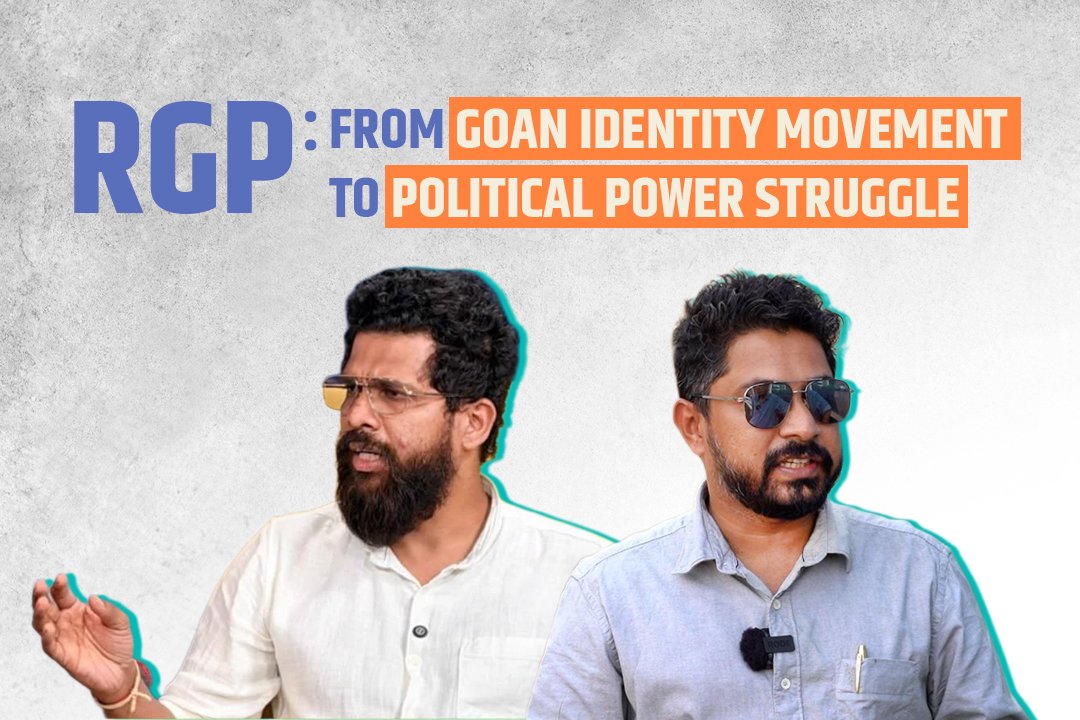
The Revolutionary Goans Party (RGP) emerged from a grassroots movement advocating the protection of Goan identity, land, employment and cultural interests. The party made an electoral breakthrough in the 2022 Goa Assembly elections, winning the St Andre constituency.
Its internal leadership dispute has now brought its founding principles, organisational authority and political direction into question.
Ajay Kholkar has announced legal action against Viresh Borkar for the alleged unauthorised use of the RGP name and election symbol following the expulsion dispute.
From a Grassroots Movement to an Electoral Force
The Revolutionary Goans Party (RGP) began as a grassroots movement in March 2017, driven by a group of young Goans who wanted to protect the state’s identity, land, employment opportunities, culture and heritage. Led by Manoj Parab, Vishvesh Naik and Viresh Borkar, the movement sought to create a political voice for people who felt that established political parties had failed to adequately address the concerns of native Goans.
The movement raised issues such as land ownership, employment opportunities for Goans, the preservation of cultural identity, and the protection of local communities. Its supporters also advocated the proposed Persons of Goan Origin (POGO) Bill, which sought to prioritise protections and opportunities for people of Goan origin.
Recognising the need to take these demands into the legislative arena, the group transformed its grassroots movement into a political party. The Election Commission of India registered the Revolutionary Goans Party on November 24, 2021, giving the movement a formal political platform.
The party entered the 2022 Goa Assembly elections with an ambitious agenda. It fielded candidates in 38 of the state’s 40 constituencies, competing against established political forces such as the BJP and Congress, as well as other regional and national parties.
RGP’s 2022 Breakthrough: One Seat, Statewide Impact
Despite being a new entrant, RGP made a notable electoral impact in its maiden Assembly election. Its candidate, Viresh Borkar, won the St Andre constituency, defeating BJP candidate Francisco Silveira by a narrow margin of 76 votes.
The party secured approximately 9.96 per cent of the total vote share, emerging as one of the significant new political players in Goa. Its performance also placed it ahead of several established competitors in overall vote share.
For a party that had only recently entered electoral politics, winning an Assembly seat gave the movement considerable political visibility. Borkar’s victory provided RGP with its first representative in the Goa Legislative Assembly, while Manoj Parab continued to serve as its prominent organisational face.
The electoral breakthrough also created expectations among supporters who had backed the party for its regional identity, independent political positioning and promise to put Goan interests first.
However, building an electoral presence and maintaining organisational unity are two different challenges. The party’s subsequent leadership dispute has brought that distinction into sharp focus.
From Shared Political Vision to a Clash of Principles
The differences within RGP have gradually developed into an open leadership struggle, exposing a sharp contrast between the party’s founding vision and Viresh Borkar’s subsequent political direction.
Manoj Parab, who played a central role in building the grassroots movement and establishing RGP as a political alternative, remained associated with the party’s original regionalist ideology. He helped create a platform that sought to put Goan identity, land, culture and the interests of local communities above conventional political calculations. His emphasis on independent regional politics formed an important part of the party’s original identity.
Viresh Borkar, who rose to political prominence through the same movement and won the St Andre Assembly seat on the RGP ticket in 2022, now faces questions about his political choices and his association with the Congress. The reported shift has created a striking contrast with the party’s earlier position against aligning with Congress.
The disagreement is therefore not simply an internal leadership tussle. It raises questions about whether Borkar has moved away from the very political principles and regional identity that helped him secure his electoral victory. While Parab’s political positioning remains rooted in RGP’s original vision, Borkar’s reported political moves have cast his commitment to that vision under scrutiny.
The conflict has increasingly centred on who holds legitimate authority to represent the party, make organisational decisions and use its official identity.
RGP built its political identity around the promise of representing Goan interests independently, without relying on established political alliances. Its opposition to aligning with Congress was a defining part of the political distinction it presented to voters.
Against this background, Borkar’s reported political understanding with Congress raises a fundamental question: Was the promise of independent Goan politics a lasting commitment, or merely a political platform to secure electoral success?
Ajay Kholkar Confirms Expulsion Dispute, Announces Legal Action Over RGP Symbol
The latest development has brought the leadership conflict into sharper focus. RGP Treasurer Ajay Kholkar has confirmed the party’s position on Viresh Borkar’s expulsion and announced legal action over the alleged unauthorised use of the party’s name and election symbol.
According to the party faction led by Kholkar, Borkar no longer has authority to represent RGP following the disciplinary action against him. The faction maintains that Manoj Parab remains the legitimate leader associated with the party’s original organisational structure.
Kholkar has also indicated that the party will pursue legal remedies to protect its name, identity and election symbol from what it describes as unauthorised use.
The dispute has a larger political significance. A party’s name and election symbol represent the organisation, its registered identity and the political mandate it seeks from voters. The disagreement over who can legitimately use these identifiers therefore goes beyond an internal leadership disagreement.
The party faction’s position also raises a question about Borkar’s political association with Congress. If the party’s disciplinary action is upheld and he no longer holds its membership or authority, his ability to claim that any political arrangement represents RGP would face a serious challenge. However, the legal validity and consequences of any such arrangement will depend on the applicable party rules and decisions of the competent authorities.
A Test of Political Principles and Organisational Credibility
RGP entered Goa’s political landscape by promising to provide an alternative voice for Goans. Its first electoral success demonstrated that a grassroots movement could translate public support into legislative representation.
But the present leadership battle risks overshadowing the very issues that brought the party into existence. The dispute over expulsion, organisational authority, political alliances, and control of the party symbol now places the party’s credibility under scrutiny.
For voters who supported RGP in 2022, the central question is whether the party will continue to represent the principles it originally championed or allow its political identity to become consumed by an internal struggle for control.
A movement built around protecting Goan identity must ultimately demonstrate that its own leadership respects the principles, organisational discipline and accountability it once promised to uphold.