


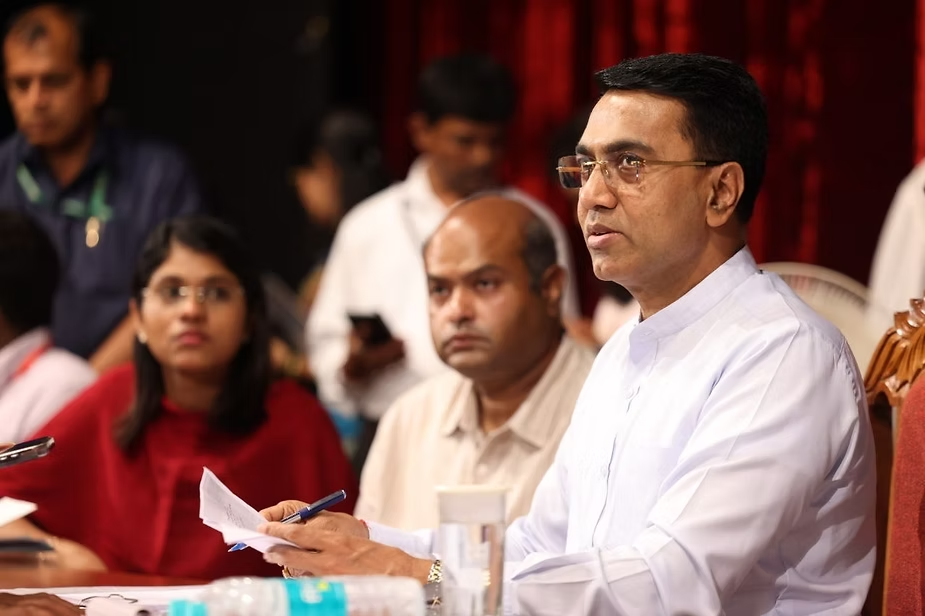
Months of dry taps, sleepless nights and mounting frustration in Bethora finally reached the Chief Minister’s Janata Darbar, prompting an on-the-spot warning to officials and a promise of urgent action.
At a Glance
- Bethora residents complained of severe drinking water shortages during the Chief Minister’s Janata Darbar.
- Villagers said the problem has persisted for months and continued even after the monsoon arrived.
- Some families claimed they stayed awake at night to collect whatever little water reached their taps.
- Chief Minister Dr. Pramod Sawant warned Drinking Water Department officials to resolve the issue immediately or face action.
- The government also promised broader improvements to Ponda’s water infrastructure over the coming months.
People Can Live Without Many Things. Not Water.
Nobody expects luxury.
People can adjust to traffic.
They can tolerate potholes.
They can even wait for a road to be repaired.
But when drinking water disappears from homes, patience runs out quickly.
That is exactly what happened in Bethora.
For months, hundreds of residents watched taps run dry. They assumed summer was to blame. Then the rains arrived. Yet nothing changed.
Families began planning their lives around uncertain water timings. Sleep became optional. Some residents claimed they remained awake late into the night because that was the only time water sometimes trickled into their homes.
The frustration finally reached the Chief Minister.
And unlike another routine complaint that disappears into paperwork, this one received an immediate public response.
During the Janata Darbar in Ponda, Chief Minister Dr. Pramod Sawant openly questioned officials responsible for drinking water supply and warned them that failure to restore normal supply would invite action.
For Bethora residents, it was more than a warning.
It was an acknowledgement that the problem could no longer be ignored.
When Citizens Spoke, The Warning Came Instantly
The Janata Darbar held in Ponda turned into an unexpected platform for one of the region’s most pressing civic problems.
Residents from Talem ward in Bethora narrated months of hardship before the Chief Minister.
Their complaint was straightforward.
Despite repeated requests and despite the arrival of the monsoon, potable water remained irregular.
Some said they were forced to wait until midnight or early morning to fill basic household containers, only to receive insufficient supply.
After hearing the grievances, the Chief Minister directly questioned Drinking Water Department officials present at the venue.
His instruction was unambiguous.
Resolve the problem immediately.
Failure would invite action.
Unlike written assurances that often take weeks to move through departments, the directive was issued publicly, placing accountability squarely on the concerned officials.
This Story Is Bigger Than One Village
At first glance, Bethora’s water crisis appears to be a local issue.
It is not.
Reliable drinking water is one of the most basic indicators of public service delivery.
When supply becomes unpredictable, everything else becomes difficult.
Children leave for school without adequate water.
Senior citizens struggle through hot days.
Working families spend hours collecting water instead of resting.
Businesses and households begin depending on private tankers, increasing their daily expenses.
The Chief Minister’s intervention therefore sends a larger governance message.
Complaints raised directly by citizens are expected to translate into visible administrative action, especially for essential public services.
A Problem That Did Not Begin Yesterday
Bethora’s struggle with water supply is not new.
The area has experienced repeated complaints over inadequate drinking water in recent years.
Previous protests saw residents gathering outside PWD offices, demanding restoration of regular supply and alleging that tanker services alone were insufficient for hundreds of households.
Earlier this year, the shortage also created an unexpected public health concern.
Residents, compelled to store tanker water in open containers, faced warnings from health authorities after suspected dengue cases emerged in parts of Bethora.
Officials conducted awareness drives, but many families argued they had little choice because regular tap water remained unreliable.
The latest Janata Darbar therefore represents another chapter in an issue that has affected the village beyond simple inconvenience.
For Residents, Every Drop Matters
For those outside Bethora, a delayed water supply may sound like a temporary inconvenience.
For residents, it changes daily life.
Morning routines begin before sunrise.
Storage tanks become precious assets.
Household schedules revolve around uncertain supply timings.
Families postpone washing, cooking and cleaning until water finally arrives.
For elderly residents and working parents, the burden is even greater.
The government’s immediate response offers hope that these routines may soon return to normal, but people will ultimately judge success by what comes out of their taps rather than what is announced from a stage.
The Government’s Message Was Clear
During the public grievance meeting, Chief Minister Pramod Sawant assured residents that resolving civic problems, not politics, remained his priority.
Beyond Bethora, he also acknowledged broader water-related challenges in Ponda and said efforts were underway to improve infrastructure.
He further assured residents that several other civic concerns, including healthcare infrastructure at the Ponda Sub-District Hospital, would also receive attention.
The administration’s challenge now is execution.
Public warnings create public expectations.
The Political Response
As of publication, there has been no major organised response from opposition parties specifically regarding the Chief Minister’s warning to officials over the Bethora issue.
However, water availability has remained a recurring political issue in Goa across multiple constituencies, with opposition leaders frequently questioning delays in infrastructure upgrades and long-term planning.
The latest intervention is therefore likely to remain under public scrutiny in the weeks ahead.
Experts Say Accountability Matters As Much As Infrastructure
Water experts often point out that shortages are not always caused by lack of water.
Distribution losses.
Pipeline leakages.
Pump failures.
Storage capacity.
Demand management.
All play equally important roles.
Publicly fixing accountability can accelerate administrative response, but sustained improvement ultimately depends on infrastructure maintenance and long-term planning.
What Happens Next
Officials are now expected to act on the Chief Minister’s directions and restore regular drinking water supply in Bethora.
Residents will be watching closely.
For them, the real deadline is not a government file.
It is the next time they open a tap.