


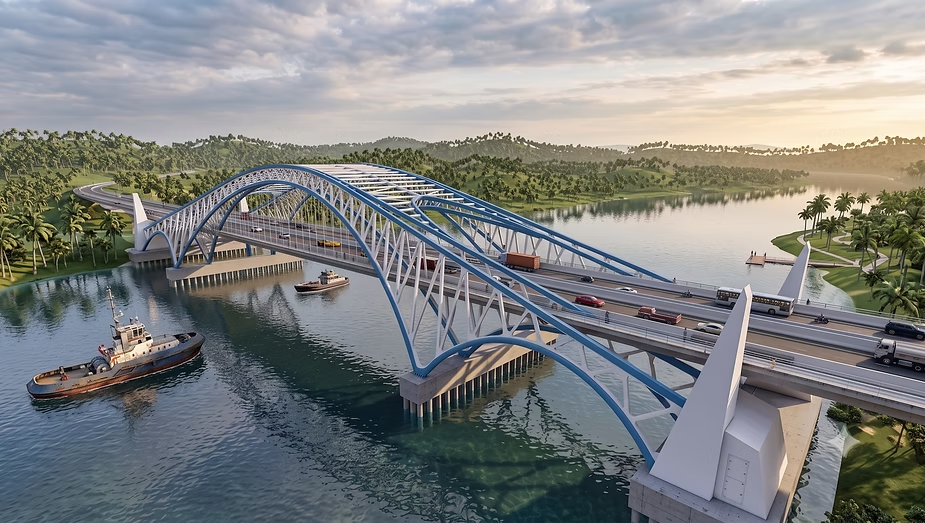
For nearly four decades, the Borim Bridge has been the lifeline between Ponda and South Goa. Now, as traffic surges and the bridge ages, Goa is planning one of its biggest transport upgrades yet. The proposed new Borim Bridge isn’t just about replacing old infrastructure. It is about preparing an entire region for the next generation.
At A Glance
- Goa has proposed a ₹2,000 crore new Borim Bridge project to the Central Government.
- The existing Borim Bridge was commissioned in 1986 and carries nearly 34,000 Passenger Car Units (PCU) every day.
- The bridge serves as one of the most important road links between Ponda, Margao, Quepem, Sanguem and eastern Goa.
- Traffic studies project demand on this corridor could reach 60,000 PCU by 2029-30, significantly exceeding the design capacity of the existing bridge.
- The project is awaiting approval and funding support from the Union Government.
The Bridge Every Goan Uses Is Quietly Reaching Its Limits
Most Goans hardly think twice before crossing Borim.
Whether you’re driving from Ponda to Margao, heading towards Quepem, travelling to Verna, or simply commuting for work, the Borim Bridge has been part of daily life for almost forty years.
It is one of those pieces of infrastructure that only gets noticed when something goes wrong.
When traffic backs up.
When repairs force lane closures.
When heavy vehicles are diverted.
When commuters spend an extra half hour staring at brake lights instead of reaching home.
That is precisely why Goa’s proposal for a brand-new Borim Bridge deserves far more attention than it has received.
Because this is not merely another bridge project.
It represents a decision to solve tomorrow’s congestion before it becomes tomorrow’s crisis.
Over the past several years, the ageing Borim Bridge has undergone repeated rehabilitation works, periodic lane closures and structural strengthening to keep it operational. Authorities have repeatedly restricted traffic during repair phases, highlighting the increasing maintenance demands of a bridge that has served Goa since 1986.
Yet engineers have made one thing increasingly clear.
Repairs can extend a bridge’s life.
They cannot expand its capacity.
Goa’s Next Big Infrastructure Bet Is Already Taking Shape
The Goa Government has now proposed constructing an entirely new high-level bridge across the Zuari River at Borim with an estimated investment of around ₹2,000 crore. The proposal has already been submitted to the Union Government seeking financial approval and support.
The objective is straightforward.
Build a modern crossing capable of handling future traffic while ensuring uninterrupted connectivity between North and South Goa’s growing economic centres.
According to government technical documents, the existing Borim Bridge currently carries around 33,990 Passenger Car Units (PCU) every day, making it one of the busiest transport corridors in the state.
That number alone explains why Borim matters.
This isn’t simply a local bridge connecting two villages.
It is a strategic transport link connecting industries, commercial centres, educational institutions, hospitals, tourism circuits and thousands of daily commuters moving between eastern and southern Goa.
Technical studies prepared during the Detailed Project Report indicate that projected traffic demand on this corridor could increase to nearly 60,000 PCU per day by 2029-30, almost double what the corridor was originally designed to handle.
In other words, Goa isn’t proposing a new bridge because the old one is collapsing.
It is proposing one because the state itself is growing.
This Isn’t Just About Concrete. It’s About Goa’s Future Economy.
Every major infrastructure project tells a larger story.
The Borim Bridge story is really about how Goa is changing.
For decades, the state’s economy revolved primarily around tourism and mining.
Today, Goa’s growth story increasingly depends on industrial corridors, logistics, manufacturing, education, healthcare and faster movement between different regions of the state.
That makes reliable road connectivity more important than ever.
Every delay at Borim affects commuters travelling to work, trucks transporting goods, emergency services responding to incidents and businesses dependent on timely movement across districts.
Infrastructure experts often describe bridges like Borim as “critical transport links.”
Goans simply know them as the roads they cannot afford to lose.
Which is why this project carries significance far beyond engineering.
It is an investment in the future mobility of South Goa itself.
For the Thousands Who Cross Borim Every Day, This Project Could Change More Than Their Commute
Infrastructure often sounds like an abstract government promise until you realise how much your daily routine depends on it.
The Borim Bridge is a perfect example.
Every morning, office-goers from Ponda head towards Verna and Margao. School buses ferry students across the Zuari. Trucks carrying industrial goods travel between manufacturing hubs and ports. Ambulances use the route to connect hospitals across North and South Goa. Tourists heading inland also pass through this corridor.
When traffic slows here, the ripple effect extends far beyond Borim.
A single bottleneck can delay deliveries, increase fuel consumption, affect public transport schedules and add precious minutes to emergency response times.
According to official traffic studies, the existing Borim Bridge already handles close to 34,000 Passenger Car Units (PCU) every day. By the end of this decade, traffic demand is expected to approach 60,000 PCU daily, nearly doubling the current load. That projection alone explains why authorities believe simply repairing the existing bridge will no longer be enough.
If completed, the new bridge could improve travel reliability, reduce congestion during peak hours and provide greater resilience during maintenance or emergencies. For commuters, the biggest benefit may not be faster speeds, but more predictable travel times.
In transport planning, reliability often matters more than speed.
Government Says Goa Cannot Wait for the Bridge to Become a Crisis
The Goa Government has consistently maintained that the proposed Borim Bridge is a forward-looking infrastructure investment rather than a reactive replacement.
Chief Minister Dr. Pramod Sawant recently confirmed that the state has submitted a proposal worth approximately ₹2,000 crore to the Union Government, seeking financial assistance for the project. The proposal was among several major infrastructure initiatives presented during discussions with the Centre.
Public Works Department officials have repeatedly pointed to increasing traffic demand and the strategic importance of the corridor as key reasons for pursuing a completely new bridge instead of relying solely on periodic rehabilitation of the existing structure.
Government documents indicate that while the current bridge remains structurally serviceable after multiple rounds of strengthening, long-term mobility requirements demand additional capacity.
The proposed project therefore fits into a broader strategy of expanding Goa’s transport infrastructure before existing assets reach their operational limits.
This approach mirrors other recent investments such as the new Zuari Bridge, expansion of national highways and improved connectivity to Mopa Airport.
Rather than solving today’s problem, the government argues it is planning for tomorrow’s.
Political Consensus Exists, But Questions Around Funding And Timelines Continue
Unlike many infrastructure debates, the Borim Bridge has largely avoided becoming a partisan political flashpoint.
Across party lines, there is broad acknowledgement that the existing bridge has served Goa for nearly four decades and that additional capacity will eventually become necessary.
However, political questions remain focused on execution rather than intent.
Opposition leaders have sought greater clarity on three issues.
First, when will the Union Government formally approve funding?
Second, what will be the final project timeline?
Third, how will construction be managed without causing major disruption to one of Goa’s busiest transport corridors?
These are legitimate concerns.
Goans have seen several large infrastructure projects experience delays due to environmental clearances, land acquisition, tendering processes or funding approvals.
For residents who depend on Borim every day, announcements matter.
Construction timelines matter even more.
Ultimately, the success of this project will be judged not by estimates or proposals, but by how efficiently it moves from paper to reality.
Transport Experts Say Capacity Planning Is Cheaper Than Congestion
Urban transport experts often make one point repeatedly.
The best time to expand infrastructure is before it becomes overloaded.
Once a major transport corridor reaches saturation, the economic cost of congestion begins to multiply rapidly.
Longer travel times increase fuel consumption.
Freight becomes more expensive.
Businesses lose productivity.
Public transport becomes less reliable.
Emergency services face greater delays.
These hidden costs rarely appear in government budgets, but they are paid every day by ordinary citizens.
This is why transport planners use traffic forecasting rather than waiting for roads and bridges to fail before upgrading them.
In the case of Borim, official projections indicate that traffic volumes could exceed the bridge’s practical carrying capacity within the next few years.
Building additional capacity before that happens allows future demand to be absorbed more smoothly while reducing dependence on repeated maintenance interventions.
From a planning perspective, this is not merely a bridge project.
It is an investment in economic efficiency.
The Numbers Behind Goa’s Biggest Proposed River Crossing
Every major infrastructure story is ultimately backed by data.
And the numbers behind Borim explain why this proposal has attracted attention.
Key Data
| Indicator | Data |
| Existing Borim Bridge Commissioned | 1986 |
| Current Daily Traffic | ≈33,990 Passenger Car Units (PCU) |
| Projected Daily Traffic by 2029-30 | ≈60,000 PCU |
| Estimated Cost of Proposed New Bridge | ₹2,000 crore |
| River Crossed | Zuari River |
| Primary Corridor | Ponda–Margao–Quepem–Sanguem Connectivity |
| Funding Status | Proposal submitted to Union Government |
Beyond these statistics lies a much larger story.
Goa’s population has grown.
Vehicle ownership has increased sharply over the last two decades.
Industrial activity has expanded around Verna and surrounding regions.
Tourism continues to generate seasonal traffic surges.
Healthcare, education and logistics now depend on faster movement between North and South Goa.
Each of these trends places additional pressure on transport infrastructure that was designed for a very different Goa.
The Borim Bridge proposal reflects an acknowledgement that infrastructure must evolve alongside the state itself.
For policymakers, the numbers justify the investment.
For citizens, they explain why this bridge could become one of Goa’s most important infrastructure projects of the coming decade.
The Questions That Will Decide Whether This Bridge Delivers On Its Promise
Every landmark infrastructure project reaches a point where excitement gives way to scrutiny.
The proposed Borim Bridge is no exception.
The first question is funding. While the Goa Government has submitted the proposal to the Union Government, the project cannot move into full-scale execution until financial approval is secured.
The second is timeline. Large bridge projects typically take several years to complete, involving detailed design, environmental approvals, tendering, utility shifting and phased construction. Citizens will want clarity on when work begins and when the bridge is expected to open.
The third is traffic management during construction.
Borim is not a road that can simply be closed for months. Thousands of commuters, commercial vehicles and public transport services depend on this crossing every day. Maintaining uninterrupted connectivity while construction progresses will be one of the project’s biggest engineering challenges.
Environmental safeguards will also come under close observation. The Zuari River is an ecologically sensitive waterway, and any major construction activity will require compliance with environmental regulations and mitigation measures.
Finally, there is the question every taxpayer asks.
Will the project be delivered on time and within budget?
Goa has demonstrated with the New Zuari Bridge that complex infrastructure can be completed successfully. Citizens will expect the same level of execution from Borim.
The Next Few Months Could Shape One Of Goa’s Biggest Infrastructure Projects
The immediate focus now shifts to New Delhi.
The Goa Government has sought financial assistance from the Centre for the proposed ₹2,000 crore project. If approved, the next stages would include detailed engineering, statutory clearances, tendering and appointment of contractors before physical construction begins.
Once work starts, the project is likely to become one of the state’s most closely watched infrastructure developments.
For thousands of commuters, every milestone will matter.
When foundations begin.
When the first span is erected.
When the bridge deck is completed.
And finally, when vehicles make the first official crossing.
For many Goans, that day will represent far more than the opening of another bridge.
It will mark the beginning of a new chapter in how South Goa moves.
Borim Is Part Of A Much Bigger Story About Goa’s Transformation
Viewed in isolation, the Borim Bridge appears to be another Public Works Department project.
Viewed alongside the state’s recent infrastructure investments, a different picture emerges.
Over the last few years, Goa has seen a series of projects aimed at modernising its transport network.
The New Zuari Bridge has expanded one of the state’s most important river crossings. The Manohar International Airport at Mopa has opened a second aviation gateway for Goa. National highways are being upgraded to improve regional connectivity, while new bypasses and road widening projects are gradually reshaping travel across the state.
The proposed Borim Bridge fits naturally into this broader strategy.
Its purpose is not simply to replace ageing infrastructure.
It is to create a transport network capable of supporting Goa’s future economy, population growth and changing mobility patterns.
As industries expand, logistics become more sophisticated and people travel greater distances for work and education, infrastructure will increasingly determine how efficiently the state functions.
That is why Borim matters.
Not because it is the biggest bridge.
But because it is one of the busiest.
A Bridge That Says More About Goa’s Future Than Its Present
Bridges are rarely remembered on the day they are inaugurated.
Their real legacy is measured years later.
In the school bus that reaches on time.
In the ambulance that avoids delays.
In the entrepreneur whose goods reach the market faster.
In the family that spends less time stuck in traffic and more time at home.
For nearly forty years, the existing Borim Bridge has quietly carried Goa through one phase of its growth.
The proposed new bridge is designed to carry the state through the next.
If the project moves ahead as planned, future generations may never remember the congestion, repair works and traffic restrictions that once defined this crossing.
They will simply know Borim as another reliable link connecting people, businesses and opportunities across Goa.
Sometimes, that is the highest compliment any piece of infrastructure can receive.
Not that people notice it.
But they never have to worry about it.