


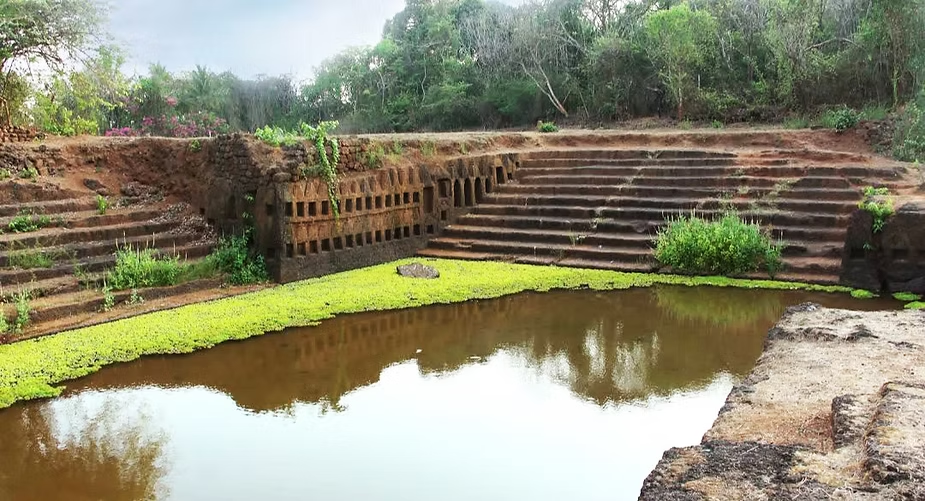
More than four centuries after the original Shri Saptakoteshwar Temple on Divar Island disappeared from Goa’s landscape, the state has approved a ₹50-crore heritage corridor that seeks to preserve one of Goa’s oldest sacred sites. The project is not about rebuilding a temple. It is about reconnecting Goans with a forgotten chapter of their own history.
At a Glance
- The Goa Cabinet has approved a ₹50-crore Koti Tirth Corridor at Divar Island.
- The project centres around the original site of the Shri Saptakoteshwar Temple, the royal shrine of the Kadamba dynasty.
- The existing Shri Saptakoteshwar Temple at Narve, restored in 2023, will remain the primary place of worship.
- The corridor aims to conserve heritage, improve visitor facilities and create a cultural tourism circuit while preserving Divar’s ecological character.
- The proposal is expected to be implemented through the Goa State Infrastructure Development Corporation (GSIDC).
A Forgotten Kingdom Still Echoes Across the Mandovi
Every Goan knows the ferry ride to Divar.
For some, it is a shortcut home. For others, it is an escape into quieter villages, old Portuguese homes and winding roads untouched by the rush of modern Goa.
Few, however, realise that beneath this peaceful landscape lies one of the most significant chapters in Goa’s history.
Long before churches rose across Old Goa, before European ships arrived on the Konkan coast and before Panaji became the state’s capital, Divar was home to one of the most revered temples of the Kadamba kingdom. The Shri Saptakoteshwar Temple was more than a place of worship. It symbolised political authority, cultural identity and the spiritual centre of medieval Goa.
Centuries later, the original shrine vanished.
Its deity survived.
Its story faded from public memory.
Now, the Goa Government has approved a ₹50-crore Koti Tirth Corridor that seeks to bring that story back into public view. Rather than reconstructing what history erased, the project proposes to preserve the original site, interpret its significance and create a heritage destination that allows visitors to understand where one of Goa’s oldest traditions began.
For a state often recognised globally for its beaches and colonial architecture, the project represents something deeper. It shines a light on a chapter of Goa that predates Portuguese rule and celebrates a legacy that helped shape the state’s identity long before modern tourism arrived.
The Government Wants to Preserve a Story, Not Rebuild a Monument
The Goa Cabinet recently approved the development of the Koti Tirth Corridor at Divar Island with an estimated investment of around ₹50 crore.
The proposal focuses on the original site associated with Shri Saptakoteshwar, the royal deity of the Kadamba dynasty that ruled Goa between the 10th and 14th centuries.
Chief Minister Pramod Sawant described the project as an important initiative to preserve Goa’s cultural heritage while creating a meaningful tourism experience rooted in history rather than commercial development. According to the government, the corridor will improve visitor infrastructure, enhance public access, conserve archaeological remains and present the history of the site through carefully designed interpretation spaces.
The proposal is not intended to reconstruct the medieval temple. Instead, it aims to conserve the historic landscape while allowing visitors to understand its significance through heritage-sensitive planning.
Officials have also indicated that the project will be designed to complement Divar’s existing character rather than transform it into a large commercial tourism hub.
This distinction is significant.
Unlike conventional tourism infrastructure projects that focus primarily on footfall, hotels or entertainment, the Koti Tirth Corridor positions heritage itself as the destination.
Goa’s History Did Not Begin in 1510
Much of Goa’s public identity is shaped by its Portuguese legacy.
Its churches, Latin quarters and colonial architecture have become internationally recognised symbols of the state.
Yet Goa’s civilisation stretches back centuries before Portuguese rule.
The Kadamba dynasty established one of western India’s most prosperous kingdoms, developing trade networks, temple architecture, literature and governance that connected Goa with the wider Deccan region.
Shri Saptakoteshwar stood at the heart of that civilisation.
Historical records describe the temple as the royal shrine of the Kadamba kings. The dynasty even issued coins bearing references to Saptakoteshwar, demonstrating the deity’s importance within the kingdom.
Following the Portuguese conquest of Goa, many temples in the island region were either destroyed or relocated. According to historical accounts, devotees secretly moved the Shiva Linga across the river to Narve, where a new temple eventually emerged under the patronage of Chhatrapati Shivaji Maharaj during the seventeenth century.
Today, most pilgrims know the Narve temple.
Far fewer know where the journey began.
The Koti Tirth Corridor attempts to reconnect these two chapters into one continuous story.
It tells visitors that Goa’s heritage is not divided between pre-colonial and colonial identities. Instead, both periods form part of a much larger historical narrative that deserves equal recognition.
For younger Goans especially, the project has the potential to become an educational landmark rather than simply another tourist attraction.
From Royal Shrine to Ruins: The Journey of Shri Saptakoteshwar Across Five Centuries
The story of Shri Saptakoteshwar begins more than eight hundred years ago.
The Kadamba kings adopted the deity as their royal protector, making the temple one of the most influential religious institutions in medieval Goa.
At the height of Kadamba rule, Divar occupied a strategic position along the Mandovi River and functioned as an important administrative and cultural centre.
Everything changed during the sixteenth century.
As Portuguese control expanded over the Old Conquests, numerous temples located within their territory disappeared. Historical chronicles record that the original shrine dedicated to Shri Saptakoteshwar on Divar was among them.
What survived was the devotion of local communities.
The sacred Shiva Linga was reportedly carried to Narve, beyond the immediate sphere of Portuguese control, where worship continued.
Several decades later, Chhatrapati Shivaji Maharaj is believed to have sponsored the construction of a new temple at Narve, ensuring that the centuries-old tradition remained alive despite the loss of its original home.
That temple continues to attract thousands of devotees today.
In February 2023, the Government of Goa completed a scientific conservation of the Narve temple through the Directorate of Archives and Archaeology. The restoration repaired weathered stonework, traditional lime plaster, wooden architectural elements and temple surroundings while preserving the monument’s original character.
The newly proposed Koti Tirth Corridor should therefore be understood as the next chapter in this larger conservation journey.
The first effort protected the temple that survived.
The second seeks to preserve the landscape where the story first began.
What Does This Mean for Goans Beyond Heritage? More Than Most People Realise
For many residents, especially those living outside Divar, the announcement of the Koti Tirth Corridor may initially appear to be another heritage conservation project. In reality, its long-term impact extends far beyond archaeology.
Unlike conventional tourism projects that concentrate visitors around beaches or entertainment districts, heritage corridors encourage slower, knowledge-driven travel. Visitors spend more time in local communities, engage with guides, patronise family-run eateries, purchase locally made handicrafts and often explore neighbouring villages rather than simply passing through.
This model has gained recognition globally as one of the most sustainable forms of tourism because it distributes economic activity across smaller communities instead of concentrating it in already saturated destinations.
For Divar Island, that distinction matters.
The island has long been admired for its quiet villages, traditional Goan homes, agricultural fields and scenic river landscape. Residents have consistently expressed a desire to preserve its character even as visitor numbers grow.
If executed sensitively, the proposed corridor has the potential to strengthen that balance.
Rather than replacing Divar’s identity with commercial infrastructure, the project proposes to interpret its history while improving basic visitor amenities such as pathways, signage, viewing areas and information centres.
The benefits could extend across several sectors.
Local taxi operators and ferry users may witness increased movement.
Home-stay operators could attract travellers seeking cultural experiences rather than nightlife.
Local youth may find opportunities as trained heritage interpreters, tourist guides and cultural entrepreneurs.
Schools and colleges would gain an important educational destination where students can learn about Goa’s pre-colonial history through physical experience rather than textbooks alone.
The project also creates an opportunity for local communities to become custodians of their own heritage.
Successful heritage destinations around the world increasingly rely on community participation rather than government management alone. Residents become storytellers, conservation volunteers, tourism entrepreneurs and protectors of local traditions.
That model could prove equally valuable in Divar.
If managed carefully, the Koti Tirth Corridor can generate pride before it generates footfall.
That order is important.
When communities feel ownership over heritage, conservation becomes sustainable.
Why the Government Believes Heritage Can Become Goa’s Next Tourism Strength
The Goa Government has consistently positioned the Koti Tirth Corridor as a project that combines cultural conservation with responsible tourism.
Chief Minister Pramod Sawant has repeatedly emphasised the importance of preserving Goa’s ancient civilisational legacy alongside its globally recognised Portuguese heritage. Speaking about the project, he has highlighted that Goa’s identity is incomplete without acknowledging the contribution of the Kadamba period and other pre-colonial traditions that shaped the state’s history.
According to the government, the corridor aims to achieve several objectives simultaneously.
The first is conservation.
Rather than reconstructing medieval structures without evidence, the proposal focuses on preserving archaeological remains and protecting the broader cultural landscape.
The second objective is education.
Interpretation centres, curated pathways and heritage information are expected to help visitors understand the historical significance of the site.
The third objective is sustainable tourism.
Unlike mass tourism infrastructure, the project seeks to attract visitors interested in history, culture and spirituality while respecting Divar’s environmental sensitivity.
The government has also repeatedly underlined that the project is intended to complement, not replace, the existing Shri Saptakoteshwar Temple at Narve.
The temple at Narve remains an active place of worship and continues to hold immense religious significance for devotees.
The corridor instead focuses on preserving the memory of the original site where this centuries-old tradition first emerged.
Taken together, the project reflects a broader policy direction visible across several recent initiatives in Goa, where infrastructure is increasingly linked with heritage conservation, cultural tourism and place-based development rather than only physical construction.
Although Heritage conservationists have consistently argued that projects involving archaeological landscapes should prioritise authenticity over visual reconstruction. They caution that excessive commercialisation, modern construction or theme-park style development could diminish the historical value of such locations.
Environmental groups have also pointed to Divar Island’s fragile ecological setting.
The island’s wetlands, riverfront ecosystem, agricultural fields and low-density settlements require careful planning to ensure that increased visitor numbers do not create pressure on local infrastructure or alter the island’s distinctive character.
Some residents have echoed similar concerns.
While many welcome initiatives that celebrate Divar’s history, they also emphasise the importance of maintaining the peaceful atmosphere that makes the island unique.
These are not necessarily objections to the corridor itself.
Rather, they are reminders that heritage conservation succeeds only when cultural preservation, ecological protection and community participation evolve together.
How these concerns are addressed during the detailed planning stage will likely determine how the project is ultimately received.
Around the World, Heritage Corridors Have Become Economic Assets. Can Divar Join That List?
Across India and internationally, heritage-led urban and rural regeneration has increasingly become a preferred model for cultural tourism.
Cities such as Varanasi, Ujjain, Hampi and Ayodhya have demonstrated that carefully designed public spaces around historic sites can significantly improve visitor experience while strengthening local economies.
Internationally, countries including Italy, Greece and Japan have adopted similar approaches by investing in interpretation centres, archaeological parks and cultural corridors that allow visitors to understand historical landscapes rather than simply view isolated monuments.
Experts in heritage management argue that modern visitors increasingly seek experiences instead of destinations.
A temple alone may attract pilgrims.
A well-curated heritage landscape tells a larger story about civilisation, architecture, trade, religion and community.
That creates deeper engagement and often encourages longer visitor stays.
For Goa, this approach presents a strategic opportunity.
While the state remains internationally recognised for beaches and coastal tourism, heritage tourism offers an avenue to diversify visitor experiences and reduce seasonal dependence.
By showcasing Kadamba history alongside Goa’s celebrated Portuguese legacy, the state can present a more complete historical narrative to domestic and international audiences.
However, specialists also stress that successful heritage projects depend on restraint.
The best conservation efforts often involve doing less rather than more.
Minimal intervention, scientific restoration, authentic interpretation and careful visitor management generally produce better long-term outcomes than large-scale redevelopment.
If the Koti Tirth Corridor follows these principles, it could become one of India’s most meaningful examples of heritage-sensitive tourism.