


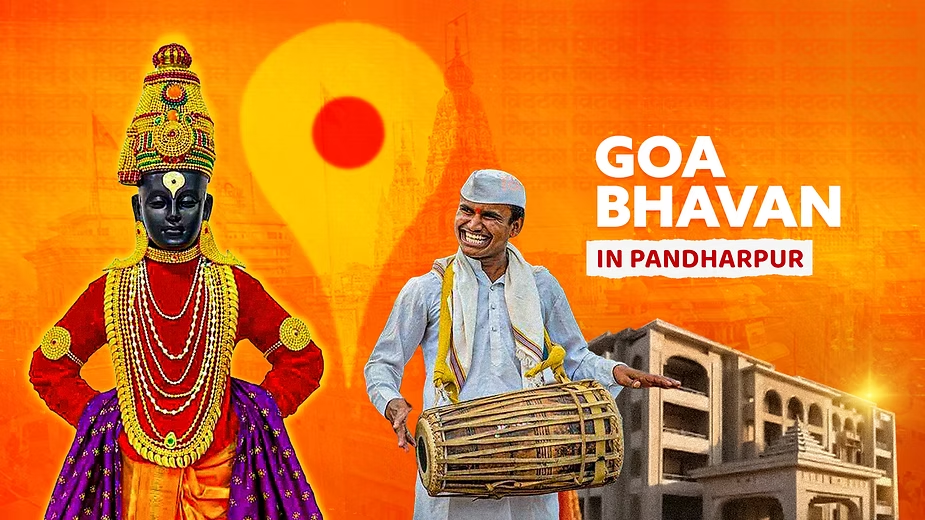
For generations, Goan devotees have travelled hundreds of kilometres to Pandharpur with little more than faith and determination. Now, the state is preparing to leave a lasting mark in one of India’s holiest pilgrimage towns through a dedicated Goa Bhavan and a new financial assistance programme for registered Warkari groups.
AT A GLANCE
- Goa has identified land in Pandharpur for the construction of a dedicated Goa Bhavan for pilgrims.
- Registered Warkari groups will receive travel assistance ranging from ₹1 lakh to ₹5 lakh, depending on participation.
- The government aims to complete the facility before the next Ashadhi Wari.
- The Bhavan is expected to provide affordable accommodation for Goan pilgrims visiting Pandharpur.
Soon, Pandharpur Will Carry a Piece of Goa.
Every year, before dawn breaks across Goa, buses begin filling with saffron flags, cymbals, tulsi malas and devotees singing the familiar chants of “Vitthal… Vitthal…”. Families that have preserved the Warkari tradition for generations begin a journey that is measured not in kilometres, but in devotion.
For many, Pandharpur is not merely another temple town.
It is where promises are fulfilled, prayers are offered, and traditions are passed from one generation to the next.
Yet despite the deep spiritual bond between Goa and Pandharpur, Goan pilgrims have always arrived as visitors.
They prayed.
They rested wherever accommodation was available.
Then they returned home.
That may soon change.
In what could become one of the most significant cultural infrastructure projects for Goan devotees in recent years, the Goa Government has announced that land has been identified for the construction of a dedicated Goa Bhavan in Pandharpur. Alongside it, registered Warkari groups travelling from Goa will receive financial assistance ranging from ₹1 lakh to ₹5 lakh to help meet return travel expenses.
On paper, it sounds like a government announcement.
In reality, it represents something much larger.
For the first time, thousands of Goan pilgrims may soon have a permanent place they can truly call their own in one of India’s most important pilgrimage destinations.
Sometimes, history is not written through monuments.
Sometimes, it is written by giving people a place that feels like home.
What Changed This Year Could Shape Every Future Wari
The announcement came as Goa flagged off this year’s Warkari pilgrimage to Pandharpur.
During the event, the government confirmed two major decisions.
First, it has identified land for the construction of Goa Vitthal Rukmini Bhavan in Pandharpur. The proposed facility is intended to provide dedicated and affordable accommodation for Goan pilgrims visiting the holy town throughout the year, particularly during the annual Wari.
Second, the state has introduced direct financial assistance for registered Warkari groups travelling from Goa. Depending on the size of the registered dindi, assistance will range between ₹1 lakh and ₹5 lakh, with funds proposed to be transferred directly to beneficiaries.
The government also distributed cloth bags, caps and first-aid kits to encourage a cleaner and safer pilgrimage, while indicating that support could expand further if participation continues to grow.
Taken individually, these are administrative measures.
Taken together, they indicate a broader attempt to institutionalise Goa’s relationship with one of India’s oldest pilgrimage traditions.
Why This Is Bigger Than a Building
It would be easy to describe Goa Bhavan as simply another government guest house.
That would completely miss the story.
The Pandharpur Wari is among India’s oldest continuously observed pilgrimages, with a history stretching back more than seven centuries. Every year, lakhs of devotees walk for days, and in many cases weeks, to seek the blessings of Lord Vitthal. The tradition is not just about reaching a destination. It is about discipline, community, equality and devotion.
Goa’s connection with this tradition is equally deep.
Across the state, Warkari bhajani mandals and dindis have kept the legacy alive for decades. Families often participate across generations, making the annual journey an enduring cultural practice rather than a one-time religious event.
That is why the proposed Goa Bhavan carries significance beyond bricks and mortar.
It creates a permanent Goan presence in a place that already holds permanent spiritual meaning for thousands of Goan families.
Infrastructure often changes how people travel.
Cultural infrastructure changes how communities remember.
For generations of Goan Warkaris yet to undertake their first pilgrimage, Pandharpur may no longer feel like a distant destination.
It may begin to feel a little more like home.
When Faith Meets Infrastructure, Every Pilgrim Stands to Benefit
For decades, the journey to Pandharpur has demanded more than devotion.
It has required planning, coordination, fundraising and sacrifice.
Many Warkari groups begin preparing months in advance. Transport costs, accommodation, food, medical emergencies and logistics often become the responsibility of community organisations and volunteers. While faith has always united pilgrims, the practical challenges of organising a large pilgrimage have continued to grow with rising travel costs.
This is where the Goa Government’s twin announcements could make a measurable difference.
The proposed Goa Bhavan is expected to provide a dedicated base for Goan pilgrims in Pandharpur, reducing dependence on temporary arrangements and making future visits more organised. At the same time, financial assistance ranging from ₹1 lakh to ₹5 lakh for registered Warkari groups is intended to ease the financial burden of organising the annual pilgrimage.
For elderly devotees, women travelling in groups and first-time pilgrims, the biggest benefit may not simply be financial.
It is predictability.
Knowing there is a recognised place linked to Goa can make the pilgrimage easier to plan, safer to manage and more comfortable to undertake.
That is a change that extends beyond one year’s Wari.
It creates infrastructure for every Wari that follows.
The Government’s Vision Goes Beyond This Year’s Pilgrimage
While announcing the initiative, Chief Minister Pramod Sawant framed the Goa Bhavan as a long-term commitment to the state’s Warkari community.
According to the announcement, land has already been identified in Pandharpur, and the government’s objective is to have the Goa Bhavan ready before the next Ashadhi Wari. Alongside the infrastructure project, the state announced structured financial assistance for registered Warkari dindis, signalling an effort to institutionalise support rather than rely on one-time grants.
The initiative also fits into a broader pattern seen across several Indian states.
Over the years, many governments have invested in pilgrim facilities outside their own borders, recognising that cultural and religious mobility often extends well beyond state boundaries.
For Goa, this represents one of its most visible attempts to establish a permanent presence at one of India’s most significant pilgrimage centres.
Increasingly, researchers view it as an important contributor to regional economies, cultural preservation and social cohesion.
Pilgrimage infrastructure does more than provide accommodation.
It creates safer travel conditions, improves visitor management, strengthens community networks and encourages repeat visits.
For states with strong devotional traditions, dedicated facilities also help preserve cultural identity outside their geographical boundaries.
In Goa’s case, the Bhavan has the potential to become more than a transit facility.
It could evolve into a cultural centre where Goan Warkari traditions, bhajans and community networks continue to thrive even beyond Goa’s borders.
If managed effectively, the project could become a lasting symbol of Goa’s contribution to one of India’s oldest devotional movements.
Goa Is Quietly Investing in Its Cultural Footprint Beyond State Borders
Goa Bhavan in Pandharpur is not an isolated decision.
It reflects a broader trend of governments investing in infrastructure that serves citizens beyond their own geographical boundaries.
Across India, state bhavans have traditionally functioned as administrative and diplomatic spaces in New Delhi.
Increasingly, governments are creating similar facilities in places of deep cultural, educational and religious importance.
For Goa, Pandharpur is an obvious choice.
The spiritual relationship between Goa and Lord Vitthal stretches back generations through bhajani mandals, dindis, temple traditions and family pilgrimages.
The proposed Bhavan transforms that relationship into something permanent.
It gives physical expression to a cultural bond that has existed for decades.
For a state often recognised for its beaches, tourism and colonial heritage, Goa Bhavan tells another story.
It reminds the country that Goa’s identity is equally rooted in living traditions, devotional culture and communities that have quietly kept those traditions alive across generations.
Goa’s Strongest Legacy in Pandharpur
Roads connect cities.
Airports connect states.
Buildings connect people.
The proposed Goa Bhavan is not the biggest infrastructure project Goa has announced this year.
It will not generate headlines for its cost.
It will not dominate economic statistics.
Yet its impact could outlast projects many times its size.
Because every Ashadhi Wari, new pilgrims will arrive.
Children will accompany their parents.
Parents will remember journeys they once made with their grandparents.
And somewhere in Pandharpur, there may finally be a place where every Goan devotee feels they have arrived not just at Lord Vitthal’s doorstep, but at a home that belongs to them.
Sometimes, the most meaningful infrastructure is not built in concrete.
It is built in belonging.